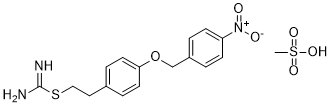
KB-R7943 mesylate, the mesylate salt of KB-R-7943, is a novel and potent reverse Na(+) /Ca(2+) exchanger (NCX(rev)) with neuroprotective action. In addition to inhibiting complex I in the mitochondrial respiratory chain, KB-R7943 blocked NMDA receptors in cultured hippocampal neurons. These results are crucial for a proper interpretation of the KB-R7943 experimental results and a clearer understanding of its neuroprotective effects.
Physicochemical Properties
| Molecular Formula | C17H21N3O6S2 |
| Molecular Weight | 427.49 |
| Exact Mass | 427.087 |
| Elemental Analysis | C, 47.76; H, 4.95; N, 9.83; O, 22.46; S, 15.00 |
| CAS # | 182004-65-5 |
| Related CAS # | 182004-64-4;182004-65-5 (mesylate); |
| PubChem CID | 9823846 |
| Appearance | White to yellow solid powder |
| Boiling Point | 534.6ºC at 760mmHg |
| Flash Point | 277.1ºC |
| Vapour Pressure | 1.67E-11mmHg at 25°C |
| LogP | 5.251 |
| Hydrogen Bond Donor Count | 3 |
| Hydrogen Bond Acceptor Count | 8 |
| Rotatable Bond Count | 7 |
| Heavy Atom Count | 28 |
| Complexity | 479 |
| Defined Atom Stereocenter Count | 0 |
| SMILES | S(/C(=N/[H])/N([H])[H])C([H])([H])C([H])([H])C1C([H])=C([H])C(=C([H])C=1[H])OC([H])([H])C1C([H])=C([H])C(=C([H])C=1[H])[N+](=O)[O-].S(C([H])([H])[H])(=O)(=O)O[H] |
| InChi Key | WGIKEBHIKKWJLG-UHFFFAOYSA-N |
| InChi Code | InChI=1S/C16H17N3O3S.CH4O3S/c17-16(18)23-10-9-12-3-7-15(8-4-12)22-11-13-1-5-14(6-2-13)19(20)21;1-5(2,3)4/h1-8H,9-11H2,(H3,17,18);1H3,(H,2,3,4) |
| Chemical Name | methanesulfonic acid;2-[4-[(4-nitrophenyl)methoxy]phenyl]ethyl carbamimidothioate |
| Synonyms | KB-R7943 mesylate; KB-R7943; KB-R 7943; KB R7943 |
| HS Tariff Code | 2934.99.9001 |
| Storage |
Powder-20°C 3 years 4°C 2 years In solvent -80°C 6 months -20°C 1 month Note: Please store this product in a sealed and protected environment, avoid exposure to moisture. |
| Shipping Condition | Room temperature (This product is stable at ambient temperature for a few days during ordinary shipping and time spent in Customs) |
Biological Activity
| Targets | Na+/Ca2+ exchanger (IC50 = 5.7±2.1 µM) |
| ln Vitro | KB-R7943 mesylate inhibits NMDA-induced cytosolic Ca2+ increase and blocks NMDAR-mediated ion currents with an IC50 value of 13.4±3.6 µM, but it speeds up calcium deregulation and mitochondrial depolarization in glutamate-treated neurons. The depolarizing effects of KB-R7943 on mitochondria are independent of Ca2+. With an IC50 of 11.4±2.4 µM, KB-R7943 prevents 2,4-dinitrophenol from stimulating the respiration of cultured neurons. KB-R7943 also reversibly and dose-dependently blocked NMDA-induced ion currents in addition to NCXrev. KB-R7943 confirms the inhibition of NMDA receptors seen in electrophysiological experiments[1] by inhibiting NMDA-induced increases in [Ca2+]c in a dose-dependent manner with an IC50 of 13.4±3.6 µM. Significantly reduced responses to caffeine were seen in wtRyR1-HEK 293 cells pretreated with KB-R7943 (10 μM, 10 min) dissolved in the bulk perfusion. Regarding this, KB-R7943 produced a more pronounced inhibition of caffeine-induced Ca2+ release elicited by 1 mM compared with 0.5 and 0.75 mM (60 versus 58 versus 37%, respectively, p<0.05)[2]. With IC50 values of ~89 and ~120 nM, respectively, for current tails at 40 mV after depolarizing voltage commands to +20 mV, KB-R7943 inhibits both IhERG and native IKr quickly on membrane depolarization. However, there is no preference for inactivated over activated channels when IhERG is inhibited by KB-R7943, which exhibits both time- and voltage-dependence[3]. |
| Cell Assay | In Dulbecco's modified Eagle's medium supplemented with 2 mM glutamine, 100 g/mL streptomycin, 100 U/mL penicillin, 1 mM sodium pyruvate, and 10% fetal bovine serum at 37°C under 5% CO2, EK 293 cells stably expressing the wtRyR1 (wtRyR1-HEK 293) are kept alive. wtRyR1-HEK 293 cells are loaded with 5 μM Fluo-4 acetoxymethyl ester at 37°C for 30 min to measure Ca2+ transients in an imaging buffer consisting of 140 mM NaCl, 5 mM KCl, 2 mM MgCl2, 2 mM CaCl2, 10 mM HEPES, and 10 mM glucose, pH 7.4, supplemented with 0.05% bovine serum albumin. Three imaging buffer washes are performed on the cells, and they are then left to sit at room temperature for an additional 20 minutes. An IX-71 microscope is equipped with a charge-coupled device camera with a 40× objective lens for imaging dye-loaded cells after they have been washed three times with imaging buffer. EasyRatioPro is used to record and keep track of the image sequence. AutoMate Scientific is used to focally apply caffeine that has been dissolved in the imaging buffer for 15 seconds. Caffeine is applied after KB-R7943 has been dissolved in the imaging buffer and incubated with wtRyR1-HEK 293 cells for 10 min[2]. |
| References |
[1]. KB-R7943, an inhibitor of the reverse Na+ /Ca2+ exchanger, blocks N-methyl-D-aspartate receptor and inhibits mitochondrial complex I. Br J Pharmacol. 2011 Jan;162(1):255-70. [2]. The Na+/Ca2+ exchange inhibitor 2-(2-(4-(4-nitrobenzyloxy)phenyl)ethyl)isothiourea methanesulfonate(KB-R7943) also blocks ryanodine receptors type 1 (RyR1) and type 2 (RyR2) channels. Mol Pharmacol. 2009 Sep;76(3):560-8. [3]. High potency inhibition of hERG potassium channels by the sodium-calcium exchange inhibitor KB-R7943. Br J Pharmacol. 2012 Apr;165(7):2260-73. [4]. The reverse-mode NCX1 activity inhibitor KB-R7943 promotes prostate cancer cell death by activating the JNK pathway and blocking autophagic flux. Oncotarget. 2016;7(27):42059-70. |
Solubility Data
| Solubility (In Vitro) | DMSO: 86~100 mg/mL (201.2~233.9 mM) |
| Solubility (In Vivo) |
Solubility in Formulation 1: ≥ 2.5 mg/mL (5.85 mM) (saturation unknown) in 10% DMSO + 40% PEG300 + 5% Tween80 + 45% Saline (add these co-solvents sequentially from left to right, and one by one), clear solution. For example, if 1 mL of working solution is to be prepared, you can add 100 μL of 25.0 mg/mL clear DMSO stock solution to 400 μL PEG300 and mix evenly; then add 50 μL Tween-80 to the above solution and mix evenly; then add 450 μL normal saline to adjust the volume to 1 mL. Preparation of saline: Dissolve 0.9 g of sodium chloride in 100 mL ddH₂ O to obtain a clear solution. Solubility in Formulation 2: ≥ 2.5 mg/mL (5.85 mM) (saturation unknown) in 10% DMSO + 90% (20% SBE-β-CD in Saline) (add these co-solvents sequentially from left to right, and one by one), clear solution. For example, if 1 mL of working solution is to be prepared, you can add 100 μL of 25.0 mg/mL clear DMSO stock solution to 900 μL of 20% SBE-β-CD physiological saline solution and mix evenly. Preparation of 20% SBE-β-CD in Saline (4°C,1 week): Dissolve 2 g SBE-β-CD in 10 mL saline to obtain a clear solution. Solubility in Formulation 3: ≥ 2.5 mg/mL (5.85 mM) (saturation unknown) in 10% DMSO + 90% Corn Oil (add these co-solvents sequentially from left to right, and one by one), clear solution. For example, if 1 mL of working solution is to be prepared, you can add 100 μL of 25.0 mg/mL clear DMSO stock solution to 900 μL of corn oil and mix evenly. (Please use freshly prepared in vivo formulations for optimal results.) |
| Preparing Stock Solutions | 1 mg | 5 mg | 10 mg | |
| 1 mM | 2.3392 mL | 11.6962 mL | 23.3924 mL | |
| 5 mM | 0.4678 mL | 2.3392 mL | 4.6785 mL | |
| 10 mM | 0.2339 mL | 1.1696 mL | 2.3392 mL |