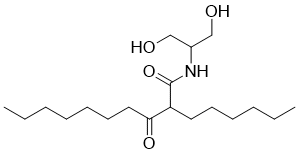
Physicochemical Properties
| Molecular Formula | C19H37NO4 |
| Molecular Weight | 343.508 |
| Exact Mass | 343.272 |
| CAS # | 756875-51-1 |
| PubChem CID | 11660192 |
| Appearance | White to off-white solid powder |
| LogP | 3.812 |
| Hydrogen Bond Donor Count | 3 |
| Hydrogen Bond Acceptor Count | 4 |
| Rotatable Bond Count | 16 |
| Heavy Atom Count | 24 |
| Complexity | 329 |
| Defined Atom Stereocenter Count | 0 |
| InChi Key | CGYVFCHCRBGGJG-UHFFFAOYSA-N |
| InChi Code | InChI=1S/C19H37NO4/c1-3-5-7-9-11-13-18(23)17(12-10-8-6-4-2)19(24)20-16(14-21)15-22/h16-17,21-22H,3-15H2,1-2H3,(H,20,24) |
| Chemical Name | N-(1,3-dihydroxypropan-2-yl)-2-hexyl-3-oxodecanamide |
| Synonyms | K6PC5 K6PC 5 K6PC-5 |
| HS Tariff Code | 2934.99.9001 |
| Storage |
Powder-20°C 3 years 4°C 2 years In solvent -80°C 6 months -20°C 1 month |
| Shipping Condition | Room temperature (This product is stable at ambient temperature for a few days during ordinary shipping and time spent in Customs) |
Biological Activity
| ln Vitro | K6PC-5 (1-10 μM; 24 hours) dose-dependently raises the levels of loricin and involucrin in normal human emergency response (NHEK) cells. K6PC-5 uses intracellular Ca2+ nutritional signaling to encourage the creation of new cells. Furthermore, c-Jun N-terminated division phosphorylation and p42/44 extracellular signal regulation are stimulated by K6PC-5 [1]. K6PC-5 (1–10 μM; 24 h) stimulates human fibroblasts and causes oscillations in the intracellular Ca2+ concentration ([Ca2+]i) in these cells [2]. In EA.hy926 cells infected with EBOV, K6PC-5 (10, 25, and 50 μM; 48 hours) dramatically decreased EBOV-induced infection. In cell supernatants, K6PC-5 dramatically lowers viral titers and, in a concentrated way, greatly lowers VP40 levels [3].] |
| ln Vivo | In an inherently aged hairless mouse (56 weeks old), 1% K6PC-5 was topically administered for 2 weeks. This K6PC-5 therapy greatly enhanced the number of cutaneous fibroblasts and collagen synthesis. Therefore, dermal thickness is also greatly raised in |
| Cell Assay |
Western Blot Analysis[1] Cell Types: Normal human epidermal keratinocytes (NHEK) Tested Concentrations: 1 μM, 5 μM, 10 μM Incubation Duration: 24 hrs (hours) Experimental Results: Involucrin and loricin levels increased in a dose-dependent manner. Cell proliferation experiment [2] Cell Types: human fibroblasts Tested Concentrations: 1 μM, 5 μM, 10 μM Incubation Duration: 24 h Experimental Results: Dramatically promoted human fibroblast proliferation and procollagen production. |
| Animal Protocol |
Animal/Disease Models: Intrinsically aged hairless mice (56 weeks old) [2] Doses: 1% (Vehicle (PEG:EtOH = 7:3)) Route of Administration: Topical application; [2 ]. twice (two times) daily for 2 weeks Experimental Results: Enhanced fibroblast proliferation, collagen production, and ultimately increased dermal thickness. |
| References |
[1]. Novel synthetic ceramide derivatives increase intracellular calcium levels and promote epidermal keratinocyte differentiation. J Lipid Res. 2007 Sep;48(9):1936-43. [2]. K6PC-5, a sphingosine kinase activator, induces anti-aging effects in intrinsically aged skin through intracellular Ca2+ signaling. J Dermatol Sci. 2008 Aug;51(2):89-102. [3]. The sphingosine kinase 1 activator, K6PC-5, attenuates Ebola virus infection. iScience. 2021 Mar 5;24(4):102266. |
Solubility Data
| Solubility (In Vitro) | DMSO : ~100 mg/mL (~291.12 mM) |
| Solubility (In Vivo) |
Solubility in Formulation 1: ≥ 2.5 mg/mL (7.28 mM) (saturation unknown) in 10% DMSO + 40% PEG300 + 5% Tween80 + 45% Saline (add these co-solvents sequentially from left to right, and one by one), clear solution. For example, if 1 mL of working solution is to be prepared, you can add 100 μL of 25.0 mg/mL clear DMSO stock solution to 400 μL PEG300 and mix evenly; then add 50 μL Tween-80 to the above solution and mix evenly; then add 450 μL normal saline to adjust the volume to 1 mL. Preparation of saline: Dissolve 0.9 g of sodium chloride in 100 mL ddH₂ O to obtain a clear solution. Solubility in Formulation 2: ≥ 2.5 mg/mL (7.28 mM) (saturation unknown) in 10% DMSO + 90% (20% SBE-β-CD in Saline) (add these co-solvents sequentially from left to right, and one by one), clear solution. For example, if 1 mL of working solution is to be prepared, you can add 100 μL of 25.0 mg/mL clear DMSO stock solution to 900 μL of 20% SBE-β-CD physiological saline solution and mix evenly. Preparation of 20% SBE-β-CD in Saline (4°C,1 week): Dissolve 2 g SBE-β-CD in 10 mL saline to obtain a clear solution. Solubility in Formulation 3: ≥ 2.5 mg/mL (7.28 mM) (saturation unknown) in 10% DMSO + 90% Corn Oil (add these co-solvents sequentially from left to right, and one by one), clear solution. For example, if 1 mL of working solution is to be prepared, you can add 100 μL of 25.0 mg/mL clear DMSO stock solution to 900 μL of corn oil and mix evenly. (Please use freshly prepared in vivo formulations for optimal results.) |
| Preparing Stock Solutions | 1 mg | 5 mg | 10 mg | |
| 1 mM | 2.9111 mL | 14.5556 mL | 29.1112 mL | |
| 5 mM | 0.5822 mL | 2.9111 mL | 5.8222 mL | |
| 10 mM | 0.2911 mL | 1.4556 mL | 2.9111 mL |