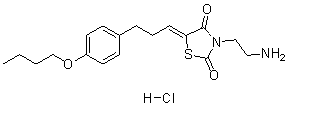
K145 is a novel and selective SphK2 (sphingosine kinase-2) inhibitor (IC50 = 4.30 μM) with antitumor activity. It shows no inhibition on SphK1 at concentrations up to 10 μM. As a selective sphingosine kinase-2 (SphK2) inhibitor, K145 has anticancer activity and inhibited the activity of SphK2 in a dose-dependent manner. Biochemical assay results indicate that K145 is a selective SphK2 inhibitor. Molecular modeling studies also support this notion. In vitro studies using human leukemia U937 cells demonstrated that K145 accumulates in U937 cells, suppresses the S1P level, and inhibits SphK2. K145 also exhibited inhibitory effects on the growth of U937 cells as well as apoptotic effects in U937 cells, and that these effects may be through the inhibition of down-stream ERK and Akt signaling pathways. K145 also significantly inhibited the growth of U937 tumors in nude mice by both intraperitoneal and oral administration, thus demonstrating its in vivo efficacy as a potential lead anticancer agent. The antitumor activity of K145 was also confirmed in a syngeneic mouse model by implanting murine breast cancer JC cells in BALB/c mice. Collectively, these results strongly encourage further optimization of K145 as a novel lead compound for development of more potent and selective SphK2 inhibitors.
Physicochemical Properties
| Molecular Formula | C18H25CLN2O3S |
| Molecular Weight | 384.920702695847 |
| Exact Mass | 384.127 |
| CAS # | 1449240-68-9 |
| Related CAS # | K145;1309444-75-4 |
| PubChem CID | 76849910 |
| Appearance | White to off-white solid powder |
| LogP | 4.776 |
| Hydrogen Bond Donor Count | 2 |
| Hydrogen Bond Acceptor Count | 5 |
| Rotatable Bond Count | 9 |
| Heavy Atom Count | 25 |
| Complexity | 459 |
| Defined Atom Stereocenter Count | 0 |
| SMILES | CCCCOC1=CC=C(C=C1)CC/C=C\2/C(=O)N(C(=O)S2)CCN.Cl |
| InChi Key | HADFDMGQKBGVAV-NKBLJONXSA-N |
| InChi Code | InChI=1S/C18H24N2O3S.ClH/c1-2-3-13-23-15-9-7-14(8-10-15)5-4-6-16-17(21)20(12-11-19)18(22)24-16;/h6-10H,2-5,11-13,19H2,1H3;1H/b16-6-; |
| Chemical Name | (Z)-3-(2-aminoethyl)-5-(3-(4-butoxyphenyl)propylidene)thiazolidine-2,4-dione hydrochloride |
| Synonyms | K-145; K-145 HCl; K145; K 145; K145 hydrochloride. |
| HS Tariff Code | 2934.99.9001 |
| Storage |
Powder-20°C 3 years 4°C 2 years In solvent -80°C 6 months -20°C 1 month Note: Please store this product in a sealed and protected environment, avoid exposure to moisture. |
| Shipping Condition | Room temperature (This product is stable at ambient temperature for a few days during ordinary shipping and time spent in Customs) |
Biological Activity
| ln Vitro | U937 cells treated with K145 (0-10 µM; 24-72 hours) exhibit considerable, concentration-dependent growth inhibition [1]. U937 cells treated with K145 (10 µM) for 24 hours showed a considerable increase in apoptosis [1]. Treatment with K145 (4-8 µM; 3 hours; U937 cells) decreases phosphorylation of ERK and Akt [1]. Treatment with K145 (10 µM) reduced total cellular S1P but did not significantly alter ceramide levels [1]. |
| ln Vivo | The treatment of BALB/c-nu mice with K145 (50 mg/kg; oral gavage; daily; for 15 days) dramatically slowed the growth of U937 tumors in nude mice [1]. |
| Cell Assay |
Cell viability assay [1] Cell Types: U937 cells Tested Concentrations: 0 µM, 4 µM, 6 µM, 8 µM, 10 µM Incubation Duration: 24 hrs (hours), 48 hrs (hours), 72 hrs (hours) Experimental Results: Dramatically inhibited the growth of U937 cells at a certain concentration Growth-dependent manner. Apoptosis analysis [1] Cell Types: U937 Cell Tested Concentrations: 10 µM Incubation Duration: 24 hrs (hours) Experimental Results: Dramatically induced apoptosis in U937 cells. Western Blot Analysis[1] Cell Types: U937 Cell Tested Concentrations: 4 µM, 8 µM Incubation Duration: 3 hrs (hours) Experimental Results: diminished phosphorylated ERK and Akt. |
| Animal Protocol |
Animal/Disease Models: BALB/c-nu (nude) mice injected with U937 cells [1] Doses: 50 mg/kg Route of Administration: po (oral gavage); daily; 15-day Experimental Results: 50 mg/kg dose can inhibit the growth of U937 tumors, and does not Significant toxicity was observed. |
| References |
[1]. Biological characterization of 3-(2-amino-ethyl)-5-[3-(4-butoxyl-phenyl)-propylidene]-thiazolidine-2,4-dione (K145) as a selective sphingosine kinase-2 inhibitor and anticancer agent. PLoS One. 2013;8(2):e56471. |
Solubility Data
| Solubility (In Vitro) |
H2O : ~126.7 mg/mL (~329.16 mM) DMSO : ~50 mg/mL (~129.90 mM) |
| Solubility (In Vivo) |
Solubility in Formulation 1: ≥ 0.83 mg/mL (2.16 mM) (saturation unknown) in 10% DMSO + 40% PEG300 + 5% Tween80 + 45% Saline (add these co-solvents sequentially from left to right, and one by one), clear solution. For example, if 1 mL of working solution is to be prepared, you can add 100 μL of 8.3 mg/mL clear DMSO stock solution to 400 μL of PEG300 and mix evenly; then add 50 μL of Tween-80 to the above solution and mix evenly; then add 450 μL of normal saline to adjust the volume to 1 mL. Preparation of saline: Dissolve 0.9 g of sodium chloride in 100 mL ddH₂ O to obtain a clear solution. Solubility in Formulation 2: ≥ 0.83 mg/mL (2.16 mM) (saturation unknown) in 10% DMSO + 90% (20% SBE-β-CD in Saline) (add these co-solvents sequentially from left to right, and one by one), clear solution. For example, if 1 mL of working solution is to be prepared, you can add 100 μL of 8.3 mg/mL clear DMSO stock solution to 900 μL of 20% SBE-β-CD physiological saline solution and mix evenly. Preparation of 20% SBE-β-CD in Saline (4°C,1 week): Dissolve 2 g SBE-β-CD in 10 mL saline to obtain a clear solution. Solubility in Formulation 3: ≥ 0.83 mg/mL (2.16 mM) (saturation unknown) in 10% DMSO + 90% Corn Oil (add these co-solvents sequentially from left to right, and one by one), clear solution. For example, if 1 mL of working solution is to be prepared, you can add 100 μL of 8.3 mg/mL clear DMSO stock solution to 900 μL of corn oil and mix evenly. (Please use freshly prepared in vivo formulations for optimal results.) |
| Preparing Stock Solutions | 1 mg | 5 mg | 10 mg | |
| 1 mM | 2.5979 mL | 12.9897 mL | 25.9794 mL | |
| 5 mM | 0.5196 mL | 2.5979 mL | 5.1959 mL | |
| 10 mM | 0.2598 mL | 1.2990 mL | 2.5979 mL |