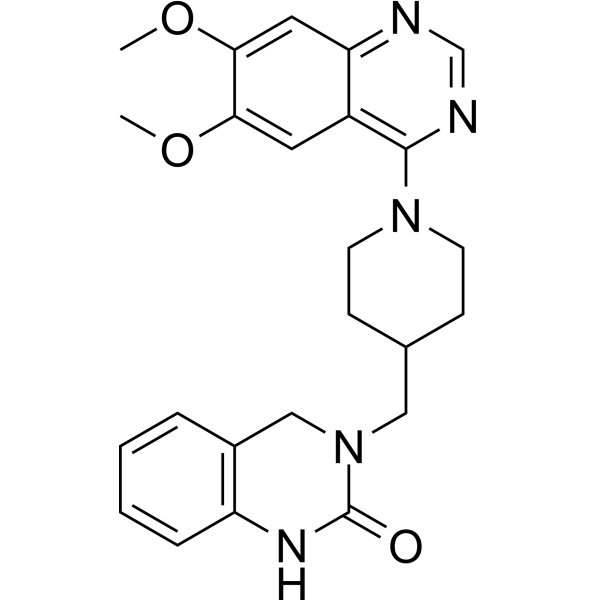
Physicochemical Properties
| Molecular Formula | C24H27N5O3 |
| Molecular Weight | 433.502885103226 |
| Exact Mass | 433.211 |
| CAS # | 130017-40-2 |
| PubChem CID | 14668434 |
| Appearance | White to off-white solid powder |
| LogP | 3.1 |
| Hydrogen Bond Donor Count | 1 |
| Hydrogen Bond Acceptor Count | 6 |
| Rotatable Bond Count | 5 |
| Heavy Atom Count | 32 |
| Complexity | 643 |
| Defined Atom Stereocenter Count | 0 |
| SMILES | O=C1NC2C=CC=CC=2CN1CC1CCN(C2C3C=C(C(=CC=3N=CN=2)OC)OC)CC1 |
| InChi Key | GWXCGEJJQFHPPA-UHFFFAOYSA-N |
| InChi Code | InChI=1S/C24H27N5O3/c1-31-21-11-18-20(12-22(21)32-2)25-15-26-23(18)28-9-7-16(8-10-28)13-29-14-17-5-3-4-6-19(17)27-24(29)30/h3-6,11-12,15-16H,7-10,13-14H2,1-2H3,(H,27,30) |
| Chemical Name | 3-[[1-(6,7-dimethoxyquinazolin-4-yl)piperidin-4-yl]methyl]-1,4-dihydroquinazolin-2-one |
| Synonyms | K756; K 756; K-756 |
| HS Tariff Code | 2934.99.9001 |
| Storage |
Powder-20°C 3 years 4°C 2 years In solvent -80°C 6 months -20°C 1 month |
| Shipping Condition | Room temperature (This product is stable at ambient temperature for a few days during ordinary shipping and time spent in Customs) |
Biological Activity
| ln Vitro | Tankyrase (TNKS) is the target of K-756, a new selective inhibitor of the Wnt/β-catenin pathway. TNKS belongs to the PARP family (paramp5, if you will). K-756 binds to TNKS's inducible pocket and stops the enzyme from active. The inhibitory activity of the PARP family enzyme at 10 μM was assessed in order to investigate the isoform selectivity of K-756. TNKS1 and TNKS2 are 97% and 100% inhibited, respectively, by K-756. On the other hand, K-756 had less than 13% of its inhibitory action against PARP1, PARP2, PARP3, PARP6, PARP7, and PARP11. By blocking the Wnt/β-catenin pathway, K-756 prevents the proliferation of APC mutant colorectal cancer COLO 320DM and SW403 cells. With an IC50 of 110 nM, K-756 significantly suppresses reporter gene activity in DLD-1/TCF-Luc cells, but not in DLD-1/mtTCF-Luc cells, not even at 1,000 nM. Following a 144-hour treatment with K-756, the APC mutant colorectal cancer cell lines COLO 320DM and SW403 cells were assessed for cell growth suppression using the XTT assay. K-756 was applied, and at a GI50 of 780 nM, it stopped COLO 320DM cells from growing. K-756 has a GI50 of 270 nM and inhibits SW403 as well[1]. |
| ln Vivo | DLD-1/TCF-Luc cell xenografts were produced in SCID mice. Vehicle (0.5% MC400) or K-756 was delivered orally once day for 3 days at dosages of 100, 200, and 400 mg/kg. Inhibition of Wnt/β-catenin signaling in tumors was examined by measuring FGF20 and LGR5 as well as luciferase activity. The expression and reporter gene activity of FGF20 were significantly reduced after 3 days of administration at doses of 100 mg/kg and above. The expression of LGR5 was dramatically reduced when supplied for 3 days at dosages of 200 mg/kg and higher. K-756 achieved maximum inhibitory activity at a dosage of 400 mg/kg for 3 days. Inhibition of Wnt/β-catenin signaling was observed at a dose of 400 mg/kg 1 day after dosing [1]. |
| References |
[1]. The Discovery and Characterization of K-756, a Novel Wnt/β-Catenin Pathway Inhibitor Targeting Tankyrase. Mol Cancer Ther. 2016 Jul;15(7):1525-34. |
Solubility Data
| Solubility (In Vitro) | DMSO : ~4.55 mg/mL (~10.50 mM) |
| Solubility (In Vivo) |
Solubility in Formulation 1: ≥ 0.46 mg/mL (1.06 mM) (saturation unknown) in 10% DMSO + 90% (20% SBE-β-CD in Saline) (add these co-solvents sequentially from left to right, and one by one), clear solution. For example, if 1 mL of working solution is to be prepared, you can add 100 μL of 4.6 mg/mL clear DMSO stock solution to 900 μL of 20% SBE-β-CD physiological saline solution and mix evenly. Preparation of 20% SBE-β-CD in Saline (4°C,1 week): Dissolve 2 g SBE-β-CD in 10 mL saline to obtain a clear solution. Solubility in Formulation 2: ≥ 0.46 mg/mL (1.06 mM) (saturation unknown) in 10% DMSO + 90% Corn Oil (add these co-solvents sequentially from left to right, and one by one), clear solution. For example, if 1 mL of working solution is to be prepared, you can add 100 μL of 4.6 mg/mL clear DMSO stock solution to 900 μL of corn oil and mix evenly. Solubility in Formulation 3: ≥ 0.45 mg/mL (1.04 mM) (saturation unknown) in 10% DMSO + 40% PEG300 + 5% Tween80 + 45% Saline (add these co-solvents sequentially from left to right, and one by one), clear solution. For example, if 1 mL of working solution is to be prepared, you can add 100 μL of 4.5 mg/mL clear DMSO stock solution to 400 μL PEG300 and mix evenly; then add 50 μL Tween-80 to the above solution and mix evenly; then add 450 μL normal saline to adjust the volume to 1 mL. Preparation of saline: Dissolve 0.9 g of sodium chloride in 100 mL ddH₂ O to obtain a clear solution. (Please use freshly prepared in vivo formulations for optimal results.) |
| Preparing Stock Solutions | 1 mg | 5 mg | 10 mg | |
| 1 mM | 2.3068 mL | 11.5340 mL | 23.0681 mL | |
| 5 mM | 0.4614 mL | 2.3068 mL | 4.6136 mL | |
| 10 mM | 0.2307 mL | 1.1534 mL | 2.3068 mL |