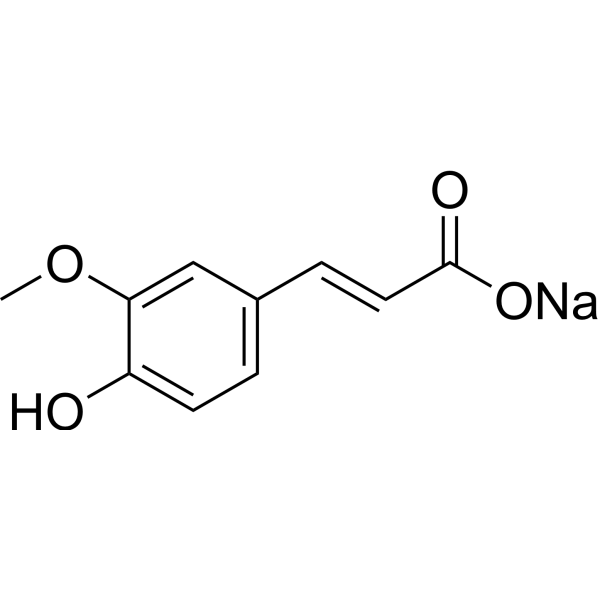
Physicochemical Properties
| Molecular Formula | C10H9NAO4 |
| Molecular Weight | 216.1658 |
| Exact Mass | 216.039 |
| CAS # | 24276-84-4 |
| Related CAS # | Ferulic acid;1135-24-6;(E)-Ferulic acid;537-98-4 |
| PubChem CID | 23669636 |
| Appearance | Off-white to yellow solid powder |
| Boiling Point | 372.3ºC at 760 mmHg |
| Flash Point | 150.5ºC |
| Vapour Pressure | 3.34E-06mmHg at 25°C |
| LogP | 0.163 |
| Hydrogen Bond Donor Count | 1 |
| Hydrogen Bond Acceptor Count | 4 |
| Rotatable Bond Count | 3 |
| Heavy Atom Count | 15 |
| Complexity | 230 |
| Defined Atom Stereocenter Count | 0 |
| SMILES | COC1=C(C=CC(=C1)/C=C/C(=O)[O-])O.[Na+] |
| InChi Key | NCTHNHPAQAVBEB-WGCWOXMQSA-M |
| InChi Code | InChI=1S/C10H10O4.Na/c1-14-9-6-7(2-4-8(9)11)3-5-10(12)13;/h2-6,11H,1H3,(H,12,13);/q;+1/p-1/b5-3+; |
| Chemical Name | sodium;(E)-3-(4-hydroxy-3-methoxyphenyl)prop-2-enoate |
| HS Tariff Code | 2934.99.9001 |
| Storage |
Powder-20°C 3 years 4°C 2 years In solvent -80°C 6 months -20°C 1 month Note: Please store this product in a sealed and protected environment, avoid exposure to moisture. |
| Shipping Condition | Room temperature (This product is stable at ambient temperature for a few days during ordinary shipping and time spent in Customs) |
Biological Activity
| Targets |
- Ferulic acid sodium targets fibroblast growth factor receptor 1 (FGFR1) [1] - Ferulic acid sodium acts on the serotonergic system, involving 5-hydroxytryptamine (5-HT) receptors [2] |
| ln Vitro |
The fibroblast growth factor receptor 1 (FGFR1) inhibitor sodium ferulate (FA) has IC50 values of 3.78 and 12.5 μM for FGFR1 and FGFR2, respectively. With an inhibition rate of 92% at 1 μM, ferrulic acid exhibited the highest inhibitory effect against FGFR1. After treating HUVECs with 5 to 40 μM sodium ferulate for 24 hours, FGF1-stimulated HUVEC proliferation was markedly decreased. In HUVEC, sodium ferulate up to 20 μM had no discernible influence on cell viability; but, above 30 μM, it showed cytotoxic effects. In a FGF1-induced way, sodium ferulate suppresses the migration and regulation of HUVEC. Significantly, sodium ferulate prevented PI3K and Akt phosphorylation that was induced by FGF1. The expression of MMP-2 and MMP-9 is dramatically inhibited by sodium ferulate when stimulated by FGF1 [1]. - In human umbilical vein endothelial cells (HUVECs), Ferulic acid sodium (10 μM, 50 μM, 100 μM) dose-dependently inhibited cell proliferation, with a significant reduction at 50 μM and 100 μM compared to the control group. It also suppressed HUVEC migration and tube formation in a concentration-dependent manner, blocking angiogenesis [1] - Ferulic acid sodium (100 μM) downregulated the phosphorylation of FGFR1, AKT, and ERK1/2 in HUVECs, inhibiting the FGFR1-mediated signaling pathway that drives angiogenesis [1] - In human lung cancer A549 cells, Ferulic acid sodium (50 μM, 100 μM) inhibited cell proliferation and induced G0/G1 cell cycle arrest, which was associated with reduced expression of cyclin D1 and cyclin-dependent kinase 4 (CDK4) [1] |
| ln Vivo |
Treatment with sodium ferulate (FA) substantially reduced FGF1-induced neovascularization. Intragastric variability of sodium ferulate was observed to dramatically reduce tumor volume and tumor weight compared to its DMSO-treated counterpart. In addition, sodium ferulate medication was well tolerated, and there was no significant difference in body weight between the excipient and sodium ferulate groups [1]. ) and immobility time in the tail suspension test (TST), but had no effect in the open field test. The results demonstrated that the medication sodium ferulate (0.001 mg/kg, po) improved the antidepressant-like effect of fluoxetine (5 mg/kg, po) in TST [2]. - In nude mice bearing A549 xenograft tumors, intraperitoneal administration of Ferulic acid sodium (20 mg/kg, 40 mg/kg) every other day for 21 days significantly reduced tumor volume and weight. The high-dose group (40 mg/kg) showed a tumor growth inhibition rate of approximately 58% compared to the control group, with reduced microvessel density in tumor tissues [1] - In ICR mice subjected to the tail suspension test (TST), oral administration of Ferulic acid sodium (10 mg/kg, 20 mg/kg, 40 mg/kg) 60 minutes before the test significantly decreased the immobility time. The 40 mg/kg dose reduced immobility time by approximately 42% compared to the vehicle control, exerting an antidepressant-like effect [2] - Pretreatment with p-chlorophenylalanine (PCPA), a serotonin synthesis inhibitor, completely abolished the antidepressant-like effect of Ferulic acid sodium (40 mg/kg) in the TST, confirming the involvement of the serotonergic system [2] |
| Enzyme Assay |
- For FGFR1 kinase activity assay: Purified FGFR1 kinase domain was incubated with different concentrations of Ferulic acid sodium (0.1 μM - 100 μM) in reaction buffer containing ATP and a specific peptide substrate. After incubation at 37°C for 30 minutes, the reaction was terminated, and the phosphorylated substrate was detected using a fluorescence-based assay. The inhibition rate of FGFR1 kinase activity was calculated to evaluate the binding and inhibitory effect of Ferulic acid sodium [1] |
| Cell Assay |
- HUVEC proliferation assay: HUVECs were seeded in 96-well plates and cultured overnight. Ferulic acid sodium at concentrations of 10 μM, 50 μM, 100 μM was added, and cells were cultured for 48 hours. Cell viability was measured using a colorimetric assay based on tetrazolium salt reduction, and the proliferation rate was calculated relative to the control group [1] - HUVEC tube formation assay: Matrigel was coated onto 96-well plates and allowed to solidify. HUVECs were resuspended in medium containing Ferulic acid sodium (10 μM, 50 μM, 100 μM) and seeded onto the Matrigel. After 6 hours of incubation, tube formation was observed under a microscope, and the total tube length was quantified using image analysis software [1] - A549 cell cycle analysis: A549 cells were treated with Ferulic acid sodium (50 μM, 100 μM) for 24 hours. Cells were harvested, fixed with ethanol, stained with propidium iodide, and analyzed by flow cytometry to determine the distribution of cells in G0/G1, S, and G2/M phases [1] - Western blot analysis: HUVECs or A549 cells were treated with Ferulic acid sodium (100 μM) for 24 hours. Total protein was extracted, separated by SDS-PAGE, and transferred to a membrane. The membrane was incubated with primary antibodies against FGFR1, p-FGFR1, AKT, p-AKT, ERK1/2, p-ERK1/2, cyclin D1, and CDK4, followed by a secondary antibody. Protein bands were visualized using a chemiluminescent substrate, and band intensity was quantified [1] |
| Animal Protocol |
- Tumor xenograft model: Male nude mice (4-6 weeks old) were subcutaneously injected with A549 cells (1×10⁷ cells/mouse) to establish xenograft tumors. When tumors reached a volume of approximately 100 mm³, mice were randomly divided into control and treatment groups. Ferulic acid sodium was dissolved in normal saline, and administered intraperitoneally at doses of 20 mg/kg and 40 mg/kg every other day for 21 days. The control group received an equal volume of normal saline. Tumor volume and body weight were measured every 3 days, and mice were euthanized at the end of the experiment to collect tumor tissues for further analysis [1] - Tail suspension test (TST): Male ICR mice (20-25 g) were randomly divided into control and treatment groups. Ferulic acid sodium was dissolved in 0.5% carboxymethylcellulose sodium (CMC-Na) solution, and administered orally at doses of 10 mg/kg, 20 mg/kg, and 40 mg/kg. The control group received an equal volume of 0.5% CMC-Na. Sixty minutes after administration, mice were suspended by the tail for 6 minutes, and the immobility time during the last 4 minutes was recorded [2] - PCPA pretreatment experiment: Mice were intraperitoneally injected with PCPA (100 mg/kg) once daily for 3 consecutive days. On the fourth day, Ferulic acid sodium (40 mg/kg) was administered orally, and the TST was performed 60 minutes later to record immobility time [2] |
| References |
[1]. Ferulic Acid Exerts Anti-Angiogenic and Anti-Tumor Activity by Targeting Fibroblast Growth Factor Receptor 1-Mediated Angiogenesis. Int J Mol Sci. 2015 Oct 12;16(10):24011-31. [2]. Ferulic acid exerts antidepressant-like effect in the tail suspension test in mice: evidence for the involvement of the serotonergic system. Eur J Pharmacol. 2012 Mar 15;679(1-3):68-74. |
| Additional Infomation |
Sodium ferulate is an organic sodium salt resulting from the replacement of the proton from the 3-hydroxy group of ferulic acid by a sodium ion. It has a role as a plant metabolite, an antioxidant, a MALDI matrix material, an anti-inflammatory agent, an apoptosis inhibitor and a cardioprotective agent. It contains a ferulate. - Ferulic acid sodium is the sodium salt form of ferulic acid, a natural phenolic compound [1][2] - Its anti-tumor activity is mediated through inhibiting FGFR1-dependent angiogenesis, which reduces nutrient supply to tumor tissues and suppresses tumor growth [1] - The antidepressant-like effect of Ferulic acid sodium is dependent on the serotonergic system, likely by increasing serotonin levels or enhancing serotonin receptor function in the brain [2] |
Solubility Data
| Solubility (In Vitro) |
H2O : ~100 mg/mL (~462.60 mM) DMSO : ~33.33 mg/mL (~154.18 mM) |
| Solubility (In Vivo) |
Solubility in Formulation 1: ≥ 2.5 mg/mL (11.56 mM) (saturation unknown) in 10% DMSO + 40% PEG300 + 5% Tween80 + 45% Saline (add these co-solvents sequentially from left to right, and one by one), clear solution. For example, if 1 mL of working solution is to be prepared, you can add 100 μL of 25.0 mg/mL clear DMSO stock solution to 400 μL PEG300 and mix evenly; then add 50 μL Tween-80 to the above solution and mix evenly; then add 450 μL normal saline to adjust the volume to 1 mL. Preparation of saline: Dissolve 0.9 g of sodium chloride in 100 mL ddH₂ O to obtain a clear solution. Solubility in Formulation 2: ≥ 2.5 mg/mL (11.56 mM) (saturation unknown) in 10% DMSO + 90% (20% SBE-β-CD in Saline) (add these co-solvents sequentially from left to right, and one by one), clear solution. For example, if 1 mL of working solution is to be prepared, you can add 100 μL of 25.0 mg/mL clear DMSO stock solution to 900 μL of 20% SBE-β-CD physiological saline solution and mix evenly. Preparation of 20% SBE-β-CD in Saline (4°C,1 week): Dissolve 2 g SBE-β-CD in 10 mL saline to obtain a clear solution. Solubility in Formulation 3: 33.33 mg/mL (154.18 mM) in PBS (add these co-solvents sequentially from left to right, and one by one), clear solution; with ultrasonication. (Please use freshly prepared in vivo formulations for optimal results.) |
| Preparing Stock Solutions | 1 mg | 5 mg | 10 mg | |
| 1 mM | 4.6260 mL | 23.1299 mL | 46.2599 mL | |
| 5 mM | 0.9252 mL | 4.6260 mL | 9.2520 mL | |
| 10 mM | 0.4626 mL | 2.3130 mL | 4.6260 mL |