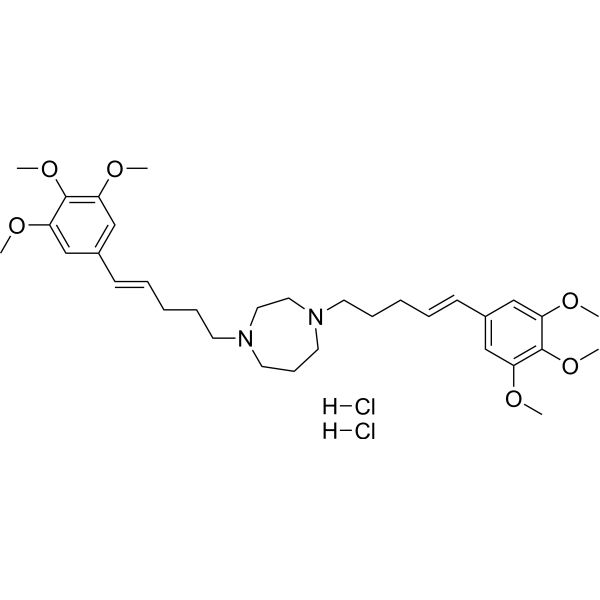
Physicochemical Properties
| Molecular Formula | C33H50CL2N2O6 |
| Molecular Weight | 641.6659 |
| Exact Mass | 568.351 |
| CAS # | 191089-60-8 |
| Related CAS # | K-7174;191089-59-5 |
| PubChem CID | 9874191 |
| Appearance | White to yellow solid powder |
| Density | 1.1±0.1 g/cm3 |
| Boiling Point | 689.9±55.0 °C at 760 mmHg |
| Flash Point | 171.2±28.7 °C |
| Vapour Pressure | 0.0±2.2 mmHg at 25°C |
| Index of Refraction | 1.552 |
| LogP | 5.61 |
| Hydrogen Bond Donor Count | 0 |
| Hydrogen Bond Acceptor Count | 8 |
| Rotatable Bond Count | 16 |
| Heavy Atom Count | 41 |
| Complexity | 663 |
| Defined Atom Stereocenter Count | 0 |
| SMILES | COC1=CC(=CC(=C1OC)OC)/C=C/CCCN2CCN(CCC2)CCC/C=C/C3=CC(=C(C(=C3)OC)OC)OC |
| InChi Key | JXXCDAKRSXICGM-AOEKMSOUSA-N |
| InChi Code | InChI=1S/C33H48N2O6/c1-36-28-22-26(23-29(37-2)32(28)40-5)14-9-7-11-16-34-18-13-19-35(21-20-34)17-12-8-10-15-27-24-30(38-3)33(41-6)31(25-27)39-4/h9-10,14-15,22-25H,7-8,11-13,16-21H2,1-6H3/b14-9+,15-10+ |
| Chemical Name | 1,4-bis[(E)-5-(3,4,5-trimethoxyphenyl)pent-4-enyl]-1,4-diazepane |
| HS Tariff Code | 2934.99.9001 |
| Storage |
Powder-20°C 3 years 4°C 2 years In solvent -80°C 6 months -20°C 1 month Note: Please store this product in a sealed and protected environment, avoid exposure to moisture. |
| Shipping Condition | Room temperature (This product is stable at ambient temperature for a few days during ordinary shipping and time spent in Customs) |
Biological Activity
| ln Vitro | VCAM-1 and its ligands' ability to adhere is inhibited by K-7174 diHClide (10 μM; 1 h) [1]. With an IC50 value of 14 μM, K-7174 diHClide (1-30 μM; 1 h) dose-dependently suppresses VCAM-1 expression [1]. With an IC50 value of 9 μM, K-7174 diHClide (1-30 μM; 1 h) dose-dependently suppresses TNFα activation of VCAM-1 mRNA[1]. In Hep3B cells, K-7174 diHClide (10–20 μM; 24 hours) dose-dependently restores Epo synthesis [2]. K-7174 diHClide decreases GATA binding activity at 2.5–30 μM for 24 hours [2]. K-7174 diHClide (0-25 μM; 72 h) causes apoptosis and suppresses the proliferation of MM cells [3]. |
| ln Vivo | K-7174 diHClide (30 mg/kg; intraperitoneally once daily for 9 days) reverses hemoglobin concentration and reticulocyte count reductions caused by TNF-α or IL-1β [2]. In vivo tumor growth is inhibited by K-7174 dihydrochloride (75 mg/kg; intraperitoneally administered once daily for 14 days) [3]. K-7174 dihydrochloride is more effective than intraperitoneal injection at inhibiting tumor growth in vivo when taken orally once daily for 14 days at a dose of 50 mg/kg [3]. |
| Cell Assay |
Cell Viability Assay[3] Cell Types: KMS12-BM, U266 and RPMI8226 Cell line Tested Concentrations: 0-25 μM Incubation Duration: 72 hrs (hours) Experimental Results: Inhibition of MM cell growth. Apoptosis analysis [3] Cell Types: KMS12-BM, U266 and RPMI8226 Cell line Tested Concentrations: 10 μM Incubation Duration: 48 h Experimental Results: As the percentage of annexin-V positive cells increased, the apoptosis of MM cells increased Dramatically. |
| Animal Protocol |
Animal/Disease Models: ICR mice injected with IL-β or TNF-α [2] Doses: 30 mg/kg Route of Administration: intraperitoneal (ip) injection; 30 mg/kg, one time/day for 9 days Experimental Results: Erythropoietin (Epo ) yield, reticulocyte count, and hemoglobin (Hb) concentration increased. Animal/Disease Models: NOD/SCID mouse xenograft [3] Doses: 75 mg/kg Route of Administration: intraperitoneal (ip) injection; one time/day for 14 days. Experimental Results: Tumor volume was Dramatically diminished, but body weight was Dramatically diminished after 10 days. Animal/Disease Models: NOD/SCID (severe combined immunodeficient) mouse with murine xenografts [3] Doses: 50 mg/kg Route of Administration: po (oral gavage); one time/day for 14 days Experimental Results: Demonstrated anti-myeloma activity. Oral administration is more effective than intraperitoneal (ip) injection. |
| References |
[1]. A novel cell adhesion inhibitor, K-7174, reduces the endothelial VCAM-1 induction by inflammatory cytokines, acting through the regulation of GATA. Biochem Biophys Res Commun. 2000 Jun 7;272(2):370-4. [2]. A GATA-specific inhibitor (K-7174) rescues anemia induced by IL-1beta, TNF-alpha, or L-NMMA. FASEB J. 2003 Sep;17(12):1742-4. [3]. The novel orally active proteasome inhibitor K-7174 exerts anti-myeloma activity in vitro and in vivo by down-regulating the expression of class I histone deacetylases. J Biol Chem. 2013 Aug 30;288(35):25593-602. |
Solubility Data
| Solubility (In Vitro) | H2O : ~15 mg/mL (~23.38 mM) |
| Solubility (In Vivo) |
Solubility in Formulation 1: 10 mg/mL (15.58 mM) in PBS (add these co-solvents sequentially from left to right, and one by one), clear solution; with sonication. (Please use freshly prepared in vivo formulations for optimal results.) |
| Preparing Stock Solutions | 1 mg | 5 mg | 10 mg | |
| 1 mM | 1.5584 mL | 7.7922 mL | 15.5843 mL | |
| 5 mM | 0.3117 mL | 1.5584 mL | 3.1169 mL | |
| 10 mM | 0.1558 mL | 0.7792 mL | 1.5584 mL |