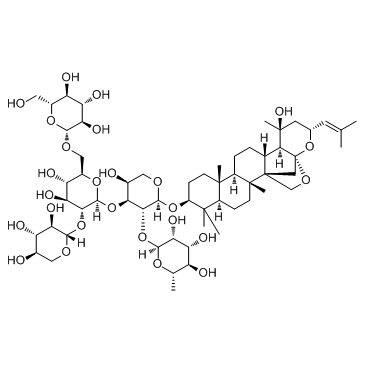
Physicochemical Properties
| Molecular Formula | C58H94O26 |
| Molecular Weight | 1207.35 |
| Exact Mass | 1206.603 |
| CAS # | 55466-04-1 |
| PubChem CID | 53399223 |
| Appearance | White to off-white solid powder |
| Density | 1.5±0.1 g/cm3 |
| Melting Point | 222-225ºC |
| Index of Refraction | 1.640 |
| LogP | 5.05 |
| Hydrogen Bond Donor Count | 14 |
| Hydrogen Bond Acceptor Count | 26 |
| Rotatable Bond Count | 13 |
| Heavy Atom Count | 84 |
| Complexity | 2330 |
| Defined Atom Stereocenter Count | 0 |
| InChi Key | KVKRFLVYJLIZFD-UHFFFAOYSA-N |
| InChi Code | InChI=1S/C58H94O26/c1-23(2)15-25-16-56(8,72)47-26-9-10-32-54(6)13-12-33(53(4,5)31(54)11-14-55(32,7)57(26)21-58(47,84-25)76-22-57)80-51-46(83-50-43(71)38(66)34(62)24(3)77-50)44(28(61)19-74-51)81-52-45(82-49-41(69)35(63)27(60)18-73-49)40(68)37(65)30(79-52)20-75-48-42(70)39(67)36(64)29(17-59)78-48/h15,24-52,59-72H,9-14,16-22H2,1-8H3 |
| Chemical Name | 2-[4-[4,5-dihydroxy-6-[[3,4,5-trihydroxy-6-(hydroxymethyl)oxan-2-yl]oxymethyl]-3-(3,4,5-trihydroxyoxan-2-yl)oxyoxan-2-yl]oxy-5-hydroxy-2-[[16-hydroxy-2,6,6,10,16-pentamethyl-18-(2-methylprop-1-enyl)-19,21-dioxahexacyclo[18.2.1.01,14.02,11.05,10.015,20]tricosan-7-yl]oxy]oxan-3-yl]oxy-6-methyloxane-3,4,5-triol |
| HS Tariff Code | 2934.99.9001 |
| Storage |
Powder-20°C 3 years 4°C 2 years In solvent -80°C 6 months -20°C 1 month |
| Shipping Condition | Room temperature (This product is stable at ambient temperature for a few days during ordinary shipping and time spent in Customs) |
Biological Activity
| ln Vitro | In both the 24-hour and 72-hour treatments, jujuboside A at a low dose of 41 μM (around 0.05 g/L) significantly increased the mRNA for the GABA(A) receptor α1, α5, and β2 subunits. The levels of GABA(A) receptor α1 and α5 subunit mRNA were significantly increased and the level of β2 subunit mRNA was decreased after a 24-hour treatment with high-dose 82 μM (approximately 0.1 g/L) jujube glycoside A [1]. After a 72-hour treatment, GABA(A) Expression of mRNA of receptor subunits α1 and β2 was decreased. A pretreatment with jujuboside A can improve ISO damage to H9C2 cells and reverse the decline in cell viability. Jujuboside A has the ability to quicken PI3K, Akt, and mTOR phosphorylation. In H9C2 cells, jujuboside A has been shown to dramatically lower the ratio of microtubule-associated protein LC3-II/I [2]. |
| ln Vivo | Ziziphus seeds considerably enhanced both total and rapid eye movement (REM) sleep throughout the day (9:00–15:00), but had no discernible impact on non-rapid eye movement (NREM) sleep. Ziziphus spinosa seeds considerably improved non-REM sleep, particularly light sleep, and total sleep during the nighttime hours of 21:00–3:00, but had no discernible impact on REM sleep or slow-wave sleep (SWS) [ 3]. Aβ1-42-induced learning and memory impairment in mice was considerably reduced by intraventricular administration with Jujuboside A, as assessed by the Y-maze, Morris water maze, and active avoidance. Jujube glycoside A injected intracerebroventricularly can decrease hippocampal Aβ1-42 levels, significantly inhibit NO and acetylcholinesterase (AChE) activities, and lessen the elevated levels of malondialdehyde (MDA) in the cerebral cortex and hippocampus of mice. Aβ1-42[4]. |
| References |
[1]. Effects on the expression of GABAA receptor subunits by jujuboside A treatment in rathippocampal neurons. J Ethnopharmacol. 2010 Mar 24;128(2):419-23. [2]. Jujuboside A Protects H9C2 Cells from Isoproterenol-Induced Injury via Activating PI3K/Akt/mTOR Signaling Pathway. Evid Based Complement Alternat Med. 2016;2016:9593716. [3]. Hypnotic effect of jujubosides from Semen Ziziphi Spinosae. J Ethnopharmacol. 2010 Jul 6;130(1):163-6. [4]. Jujuboside A, a neuroprotective agent from semen Ziziphi Spinosae ameliorates behavioral disorders of the dementia mouse model induced by Aβ 1-42. Eur J Pharmacol. 2014 Sep 5;738:206-13. |
| Additional Infomation | See also: Jujuboside A (annotation moved to). |
Solubility Data
| Solubility (In Vitro) |
DMSO : ~100 mg/mL (~82.83 mM) H2O : ~50 mg/mL (~41.41 mM) |
| Solubility (In Vivo) |
Solubility in Formulation 1: ≥ 2.5 mg/mL (2.07 mM) (saturation unknown) in 10% DMSO + 40% PEG300 + 5% Tween80 + 45% Saline (add these co-solvents sequentially from left to right, and one by one), clear solution. For example, if 1 mL of working solution is to be prepared, you can add 100 μL of 25.0 mg/mL clear DMSO stock solution to 400 μL PEG300 and mix evenly; then add 50 μL Tween-80 to the above solution and mix evenly; then add 450 μL normal saline to adjust the volume to 1 mL. Preparation of saline: Dissolve 0.9 g of sodium chloride in 100 mL ddH₂ O to obtain a clear solution. Solubility in Formulation 2: ≥ 2.5 mg/mL (2.07 mM) (saturation unknown) in 10% DMSO + 90% (20% SBE-β-CD in Saline) (add these co-solvents sequentially from left to right, and one by one), clear solution. For example, if 1 mL of working solution is to be prepared, you can add 100 μL of 25.0 mg/mL clear DMSO stock solution to 900 μL of 20% SBE-β-CD physiological saline solution and mix evenly. Preparation of 20% SBE-β-CD in Saline (4°C,1 week): Dissolve 2 g SBE-β-CD in 10 mL saline to obtain a clear solution. Solubility in Formulation 3: ≥ 2.5 mg/mL (2.07 mM) (saturation unknown) in 10% DMSO + 90% Corn Oil (add these co-solvents sequentially from left to right, and one by one), clear solution. For example, if 1 mL of working solution is to be prepared, you can add 100 μL of 25.0 mg/mL clear DMSO stock solution to 900 μL of corn oil and mix evenly. Solubility in Formulation 4: 50 mg/mL (41.41 mM) in PBS (add these co-solvents sequentially from left to right, and one by one), clear solution; with ultrasonication. (Please use freshly prepared in vivo formulations for optimal results.) |
| Preparing Stock Solutions | 1 mg | 5 mg | 10 mg | |
| 1 mM | 0.8283 mL | 4.1413 mL | 8.2826 mL | |
| 5 mM | 0.1657 mL | 0.8283 mL | 1.6565 mL | |
| 10 mM | 0.0828 mL | 0.4141 mL | 0.8283 mL |