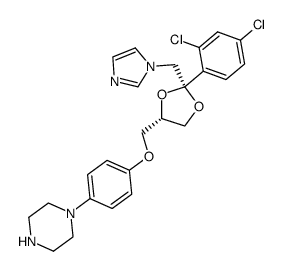
Deacylketoconazole, an active metabolite of Ketoconazole, is a novel and potent antiviral medication structurally similar to Ketoconazole, which is an antifungal drug to treat fungal infections.
Physicochemical Properties
| Molecular Formula | C24H26CL2N4O3 |
| Molecular Weight | 489.397 |
| Exact Mass | 488.138 |
| Elemental Analysis | C, 58.90; H, 5.36; Cl, 14.49; N, 11.45; O, 9.81 |
| CAS # | 67914-61-8 |
| PubChem CID | 12854716 |
| Appearance | White to off-white solid powder |
| LogP | 4.34 |
| Hydrogen Bond Donor Count | 1 |
| Hydrogen Bond Acceptor Count | 6 |
| Rotatable Bond Count | 7 |
| Heavy Atom Count | 33 |
| Complexity | 621 |
| Defined Atom Stereocenter Count | 2 |
| SMILES | c1cc(ccc1N2CCNCC2)OC[C@H]3CO[C@](O3)(Cn4ccnc4)c5ccc(cc5Cl)Cl |
| InChi Key | LOUXSEJZCPKWAX-URXFXBBRSA-N |
| InChi Code | InChI=1S/C24H26Cl2N4O3/c25-18-1-6-22(23(26)13-18)24(16-29-10-7-28-17-29)32-15-21(33-24)14-31-20-4-2-19(3-5-20)30-11-8-27-9-12-30/h1-7,10,13,17,21,27H,8-9,11-12,14-16H2/t21-,24-/m0/s1 |
| Chemical Name | 1-[4-[[(2R,4S)-2-(2,4-dichlorophenyl)-2-(imidazol-1-ylmethyl)-1,3-dioxolan-4-yl]methoxy]phenyl]piperazine |
| Synonyms | Deacyl ketoconazole; 67914-61-8; Deacetyl Ketoconazole; Deacylketoconazole; N-Deacetylketoconazole; P7P4A1FD7Z; CIS-1-[4-[[2-(2,4-DICHLOROPHENYL)-2-(1H-IMIDAZOL-1-YLMETHYL)-1,3-DIOXOLAN-4-YL]METHOXY]PHENYL]PIPERAZINE; rel-1-(4-(((2R,4S)-2-((1H-Imidazol-1-yl)methyl)-2-(2,4-dichlorophenyl)-1,3-dioxolan-4-yl)methoxy)phenyl)piperazine; Piperazine, 1-(4-((2-(2,4-dichlorophenyl)-2-(1H-imidazol-1-ylmethyl)-1,3-dioxolan-4-yl)methoxy)phenyl)-, cis-; Deacylketoconazole |
| HS Tariff Code | 2934.99.9001 |
| Storage |
Powder-20°C 3 years 4°C 2 years In solvent -80°C 6 months -20°C 1 month |
| Shipping Condition | Room temperature (This product is stable at ambient temperature for a few days during ordinary shipping and time spent in Customs) |
Biological Activity
| Targets | CYP3A4; CYP24A1; ergosterol synthesis; active metabolite of Ketoconazole |
| ln Vitro | Deacylated ketoconazole (R-39519) also affect the growth of Staphylococcus aureus, miconazole being 12.5 and 14 times, respectively, more active than R-39519 and ketoconazole.[2] |
| ln Vivo | Deacylketoconazole was 15- to 50-fold more active against Plasmodium falciparum than was ketoconazole, based on [(3)H]hypoxanthine uptake and quantitative parasite counts. In contrast, there were no significant differences between these drugs in their activity against clinical isolates of Candida spp.[1] |
| Enzyme Assay | Ketoconazole (KC), an antifungal agent, rarely causes severe liver injury when orally administered. It has been reported that KC is mainly hydrolyzed to N-deacetyl ketoconazole (DAK), followed by the N-hydroxylation of DAK by flavin-containing monooxygenase (FMO). Although the metabolism of KC has been considered to be associated with hepatotoxicity, the responsible enzyme(s) remain unknown. The purpose of this study was to identify the responsible enzyme(s) for KC hydrolysis in humans and to clarify their relevance to KC-induced toxicity. Kinetic analysis and inhibition studies using human liver microsomes (HLM) and recombinant enzymes revealed that human arylacetamide deacetylase (AADAC) is responsible for KC hydrolysis to form DAK, and confirmed that FMO3 is the enzyme responsible for DAK N-hydroxylation. In HLM, the clearance of KC hydrolysis occurred to the same extent as DAK N-hydroxylation, which indicates that both processes are not rate-limiting pathways. Cytotoxicity of KC and DAK was evaluated using HepaRG cells and human primary hepatocytes. Treatment of HepaRG cells with DAK for 24h showed cytotoxicity in a dose-dependent manner, whereas treatment with KC did not show due to the low expression of AADAC. Overexpression of AADAC in HepaRG cells with an adenovirus expression system elicited the cytotoxicity of KC. Cytotoxicity of KC in human primary hepatocytes was attenuated by diisopropylfluorophosphate, an AADAC inhibitor. In conclusion, the present study demonstrated that human AADAC hydrolyzes KC to trigger hepatocellular toxicity.[3] |
| References |
[1]. Pfaller MA, et al., Activity of ketoconazole and its deacyl derivative against Plasmodium falciparum and Candida isolates. Antimicrob Agents Chemother. 1982 Nov;22(5):917-9. [2]. Bossche H V, et al., Molecular basis for the antimycotic and antibacterial activity of N‐substituted imidazoles and triazoles: The inhibition of isoprenoid biosynthesis. Pesticide science, 1984, 15(2): 188-198. [3]. Fukami T, et al., Human arylacetamide deacetylase hydrolyzes ketoconazole to trigger hepatocellular toxicity. Biochem Pharmacol. 2016 Sep 15;116:153-61. |
| Additional Infomation | The antimycotic N-substituted imidazoles and triazoles, such as imazalil, ketoconazole and itraconazole, interfere selectively at low concentrations (≥0.01nm) with the 14α-demethylase system (which is dependent on cytochrome P-450) of fungal cells, for example, Candida albicans and Penicillium italicum. This results in a decreased availability of ergosterol and the accumulation of 14α-methyl-sterols such as lanosterol. Cholesterol synthesis in a subcellular fraction of rat liver, in intact fibroblasts, and in vivo in rat liver, was much less sensitive, for example, to ketoconazole. The imidazole derivatives imazalil, miconazole, ketoconazole and parconazole, and the triazole derivatives propiconazole, terconazole and itraconazole affect the cytochrome P-450 species of microsomal fractions from Saccharomyces cerevisiae and rat liver. Cytochrome P-450 of rat-liver microsomes was much less sensitive to these azole derivatives, in parallel with the lower sensitivity of cholesterol synthesis. Using unilamellar vesicles composed of phosphatidylcholine, phosphatidyl-ethanolamine and diphosphatidylcholine, multilamellar vesicles of dipalmitoylphos-phatidylcholine, and intact S. cerevisiae, it was shown that the substitution of ergosterol by lanosterol leads to functional changes in the membranes. It is speculated that the selective interaction of the azole derivatives with the yeast microsomal cytochrome P-450 leads to the accumulation of 14a-methyl-sterols and results in changes in the permeability of the membranes and leakages. The observed inhibition of growth may have its origin in these changes. Miconazole, ketoconazole and deacylated ketoconazole (R-39519) also affect the growth of Staphylococcus aureus, miconazole being 12.5 and 14 times, respectively, more active than R-39519 and ketoconazole. The greater antibacterial activity of miconazole coincides with its greater inhibition of the biosynthesis of C-55 isoprenoid alcohol and vitamin K. The phosphorylated derivative of C-55 isoprenoid alcohol has functional importance in the biosynthesis of bacterial cell wall and membrane polymers, and the menaquinone vitamin K plays a role in the electron transport of Gram-positive bacteria. The reduced synthesis of these vital compounds may contribute to the antibacterial activity of miconazole.[2] |
Solubility Data
| Solubility (In Vitro) | May dissolve in DMSO (in most cases), if not, try other solvents such as H2O, Ethanol, or DMF with a minute amount of products to avoid loss of samples |
| Solubility (In Vivo) |
Note: Listed below are some common formulations that may be used to formulate products with low water solubility (e.g. < 1 mg/mL), you may test these formulations using a minute amount of products to avoid loss of samples. Injection Formulations (e.g. IP/IV/IM/SC) Injection Formulation 1: DMSO : Tween 80: Saline = 10 : 5 : 85 (i.e. 100 μL DMSO stock solution → 50 μL Tween 80 → 850 μL Saline) *Preparation of saline: Dissolve 0.9 g of sodium chloride in 100 mL ddH ₂ O to obtain a clear solution. Injection Formulation 2: DMSO : PEG300 :Tween 80 : Saline = 10 : 40 : 5 : 45 (i.e. 100 μL DMSO → 400 μLPEG300 → 50 μL Tween 80 → 450 μL Saline) Injection Formulation 3: DMSO : Corn oil = 10 : 90 (i.e. 100 μL DMSO → 900 μL Corn oil) Example: Take the Injection Formulation 3 (DMSO : Corn oil = 10 : 90) as an example, if 1 mL of 2.5 mg/mL working solution is to be prepared, you can take 100 μL 25 mg/mL DMSO stock solution and add to 900 μL corn oil, mix well to obtain a clear or suspension solution (2.5 mg/mL, ready for use in animals). Injection Formulation 4: DMSO : 20% SBE-β-CD in saline = 10 : 90 [i.e. 100 μL DMSO → 900 μL (20% SBE-β-CD in saline)] *Preparation of 20% SBE-β-CD in Saline (4°C,1 week): Dissolve 2 g SBE-β-CD in 10 mL saline to obtain a clear solution. Injection Formulation 5: 2-Hydroxypropyl-β-cyclodextrin : Saline = 50 : 50 (i.e. 500 μL 2-Hydroxypropyl-β-cyclodextrin → 500 μL Saline) Injection Formulation 6: DMSO : PEG300 : castor oil : Saline = 5 : 10 : 20 : 65 (i.e. 50 μL DMSO → 100 μLPEG300 → 200 μL castor oil → 650 μL Saline) Injection Formulation 7: Ethanol : Cremophor : Saline = 10: 10 : 80 (i.e. 100 μL Ethanol → 100 μL Cremophor → 800 μL Saline) Injection Formulation 8: Dissolve in Cremophor/Ethanol (50 : 50), then diluted by Saline Injection Formulation 9: EtOH : Corn oil = 10 : 90 (i.e. 100 μL EtOH → 900 μL Corn oil) Injection Formulation 10: EtOH : PEG300:Tween 80 : Saline = 10 : 40 : 5 : 45 (i.e. 100 μL EtOH → 400 μLPEG300 → 50 μL Tween 80 → 450 μL Saline) Oral Formulations Oral Formulation 1: Suspend in 0.5% CMC Na (carboxymethylcellulose sodium) Oral Formulation 2: Suspend in 0.5% Carboxymethyl cellulose Example: Take the Oral Formulation 1 (Suspend in 0.5% CMC Na) as an example, if 100 mL of 2.5 mg/mL working solution is to be prepared, you can first prepare 0.5% CMC Na solution by measuring 0.5 g CMC Na and dissolve it in 100 mL ddH2O to obtain a clear solution; then add 250 mg of the product to 100 mL 0.5% CMC Na solution, to make the suspension solution (2.5 mg/mL, ready for use in animals). Oral Formulation 3: Dissolved in PEG400 Oral Formulation 4: Suspend in 0.2% Carboxymethyl cellulose Oral Formulation 5: Dissolve in 0.25% Tween 80 and 0.5% Carboxymethyl cellulose Oral Formulation 6: Mixing with food powders Note: Please be aware that the above formulations are for reference only. InvivoChem strongly recommends customers to read literature methods/protocols carefully before determining which formulation you should use for in vivo studies, as different compounds have different solubility properties and have to be formulated differently. (Please use freshly prepared in vivo formulations for optimal results.) |
| Preparing Stock Solutions | 1 mg | 5 mg | 10 mg | |
| 1 mM | 2.0433 mL | 10.2166 mL | 20.4332 mL | |
| 5 mM | 0.4087 mL | 2.0433 mL | 4.0866 mL | |
| 10 mM | 0.2043 mL | 1.0217 mL | 2.0433 mL |