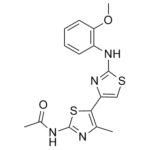
JNJ0966 is a novel, potent and highly selective allosteric inhibitor of MMP-9 (matrix metalloproteinase-9) zymogen with an IC50 of 440 nM. JNJ0966 prevented the MMP-9 zymogen from activating and producing an enzyme that was catalytically active. JNJ0966 did not suppress activation of the closely related MMP-2 zymogen and had no effect on MMP-1, MMP-2, MMP-3, MMP-9, or MMP-14 catalytic activity. The molecular mechanism of this activity was identified as JNJ0966 interacting with a structural pocket, separate from the catalytic domain, close to the MMP-9 zymogen cleavage site near Arg-106. JNJ0966 effectively decreased the severity of the disease in an experimental autoimmune encephalomyelitis mouse model, indicating the feasibility of this treatment strategy.
Physicochemical Properties
| Molecular Formula | C16H16N4O2S2 |
| Molecular Weight | 360.4538 |
| Exact Mass | 360.07 |
| Elemental Analysis | C, 53.32; H, 4.47; N, 15.54; O, 8.88; S, 17.79 |
| CAS # | 315705-75-0 |
| Related CAS # | 315705-75-0 |
| PubChem CID | 1117189 |
| Appearance | Light brown to brown solid powder |
| LogP | 3.4 |
| Hydrogen Bond Donor Count | 2 |
| Hydrogen Bond Acceptor Count | 7 |
| Rotatable Bond Count | 5 |
| Heavy Atom Count | 24 |
| Complexity | 442 |
| Defined Atom Stereocenter Count | 0 |
| InChi Key | ZADCDCMLLGDCRM-UHFFFAOYSA-N |
| InChi Code | InChI=1S/C16H16N4O2S2/c1-9-14(24-16(17-9)18-10(2)21)12-8-23-15(20-12)19-11-6-4-5-7-13(11)22-3/h4-8H,1-3H3,(H,19,20)(H,17,18,21) |
| Chemical Name | N-[5-[2-(2-methoxyanilino)-1,3-thiazol-4-yl]-4-methyl-1,3-thiazol-2-yl]acetamide |
| Synonyms | JNJ-0966; JNJ 0966; JNJ0966 |
| HS Tariff Code | 2934.99.9001 |
| Storage |
Powder-20°C 3 years 4°C 2 years In solvent -80°C 6 months -20°C 1 month |
| Shipping Condition | Room temperature (This product is stable at ambient temperature for a few days during ordinary shipping and time spent in Customs) |
Biological Activity
| Targets |
MMP-9 (IC50 = 440 nM) Matrix Metalloproteinase-9 (MMP-9) (IC50 = 0.8 μM for zymogen activation inhibition; no effect on mature MMP-9 activity) [1] - MMP-1, MMP-2, MMP-3, MMP-7, MMP-8, MMP-10, MMP-12, MMP-13 (IC50 > 100 μM, no significant inhibition) [1] |
| ln Vitro |
JNJ0966 is not a direct inhibitor of MMP-9 or MMP-3 enzymatic activity, but it does prevent the conversion of proMMP-9 to active MMP-9. JNJ0966 prevents the maturation of proMMP-9[1]. Acts as a highly selective allosteric inhibitor of MMP-9, specifically blocking pro-MMP-9 activation by MMP-3, MMP-14, and other activators without affecting the catalytic activity of mature MMP-9 [1] - Inhibited pro-MMP-9 to active MMP-9 conversion in a concentration-dependent manner, with 10 μM JNJ0966 reducing activation efficiency by ~90% in cell-free assays [1] - Exhibited exceptional selectivity for MMP-9 over other MMP family members (MMP-1, 2, 3, 7, 8, 10, 12, 13), with IC50 values > 100 μM for all tested off-target MMPs [1] - Suppressed MMP-9-dependent invasion of HT1080 fibrosarcoma cells through Matrigel: 10 μM concentration reduced cell invasion by ~75% compared to vehicle control [1] - Did not affect HT1080 cell viability at concentrations up to 20 μM, indicating anti-invasive activity is independent of cytotoxicity [1] - Reduced pro-MMP-9 activation in LPS-stimulated THP-1 macrophages by ~80% at 10 μM, without altering total MMP-9 protein expression [1] |
| ln Vivo | JNJ0966 administered orally dramatically reduces the clinical disease score in the mouse EAE model[1]. |
| Enzyme Assay |
Pro-MMP-9 activation inhibition assay: Recombinant human pro-MMP-9 was incubated with recombinant MMP-3 (activator) in reaction buffer containing CaCl2 and ZnCl2. Various concentrations of JNJ0966 (0.01-20 μM) were added, and the mixture was incubated at 37°C for 2 hours. The reaction was stopped by adding SDS-PAGE sample buffer, and proteins were separated by SDS-PAGE. Pro-MMP-9 and mature MMP-9 bands were visualized by Coomassie Brilliant Blue staining, and the activation ratio was quantified by densitometry to calculate IC50 [1] - MMP family selectivity assay: Recombinant human MMP-1, 2, 3, 7, 8, 10, 12, 13 were individually incubated with their respective fluorescently labeled peptide substrates and JNJ0966 (0.1-100 μM) in assay buffer. After incubation at 37°C for 1 hour, fluorescence intensity was measured to assess enzyme activity. IC50 values were calculated for each MMP to determine selectivity [1] |
| Cell Assay |
JNJ0966 is added to the upper chamber along with 13,000 HT1080 cells per well in 10 μL of serum-free medium. After adding 6% fetal bovine serum and JNJ0966 to serum-free medium, the bottom feeder tray is incubated for 24 hours at 37°C with 5% CO₂. To identify the cells that have moved to the bottom layer, calcein AM is added to the feeder layer. The fluorescence intensity of these cells is then measured. It computes the IC₅₀ values and mean percentage inhibition of invasion. On an inverted microscope, digital cameras are used to capture images of migrated cells[1]. HT1080 cell invasion assay: Transwell inserts were coated with Matrigel and rehydrated. HT1080 cells were pre-treated with JNJ0966 (0.1-10 μM) for 1 hour, then seeded into the upper chamber. The lower chamber was filled with serum-containing medium as a chemoattractant. After 24 hours of incubation at 37°C, non-invading cells on the upper surface were removed, and invading cells on the lower surface were fixed, stained with crystal violet, and counted under a microscope. Inhibition rate was calculated relative to vehicle control [1] - THP-1 macrophage pro-MMP-9 activation assay: THP-1 cells were differentiated into macrophages with PMA, then stimulated with LPS (1 μg/mL) in the presence or absence of JNJ0966 (0.1-10 μM). After 24 hours, cell culture supernatants were collected, and pro-MMP-9 and mature MMP-9 levels were detected by western blot. Total MMP-9 protein expression was quantified by ELISA to confirm no effect on synthesis [1] |
| Animal Protocol | Female C57Bl/6 mice, aged 6 to 8 weeks, are used in encephalomyelitis (EAE) experiments. Mice are sorted into several groups at random. Animals treated with vehicles are given oral gavage containing 20% hydroxypropyl-β-cyclodextrin. Animals are given 10 or 30 mg of JNJ0966 per kg of body weight (mg/kg) via oral gavage after the drug is dissolved in 20% hydroxypropyl-β-cyclodextrin. Up until day 17 of the trial, all groups get two daily doses. At that time, the animals are sacrificed, and brain tissue and plasma are taken in order to use mass spectroscopy to determine the levels of JNJ0966 in the brain[1]. |
| References |
[1]. Discovery of a highly selective chemical inhibitor of matrix metalloproteinase-9 (MMP-9) thatallosterically inhibits zymogen activation. J Biol Chem. 2017 Oct 27;292(43):17963-17974. [2]. Pharmacokinetics, Safety, and Tolerability of the Novel Chymase Inhibitor BAY 1142524 in Healthy Male Volunteers. Clin Pharmacol Drug Dev. 2018 Jun 7. |
| Additional Infomation |
JNJ0966 is a novel, highly selective allosteric inhibitor of matrix metalloproteinase-9 (MMP-9), specifically targeting the zymogen activation process rather than the catalytic domain of mature MMP-9 [1] - Its mechanism of action involves binding to the prodomain of pro-MMP-9, stabilizing the zymogen conformation and preventing cleavage by activating proteases (e.g., MMP-3, MMP-14), thereby blocking the generation of active MMP-9 [1] - MMP-9 is implicated in various pathological processes including tumor metastasis, inflammation, and tissue remodeling; JNJ0966 represents a potential therapeutic agent for MMP-9-mediated diseases due to its high selectivity and lack of off-target MMP inhibition [1] - Unlike broad-spectrum MMP inhibitors, JNJ0966 avoids inhibiting other MMP family members, which may reduce the risk of adverse effects associated with non-selective MMP inhibition (e.g., musculoskeletal toxicity) [1] |
Solubility Data
| Solubility (In Vitro) | DMSO: 72~100 mg/mL (199.8~277.4 mM) |
| Solubility (In Vivo) |
Solubility in Formulation 1: 2.5 mg/mL (6.94 mM) in 10% DMSO + 90% (20% SBE-β-CD in Saline) (add these co-solvents sequentially from left to right, and one by one), suspension solution; with sonication. For example, if 1 mL of working solution is to be prepared, you can add 100 μL of 25.0 mg/mL clear DMSO stock solution to 900 μL of 20% SBE-β-CD physiological saline solution and mix evenly. Preparation of 20% SBE-β-CD in Saline (4°C,1 week): Dissolve 2 g SBE-β-CD in 10 mL saline to obtain a clear solution. Solubility in Formulation 2: ≥ 2.5 mg/mL (6.94 mM) (saturation unknown) in 10% DMSO + 90% Corn Oil (add these co-solvents sequentially from left to right, and one by one), clear solution. For example, if 1 mL of working solution is to be prepared, you can add 100 μL of 25.0 mg/mL clear DMSO stock solution to 900 μL of corn oil and mix evenly. (Please use freshly prepared in vivo formulations for optimal results.) |
| Preparing Stock Solutions | 1 mg | 5 mg | 10 mg | |
| 1 mM | 2.7743 mL | 13.8715 mL | 27.7431 mL | |
| 5 mM | 0.5549 mL | 2.7743 mL | 5.5486 mL | |
| 10 mM | 0.2774 mL | 1.3872 mL | 2.7743 mL |