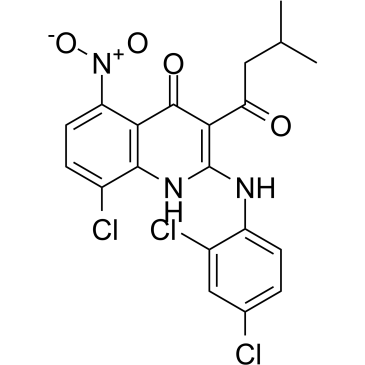
JH-RE-06 is a novel and potent REV1-REV7 interface inhibitor with the potential to be used as a chemotherapy adjuvant. It inhibits REV1-REV7 with IC50 of 0.78 μM and Kd of0.42 μM.
Physicochemical Properties
| Molecular Formula | C20H16CL3N3O4 |
| Molecular Weight | 468.7177 |
| Exact Mass | 467.02 |
| CAS # | 1361227-90-8 |
| PubChem CID | 70691604 |
| Appearance | White to yellow solid powder |
| LogP | 6.7 |
| Hydrogen Bond Donor Count | 2 |
| Hydrogen Bond Acceptor Count | 6 |
| Rotatable Bond Count | 5 |
| Heavy Atom Count | 30 |
| Complexity | 739 |
| Defined Atom Stereocenter Count | 0 |
| SMILES | ClC1C=CC(=C2C(C(=C(NC3C=CC(=CC=3Cl)Cl)NC2=1)C(CC(C)C)=O)=O)[N+](=O)[O-] |
| InChi Key | LRTXIQCBQIKIOH-UHFFFAOYSA-N |
| InChi Code | InChI=1S/C20H16Cl3N3O4/c1-9(2)7-15(27)17-19(28)16-14(26(29)30)6-4-11(22)18(16)25-20(17)24-13-5-3-10(21)8-12(13)23/h3-6,8-9H,7H2,1-2H3,(H2,24,25,28) |
| Chemical Name | 8-chloro-2-(2,4-dichloroanilino)-3-(3-methylbutanoyl)-5-nitro-1H-quinolin-4-one |
| HS Tariff Code | 2934.99.9001 |
| Storage |
Powder-20°C 3 years 4°C 2 years In solvent -80°C 6 months -20°C 1 month |
| Shipping Condition | Room temperature (This product is stable at ambient temperature for a few days during ordinary shipping and time spent in Customs) |
Biological Activity
| Targets | JH-RE-06 targets the REV7-binding surface on the C-terminal domain (CTD) of the REV1 protein, thereby disrupting the REV1-REV7 protein-protein interaction which is critical for the recruitment of mutagenic polymerase Pol ζ during transfusion synthesis (TLS). The compound binds to and induces dimerization of the REV1 CTD, effectively blocking its interaction with REV7 [1]. |
| ln Vitro |
Unexpectedly, JH-RE-06 dimerizes the REV1 CTD on its surface where REV7 binds, preventing REV1 from interacting with REV7 [1]. - JH-RE-06 inhibited the REV1 CTD-REV7 interaction in an AlphaScreen assay with an IC50 of 0.78 ± 0.16 µM. Isothermal titration calorimetry (ITC) confirmed binding with a dissociation constant (Kd) of 0.42 µM and a protein-to-inhibitor stoichiometry of approximately 2:1, consistent with induced dimerization [1]. - In cell viability assays, JH-RE-06 (1.5 µM) significantly enhanced the cytotoxicity of cisplatin (0.5 µM) in various human and mouse cancer cell lines (HT1080 fibrosarcoma, A375 melanoma, KP lung adenocarcinoma, LNCaP prostate adenocarcinoma), as measured by reduced colony formation. This sensitization effect was not observed in non-cancerous human primary fibroblasts (AG01522) [1]. - JH-RE-06 (1.5 µM) also sensitized KP cells to other DNA-damaging agents including benzo[a]pyrene diol epoxide (BPDE), 4-nitroquinolone 1-oxide (4-NQO), and methyl methanesulfonate (MMS) [1]. - JH-RE-06 (1.5 µM) significantly suppressed both spontaneous and cisplatin-induced mutagenesis, as measured by a reduction in HPRT mutation frequency in HT1080 cells [1]. - Using a quantitative gapped plasmid assay containing a site-specific cisplatin-1,2-GG adduct, JH-RE-06 (1.5, 3.0, and 15.0 µM) was shown to significantly inhibit transfusion synthesis (TLS) across the lesion in HT1080 cells [1]. - Genetic dependency was confirmed: JH-RE-06-mediated sensitization to cisplatin and reduction of HPRT mutations were observed in wild-type (Rev1+/+) mouse embryonic fibroblasts (MEFs) but not in Rev1 knockout (Rev1−/−) MEFs. Complementation of Rev1−/− cells with plasmid-encoded REV1 restored sensitization. Similarly, siRNA knockdown of REV1 in HT1080 and A375 cells abolished the sensitizing effect of JH-RE-06 [1]. |
| ln Vivo |
In cultured human and mouse cell lines, JH-RE-06 increases cisplatin-induced toxicity and suppresses mutagenic TLS [1]. Human melanoma xenografts in mice are inhibited from growing when JH-RE-06 and cisplatin are delivered together [1]. - In a murine xenograft model of human melanoma (A375 cells), co-administration of JH-RE-06 (1.6 mg/kg) with cisplatin (1 mg/kg) via intratumoral injection twice weekly for 5 weeks resulted in virtually complete inhibition of tumor growth, significantly superior to treatment with saline, JH-RE-06 alone, or cisplatin alone [1]. - Mice receiving the combination treatment of JH-RE-06 and cisplatin survived longer than mice in all other treatment groups [1]. |
| Enzyme Assay |
- An ELISA assay was developed to screen for inhibitors of the REV1-REV7 interaction. Purified His8-tagged REV7 (co-expressed with a REV3L peptide, termed His8-REV7/3) was immobilized on Ni2+-NTA coated plates. FLAG-tagged chimeric REV1 CTD protein (fused to a POL κ peptide for stability) was pre-incubated with test compounds and then added to the wells. Binding was detected using an HRP-conjugated anti-FLAG antibody. This assay was used to screen approximately 10,000 compounds, leading to the identification of JH-RE-06 as a hit that potently inhibited the interaction at 10 µM [1]. - The dose-dependent inhibition of the REV1 CTD-REV7 interaction by JH-RE-06 was quantitatively assessed using an AlphaScreen assay. FLAG-tagged REV1 CTD (1 nM) was incubated with serially diluted JH-RE-06, followed by addition of anti-FLAG donor beads. His8-REV7/3 (10 nM) was then added, followed by anti-His acceptor beads. Chemiluminescent signal was measured, and an IC50 was calculated [1]. - Binding affinity and stoichiometry were determined by isothermal titration calorimetry (ITC). A solution of the chimeric REV1 CTD protein (300 µM) was titrated into a cell containing JH-RE-06 (15 µM) in a buffer containing HEPES, KCl, TCEP, DMSO, and MPD at 25°C. The data were analyzed to obtain the Kd and binding stoichiometry [1]. |
| Cell Assay |
- Clonogenic Survival Assay: Cells (e.g., 300 HT1080 cells per well) were plated and allowed to adhere for 24 hours. Cisplatin was added for 24 hours. The media was then replaced, and JH-RE-06 (1.5 µM) was added to the appropriate wells for another 24 hours. After treatment, cells were washed, allowed to grow in fresh media for 7 days to form colonies, which were then fixed, stained with Coomassie blue, and counted. Colonies with at least 40 cells were counted, and survival was normalized to control [1]. - Cell Viability Assay (CellTiter-Glo): Cells (e.g., 10,000 per well in 96-well plates) were treated with JH-RE-06 alone or in combination with DNA-damaging agents for 24 hours. CellTiter-Glo reagent was added to measure ATP levels as an indicator of metabolically active cells. Luminescence was measured and normalized to control-treated cells [1]. - HPRT Mutagenesis Assay: Cells were first grown in HAT selection media for 14 days to eliminate pre-existing HPRT mutants. They were then treated with cisplatin (0.5 µM) for 24 hours, followed by JH-RE-06 (1.5 µM) for 24 hours. After a phenotypic expression period of 8 days in regular media, cells were plated in media containing the toxic guanine analog 6-thioguanine (6-TG). HPRT-deficient mutant colonies that survived in 6-TG were counted after 14-20 days. Mutation frequency was calculated as the ratio of mutants in 6-TG media to the clonal efficiency determined from parallel platings in non-selective media [1]. - Gapped Plasmid TLS Assay: A plasmid containing a site-specific cisplatin-1,2-GG adduct opposite a single-stranded gap was constructed. HT1080 cells pre-treated with JH-RE-06 or DMSO were transfected with this lesion-containing plasmid along with a longer competitor plasmid as an internal control. After 4 hours, plasmid DNA was recovered from cells, transformed into recA- E. coli, and re-isolated. The region spanning the lesion was amplified by PCR, digested with restriction enzymes to yield unique fragments for the lesion and competitor plasmids, and quantified using HPLC coupled with mass spectrometry to determine the efficiency of TLS-mediated gap filling [1]. - siRNA Knockdown and Complementation: For REV1 knockdown, cells were transfected with REV1-targeting siRNA using a nucleofection device and buffer system. For complementation, Rev1−/− MEFs were nucleofected with a plasmid encoding full-length mouse REV1. Cell survival or mutagenesis assays were then performed to assess the dependency on REV1 for JH-RE-06 activity [1]. |
| Animal Protocol | - Murine Xenograft Tumor Model: Human A375 melanoma cells were mixed with matrigel and injected subcutaneously into both flanks of immunodeficient nude mice. When tumors reached approximately 100 mm³ in volume, mice were randomized into treatment groups (saline, JH-RE-06 alone, cisplatin alone, combination). The drug formulation consisted of JH-RE-06 and/or cisplatin dissolved in a vehicle of 10% ethanol, 40% PEG400, and 50% saline. JH-RE-06 was administered at a dose of 1.6 mg/kg and cisplatin at 1.0 mg/kg per injection. Treatments (100 µL volume) were administered via direct intratumoral injection twice per week for 5 weeks. Tumor dimensions were measured with calipers, and volume was calculated as (width² × length)/2. Mouse survival was also monitored [1]. |
| References |
[1]. A Small Molecule Targeting Mutagenic Translesion Synthesis Improves Chemotherapy. Cell. 2019 Jun 27;178(1):152-159.e11. [2]. REV1-POLς Inhibition Enhances Cisplatin-Induced Cytotoxicity. Cancer Discov. 2019 Aug;9(8):OF17. |
| Additional Infomation |
- Background & Mechanism: JH-RE-06 is a 1,4-dihydroquinolin-4-one derivative discovered as a specific inhibitor of mutagenic transfusion synthesis (TLS). It targets a shallow, dynamic surface on the REV1 CTD that normally interacts with the REV7 subunit of Pol ζ. Binding of JH-RE-06 induces an asymmetric dimerization of the REV1 CTD, creating a deep cavity that encapsulates the compound and simultaneously occludes the REV7-binding interface. This unique mechanism blocks the recruitment of the mutagenic Pol ζ complex to sites of DNA damage [1]. - Therapeutic Potential: By inhibiting REV1/Pol ζ-dependent mutagenic TLS, JH-RE-06 sensitizes cancer cells to DNA-damaging chemotherapeutics like cisplatin and suppresses therapy-induced mutagenesis. It represents a novel class of potential chemotherapy adjuvants aimed at overcoming intrinsic/acquired chemoresistance and reducing the risk of secondary malignancies [1]. - Specificity: An analog, JH-RE-25, where a key dichloroaniline group was replaced with a hydrophilic morpholine, was inactive in binding and cellular assays, underscoring the specificity of the interactions required for JH-RE-06 activity [1]. |
Solubility Data
| Solubility (In Vitro) | DMSO : ~5 mg/mL (~10.67 mM) |
| Solubility (In Vivo) |
Note: Listed below are some common formulations that may be used to formulate products with low water solubility (e.g. < 1 mg/mL), you may test these formulations using a minute amount of products to avoid loss of samples. Injection Formulations (e.g. IP/IV/IM/SC) Injection Formulation 1: DMSO : Tween 80: Saline = 10 : 5 : 85 (i.e. 100 μL DMSO stock solution → 50 μL Tween 80 → 850 μL Saline) *Preparation of saline: Dissolve 0.9 g of sodium chloride in 100 mL ddH ₂ O to obtain a clear solution. Injection Formulation 2: DMSO : PEG300 :Tween 80 : Saline = 10 : 40 : 5 : 45 (i.e. 100 μL DMSO → 400 μLPEG300 → 50 μL Tween 80 → 450 μL Saline) Injection Formulation 3: DMSO : Corn oil = 10 : 90 (i.e. 100 μL DMSO → 900 μL Corn oil) Example: Take the Injection Formulation 3 (DMSO : Corn oil = 10 : 90) as an example, if 1 mL of 2.5 mg/mL working solution is to be prepared, you can take 100 μL 25 mg/mL DMSO stock solution and add to 900 μL corn oil, mix well to obtain a clear or suspension solution (2.5 mg/mL, ready for use in animals). Injection Formulation 4: DMSO : 20% SBE-β-CD in saline = 10 : 90 [i.e. 100 μL DMSO → 900 μL (20% SBE-β-CD in saline)] *Preparation of 20% SBE-β-CD in Saline (4°C,1 week): Dissolve 2 g SBE-β-CD in 10 mL saline to obtain a clear solution. Injection Formulation 5: 2-Hydroxypropyl-β-cyclodextrin : Saline = 50 : 50 (i.e. 500 μL 2-Hydroxypropyl-β-cyclodextrin → 500 μL Saline) Injection Formulation 6: DMSO : PEG300 : castor oil : Saline = 5 : 10 : 20 : 65 (i.e. 50 μL DMSO → 100 μLPEG300 → 200 μL castor oil → 650 μL Saline) Injection Formulation 7: Ethanol : Cremophor : Saline = 10: 10 : 80 (i.e. 100 μL Ethanol → 100 μL Cremophor → 800 μL Saline) Injection Formulation 8: Dissolve in Cremophor/Ethanol (50 : 50), then diluted by Saline Injection Formulation 9: EtOH : Corn oil = 10 : 90 (i.e. 100 μL EtOH → 900 μL Corn oil) Injection Formulation 10: EtOH : PEG300:Tween 80 : Saline = 10 : 40 : 5 : 45 (i.e. 100 μL EtOH → 400 μLPEG300 → 50 μL Tween 80 → 450 μL Saline) Oral Formulations Oral Formulation 1: Suspend in 0.5% CMC Na (carboxymethylcellulose sodium) Oral Formulation 2: Suspend in 0.5% Carboxymethyl cellulose Example: Take the Oral Formulation 1 (Suspend in 0.5% CMC Na) as an example, if 100 mL of 2.5 mg/mL working solution is to be prepared, you can first prepare 0.5% CMC Na solution by measuring 0.5 g CMC Na and dissolve it in 100 mL ddH2O to obtain a clear solution; then add 250 mg of the product to 100 mL 0.5% CMC Na solution, to make the suspension solution (2.5 mg/mL, ready for use in animals). Oral Formulation 3: Dissolved in PEG400 Oral Formulation 4: Suspend in 0.2% Carboxymethyl cellulose Oral Formulation 5: Dissolve in 0.25% Tween 80 and 0.5% Carboxymethyl cellulose Oral Formulation 6: Mixing with food powders Note: Please be aware that the above formulations are for reference only. InvivoChem strongly recommends customers to read literature methods/protocols carefully before determining which formulation you should use for in vivo studies, as different compounds have different solubility properties and have to be formulated differently. (Please use freshly prepared in vivo formulations for optimal results.) |
| Preparing Stock Solutions | 1 mg | 5 mg | 10 mg | |
| 1 mM | 2.1335 mL | 10.6673 mL | 21.3347 mL | |
| 5 mM | 0.4267 mL | 2.1335 mL | 4.2669 mL | |
| 10 mM | 0.2133 mL | 1.0667 mL | 2.1335 mL |