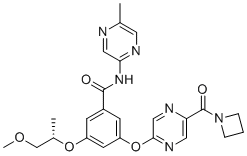
AZD-1656 (AZD 1656; AZD1656) is a novel and potent glucokinase (GK) activator with the potential for the treatment of T2DM (type 2 diabetes) and obesity.
Physicochemical Properties
| Exact Mass | 478.196 |
| CAS # | 919783-22-5 |
| PubChem CID | 16039797 |
| Appearance | White to off-white solid powder |
| Density | 1.3±0.1 g/cm3 |
| Boiling Point | 635.0±55.0 °C at 760 mmHg |
| Flash Point | 337.8±31.5 °C |
| Vapour Pressure | 0.0±1.9 mmHg at 25°C |
| Index of Refraction | 1.631 |
| LogP | -0.21 |
| Hydrogen Bond Donor Count | 1 |
| Hydrogen Bond Acceptor Count | 9 |
| Rotatable Bond Count | 9 |
| Heavy Atom Count | 35 |
| Complexity | 710 |
| Defined Atom Stereocenter Count | 1 |
| SMILES | O=C(C1C=NC(=CN=1)OC1=CC(C(NC2C=NC(C)=CN=2)=O)=CC(=C1)O[C@@H](C)COC)N1CCC1 |
| InChi Key | FJEJHJINOKKDCW-INIZCTEOSA-N |
| InChi Code | InChI=1S/C24H26N6O5/c1-15-10-27-21(12-25-15)29-23(31)17-7-18(34-16(2)14-33-3)9-19(8-17)35-22-13-26-20(11-28-22)24(32)30-5-4-6-30/h7-13,16H,4-6,14H2,1-3H3,(H,27,29,31)/t16-/m0/s1 |
| Chemical Name | 3-[5-(azetidine-1-carbonyl)pyrazin-2-yl]oxy-5-[(2S)-1-methoxypropan-2-yl]oxy-N-(5-methylpyrazin-2-yl)benzamide |
| Synonyms | AZD-1656 AZD 1656 AZD1656 |
| HS Tariff Code | 2934.99.9001 |
| Storage |
Powder-20°C 3 years 4°C 2 years In solvent -80°C 6 months -20°C 1 month |
| Shipping Condition | Room temperature (This product is stable at ambient temperature for a few days during ordinary shipping and time spent in Customs) |
Biological Activity
| ln Vivo | C57BL/6 mice treated with AZD1656 (0–9 mg/kg; oral gavage; daily; for 8 weeks) had lower blood glucose and glucose excursions and higher insulin levels. Numerous ChREBP target genes, such as G6pc, Pklr, Acly, Acac, and Gpd2, as well as carbohydrate response element binding protein beta isoform (ChREBP-β), can have their liver mRNA levels increased by AZD1656 [1]. |
| Animal Protocol |
Animal/Disease Models: C57BL/6 mice[1] Doses: 0 mg/kg, 2 mg/kg, 4.5 mg/kg, 9 mg/kg Route of Administration: po (oral gavage); daily; 8 consecutive weeks Experimental Results: Oral glucose Take it 2 hrs (hrs (hours)) before a tolerance test to reduce blood sugar and glucose excursions and increase insulin levels. |
| References |
[1]. Chronic glucokinase activator treatment activates liver Carbohydrate response element binding protein and improves hepatocyte ATP homeostasis during substrate challenge. Diabetes Obes Metab. 2020 Jun 10. [2]. Design and Development of the Glucokinase Activator AZD1656. Complete Accounts of Integrated Drug Discovery and Development: Recent Examples from the Pharmaceutical Industry Volume 1, 185-220. [3]. The novel use of a heterozygous knockout mouse for embryofetal development assessment of a glucokinase activator. Birth Defects Res B Dev Reprod Toxicol. 2014 Apr;101(2):152-61. |
| Additional Infomation | AZD-1656 is under investigation in clinical trial NCT00747175 (A Study to Evaluate Safety, Tolerability and P-Glucose After Multiple Ascending Oral Doses of AZD1656 in Type 2 Diabetes). |
Solubility Data
| Solubility (In Vitro) | DMSO : ~250 mg/mL (~522.47 mM) |
| Solubility (In Vivo) |
Solubility in Formulation 1: ≥ 2.08 mg/mL (4.35 mM) (saturation unknown) in 10% DMSO + 40% PEG300 + 5% Tween80 + 45% Saline (add these co-solvents sequentially from left to right, and one by one), clear solution. For example, if 1 mL of working solution is to be prepared, you can add 100 μL of 20.8 mg/mL clear DMSO stock solution to 400 μL PEG300 and mix evenly; then add 50 μL Tween-80 to the above solution and mix evenly; then add 450 μL normal saline to adjust the volume to 1 mL. Preparation of saline: Dissolve 0.9 g of sodium chloride in 100 mL ddH₂ O to obtain a clear solution. Solubility in Formulation 2: ≥ 2.08 mg/mL (4.35 mM) (saturation unknown) in 10% DMSO + 90% (20% SBE-β-CD in Saline) (add these co-solvents sequentially from left to right, and one by one), clear solution. For example, if 1 mL of working solution is to be prepared, you can add 100 μL of 20.8 mg/mL clear DMSO stock solution to 900 μL of 20% SBE-β-CD physiological saline solution and mix evenly. Preparation of 20% SBE-β-CD in Saline (4°C,1 week): Dissolve 2 g SBE-β-CD in 10 mL saline to obtain a clear solution. Solubility in Formulation 3: ≥ 2.08 mg/mL (4.35 mM) (saturation unknown) in 10% DMSO + 90% Corn Oil (add these co-solvents sequentially from left to right, and one by one), clear solution. For example, if 1 mL of working solution is to be prepared, you can add 100 μL of 20.8 mg/mL clear DMSO stock solution to 900 μL of corn oil and mix evenly. (Please use freshly prepared in vivo formulations for optimal results.) |