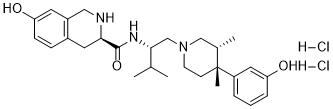
JDTic dihydrochloride is a novel and highly selective antagonist for the κ-opioid receptor with no effects on the μ- or δ-opioid receptors, blocking the κ-agonist U50, 488-induced antinociception.. It prevents stress-induced reinstatement of cocaine-maintained responding and has antidepressant-like effects.
Physicochemical Properties
| Molecular Formula | C28H41CL2N3O3 |
| Molecular Weight | 538.554 |
| Exact Mass | 537.252 |
| Elemental Analysis | C, 62.45; H, 7.67; Cl, 13.16; N, 7.80; O, 8.91 |
| CAS # | 785835-79-2 |
| Related CAS # | JDTic;361444-66-8 |
| PubChem CID | 66576991 |
| Appearance | White to off-white solid powder |
| LogP | 6.263 |
| Hydrogen Bond Donor Count | 6 |
| Hydrogen Bond Acceptor Count | 5 |
| Rotatable Bond Count | 6 |
| Heavy Atom Count | 36 |
| Complexity | 688 |
| Defined Atom Stereocenter Count | 4 |
| SMILES | C[C@H]1CN(CC[C@@]1(C)C2=CC(=CC=C2)O)C[C@H](C(C)C)NC(=O)[C@H]3CC4=C(CN3)C=C(C=C4)O.Cl.Cl |
| InChi Key | QJNHURYCTCUGHH-AVWZHOAASA-N |
| InChi Code | QJNHURYCTCUGHH-AVWZHOAASA-N |
| Chemical Name | JDTic dihydrochloride. InChi Key |
| Synonyms | JDTic dihydrochloride; 785835-79-2; JDTic (dihydrochloride); Jdtic hydrochloride; VR27M77CW3; JDTic 2HCl; (3R)-7-Hydroxy-N-[(2S)-1-[(3R,4R)-4-(3-hydroxyphenyl)-3,4-dimethylpiperidin-1-yl]-3-methylbutan-2-yl]-1,2,3,4-tetrahydroisoquinoline-3-carboxamide dihydrochloride; 785835-79-2 (HCl); |
| HS Tariff Code | 2934.99.9001 |
| Storage |
Powder-20°C 3 years 4°C 2 years In solvent -80°C 6 months -20°C 1 month Note: Please store this product in a sealed and protected environment, avoid exposure to moisture. |
| Shipping Condition | Room temperature (This product is stable at ambient temperature for a few days during ordinary shipping and time spent in Customs) |
Biological Activity
| Targets | κ-opioid receptor |
| ln Vitro | Opioid receptors mediate the actions of endogenous and exogenous opioids on many physiological processes, including the regulation of pain, respiratory drive, mood, and--in the case of κ-opioid receptor (κ-OR)--dysphoria and psychotomimesis. Here we report the crystal structure of the human κ-OR in complex with the selective antagonist JDTic, arranged in parallel dimers, at 2.9 Å resolution. The structure reveals important features of the ligand-binding pocket that contribute to the high affinity and subtype selectivity of JDTic for the human κ-OR. Modelling of other important κ-OR-selective ligands, including the morphinan-derived antagonists norbinaltorphimine and 5'-guanidinonaltrindole, and the diterpene agonist salvinorin A analogue RB-64, reveals both common and distinct features for binding these diverse chemotypes. Analysis of site-directed mutagenesis and ligand structure-activity relationships confirms the interactions observed in the crystal structure, thereby providing a molecular explanation for κ-OR subtype selectivity, and essential insights for the design of compounds with new pharmacological properties targeting the human κ-OR.[5] |
| ln Vivo |
JDTic dihydrochloride (2.5-16 mg/kg, sc) inhibits the analgesic response to nicotine in a dance manner in the tail flick test but not in the hot plate test or sleep assessment in nicotine-injected mice when tested at any dose JDTic diHClide (3 mg/kg, ip) reverses anxiety-like behavior in a model of the hangover anxiety state. JDTic diHClide (10 mg/kg, intraperitoneal injection) lowers alcohol self-anesthesia and has no effect on preventing cue induction [1]. The effects of alcohol-seeking KOR agonists resume and stop at a swing boiling time point within 2 hours [2]. JDTic dihydrochloride (30 mg/kg, ig) greatly exerts the diuretic action of U50,488 conduction in boiling [3]. JDTic dose-dependently blocked acute nicotine-induced antinociception in the tail-flick but not the hot-plate test and did not significantly attenuate morphine's antinociceptive effect in either the tail-flick or hot-plate test. Furthermore, JDTic (8 and 16 mg/kg, s.c.) failed to block the expression of nicotine reward as measured by the conditioned place preference model. In contrast, JDTic and the KOR antagonist norBNI attenuated the expression of both the physical (somatic signs and hyperalgesia) and affective (anxiety-related behavior and conditioned place aversion) nicotine withdrawal signs. Conclusions: Our findings clearly show that the KOR is involved in mediating the withdrawal aspects of nicotine dependence. The results from this study suggest that blockade of the KOR by selective KOR antagonists may be useful smoking cessation pharmacotherapies.[2] The current study assessed the effects of the selective kappa opioid antagonist JDTic on alcohol (EtOH)-seeking behavior, EtOH relapse, and maintenance responding for EtOH. Adult alcohol-preferring (P) rats were trained in 2-lever operant chambers to self-administer 15% EtOH (v/v) on a fixed-ratio 5 (FR-5) and water on a FR-1 schedule of reinforcement during 1-hr sessions. After 10 weeks, rats underwent extinction training for seven sessions. Rats were then maintained in their home cages for 3 weeks without EtOH access. All rats received an injection (s.c.) of 0, 1, 3, or 10 mg/kg JDTic (n=11-14/group) after the first week of the home cage period. Rats were then tested using the Pavlovian Spontaneous Recovery paradigm (PSR; an animal model of alcohol-seeking) for four sessions during which, responses on the EtOH and water levers were recorded but did not produce their respective reinforcer. Following PSR testing rats were returned to their home cages without access to EtOH for one week prior to the start of EtOH relapse testing. To examine EtOH relapse responding, rats were returned to the operant chambers and the EtOH (FR5) and water (FR1) levers were active. Finally, rats were then tested over 17 operant sessions to assess the effects of JDTic on maintenance responding for EtOH. Rats received 0, 1, 3, or 10 mg/kg JDTic (counterbalanced from the initial experiment) 30 minutes prior to the initial maintenance session. JDTic administered 14 and 25 days prior to testing dose-dependently reduced the expression of an EtOH PSR and relapse responding. In contrast, JDTic did not alter EtOH responding under maintenance conditions. Overall, the results of this study indicate that different mechanisms mediate EtOH self-administration under relapse and maintenance conditions and kappa opioid receptors are involved in mediating EtOH-seeking behavior and relapse responding but not on-going EtOH self-administration.[4] |
| Animal Protocol | The objective of this study is to determine the involvement of the KOR in the initial behavioral responses of nicotine, nicotine reward, and nicotine withdrawal using the highly selective KOR antagonist JDTic. JDTic doses of 1, 4, 8, or 16 mg/kg were administered subcutaneously (s.c.) 18 h prior to nicotine treatment.[2] |
| References |
[1]. Importance of Phenolic Address Groups in Opioid Kappa Receptor Selective Antagonists. Journal of Medicinal Chemistry (2004), 47(4), 1070-1073. [2]. Effect of the selective kappa-opioid receptor antagonist JDTic on nicotine antinociception, reward, and withdrawal in the mouse. Psychopharmacology (Berl). 2010 Jun;210(2):285-94. [3]. Effectiveness of analogs of the kappa opioid receptor antagonist (3R)-7-hydroxy-N-((1S)-1-{[(3R,4R)-4-(3-hydroxyphenyl)-3,4-dimethyl-1-piperidinyl]methyl}-2-methylpropyl)-1,2,3,4-tetrahydro-3-isoquinolinec.Psychopharmacology (Berl). 2010 Jun;210(2):189-98 [4]. The long-lasting effects of JDTic, a kappa opioid receptor antagonist, on the expression of ethanol-seeking behavior and the relapse drinking of female alcohol-preferring (P) rats. Pharmacol Bi. [5]. Structure of the human κ-opioid receptor in complex with JDTic. Nature. 2012 Mar 21;485(7398):327-32. |
| Additional Infomation | In vitro characterization and comparison of JDTic, its dehydroxy analogue and nor-BNI, and its dehydroxy analogue demonstrates that the N-substituted 3,4-dimethyl-(3-hydroxyphenyl)piperidine-derived antagonist, JDTic, relies more heavily on its phenol address group for affinity and antagonist activity relative to the corresponding naltrexone derived antagonists, nor-BNI. The structural flexibility of the former class of compound relative to the latter is postulated to underlie the difference.[1] |
Solubility Data
| Solubility (In Vitro) |
DMSO : ~100 mg/mL (~185.68 mM) H2O : ~50 mg/mL (~92.84 mM) |
| Solubility (In Vivo) |
Solubility in Formulation 1: 100 mg/mL (185.68 mM) in PBS (add these co-solvents sequentially from left to right, and one by one), clear solution; with sonication. (Please use freshly prepared in vivo formulations for optimal results.) |
| Preparing Stock Solutions | 1 mg | 5 mg | 10 mg | |
| 1 mM | 1.8568 mL | 9.2842 mL | 18.5684 mL | |
| 5 mM | 0.3714 mL | 1.8568 mL | 3.7137 mL | |
| 10 mM | 0.1857 mL | 0.9284 mL | 1.8568 mL |