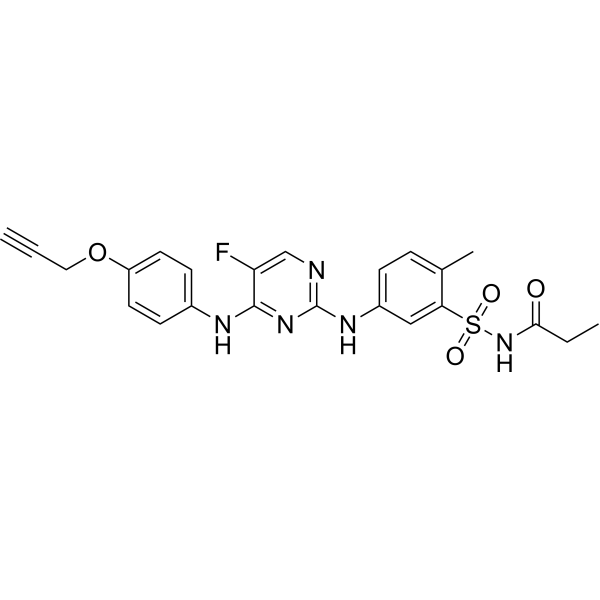
Physicochemical Properties
| Molecular Formula | C23H22FN5O4S |
| Molecular Weight | 483.515286922455 |
| Exact Mass | 483.137 |
| CAS # | 916742-11-5 |
| PubChem CID | 23648971 |
| Appearance | Off-white to light yellow solid powder |
| Density | 1.4±0.1 g/cm3 |
| Index of Refraction | 1.625 |
| LogP | 2 |
| Hydrogen Bond Donor Count | 3 |
| Hydrogen Bond Acceptor Count | 9 |
| Rotatable Bond Count | 9 |
| Heavy Atom Count | 34 |
| Complexity | 821 |
| Defined Atom Stereocenter Count | 0 |
| InChi Key | IGLNXKVGKIFNBQ-UHFFFAOYSA-N |
| InChi Code | InChI=1S/C23H22FN5O4S/c1-4-12-33-18-10-8-16(9-11-18)26-22-19(24)14-25-23(28-22)27-17-7-6-15(3)20(13-17)34(31,32)29-21(30)5-2/h1,6-11,13-14H,5,12H2,2-3H3,(H,29,30)(H2,25,26,27,28) |
| Chemical Name | N-[5-[[5-fluoro-4-(4-prop-2-ynoxyanilino)pyrimidin-2-yl]amino]-2-methylphenyl]sulfonylpropanamide |
| HS Tariff Code | 2934.99.9001 |
| Storage |
Powder-20°C 3 years 4°C 2 years In solvent -80°C 6 months -20°C 1 month Note: Please store this product in a sealed and protected environment (e.g. under nitrogen), avoid exposure to moisture. |
| Shipping Condition | Room temperature (This product is stable at ambient temperature for a few days during ordinary shipping and time spent in Customs) |
Biological Activity
| ln Vitro | The cytoplasmic protein tyrosine kinases known as JAK kinases consist of JAK1, JAK2, JAK3, and TYK2. In the end, STAT proteins attach to particular DNA sequences found in the promoters of cytokine-responsive genes and function as both transcription factors and signaling molecules. Numerous aberrant immune responses, including allergies, asthma, autoimmune diseases like transplant rejection, rheumatoid arthritis, amyotrophic lateral sclerosis, multiple sclerosis, eye disorders, and hematological and solid diseases, are mediated by JAK/STAT signaling. Malignant tumors, include lymphoma and leukemia [1]. |
| References |
[1]. 2,4 substituted pyrimidinediamines for use in discoid lupus. WO2012122452A1. |
| Additional Infomation |
Drug Indication Investigated for use/treatment in autoimmune diseases. Mechanism of Action R438 is a selective Janus tyrosine kinase 3 (JAK3) inhibitor prodrug which is converted to its active metabolite R333. JAKs are cytoplasmic tyrosine kinases that are involved in immune system activation and cytokine signaling. They achieve their effects when coupled with signal tranducers and activators of transcription (STATs). JAK3 is critical to immune system activation, and high levels of JAK3 are expressed in cells and thyocytes, and are inducible in T and B cells. JAK3 is also found in nonhematopoietic cells, but its function in these cells is currently undetermined. JAK3 inhibitors impede the development of CD8 memory cells by attenuating the interleukin 7 (IL7) and interleukin 15 (IL-15) pathways, making it a promising drug for treatment of autoimmune disorders. |
Solubility Data
| Solubility (In Vitro) | DMSO : ~125 mg/mL (~258.52 mM) |
| Solubility (In Vivo) |
Note: Listed below are some common formulations that may be used to formulate products with low water solubility (e.g. < 1 mg/mL), you may test these formulations using a minute amount of products to avoid loss of samples. Injection Formulations (e.g. IP/IV/IM/SC) Injection Formulation 1: DMSO : Tween 80: Saline = 10 : 5 : 85 (i.e. 100 μL DMSO stock solution → 50 μL Tween 80 → 850 μL Saline) *Preparation of saline: Dissolve 0.9 g of sodium chloride in 100 mL ddH ₂ O to obtain a clear solution. Injection Formulation 2: DMSO : PEG300 :Tween 80 : Saline = 10 : 40 : 5 : 45 (i.e. 100 μL DMSO → 400 μLPEG300 → 50 μL Tween 80 → 450 μL Saline) Injection Formulation 3: DMSO : Corn oil = 10 : 90 (i.e. 100 μL DMSO → 900 μL Corn oil) Example: Take the Injection Formulation 3 (DMSO : Corn oil = 10 : 90) as an example, if 1 mL of 2.5 mg/mL working solution is to be prepared, you can take 100 μL 25 mg/mL DMSO stock solution and add to 900 μL corn oil, mix well to obtain a clear or suspension solution (2.5 mg/mL, ready for use in animals). Injection Formulation 4: DMSO : 20% SBE-β-CD in saline = 10 : 90 [i.e. 100 μL DMSO → 900 μL (20% SBE-β-CD in saline)] *Preparation of 20% SBE-β-CD in Saline (4°C,1 week): Dissolve 2 g SBE-β-CD in 10 mL saline to obtain a clear solution. Injection Formulation 5: 2-Hydroxypropyl-β-cyclodextrin : Saline = 50 : 50 (i.e. 500 μL 2-Hydroxypropyl-β-cyclodextrin → 500 μL Saline) Injection Formulation 6: DMSO : PEG300 : castor oil : Saline = 5 : 10 : 20 : 65 (i.e. 50 μL DMSO → 100 μLPEG300 → 200 μL castor oil → 650 μL Saline) Injection Formulation 7: Ethanol : Cremophor : Saline = 10: 10 : 80 (i.e. 100 μL Ethanol → 100 μL Cremophor → 800 μL Saline) Injection Formulation 8: Dissolve in Cremophor/Ethanol (50 : 50), then diluted by Saline Injection Formulation 9: EtOH : Corn oil = 10 : 90 (i.e. 100 μL EtOH → 900 μL Corn oil) Injection Formulation 10: EtOH : PEG300:Tween 80 : Saline = 10 : 40 : 5 : 45 (i.e. 100 μL EtOH → 400 μLPEG300 → 50 μL Tween 80 → 450 μL Saline) Oral Formulations Oral Formulation 1: Suspend in 0.5% CMC Na (carboxymethylcellulose sodium) Oral Formulation 2: Suspend in 0.5% Carboxymethyl cellulose Example: Take the Oral Formulation 1 (Suspend in 0.5% CMC Na) as an example, if 100 mL of 2.5 mg/mL working solution is to be prepared, you can first prepare 0.5% CMC Na solution by measuring 0.5 g CMC Na and dissolve it in 100 mL ddH2O to obtain a clear solution; then add 250 mg of the product to 100 mL 0.5% CMC Na solution, to make the suspension solution (2.5 mg/mL, ready for use in animals). Oral Formulation 3: Dissolved in PEG400 Oral Formulation 4: Suspend in 0.2% Carboxymethyl cellulose Oral Formulation 5: Dissolve in 0.25% Tween 80 and 0.5% Carboxymethyl cellulose Oral Formulation 6: Mixing with food powders Note: Please be aware that the above formulations are for reference only. InvivoChem strongly recommends customers to read literature methods/protocols carefully before determining which formulation you should use for in vivo studies, as different compounds have different solubility properties and have to be formulated differently. (Please use freshly prepared in vivo formulations for optimal results.) |
| Preparing Stock Solutions | 1 mg | 5 mg | 10 mg | |
| 1 mM | 2.0682 mL | 10.3408 mL | 20.6817 mL | |
| 5 mM | 0.4136 mL | 2.0682 mL | 4.1363 mL | |
| 10 mM | 0.2068 mL | 1.0341 mL | 2.0682 mL |