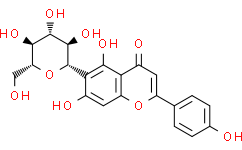
Physicochemical Properties
| Molecular Formula | C21H20O10 |
| Molecular Weight | 432.38 |
| Exact Mass | 432.105 |
| Elemental Analysis | C, 58.34; H, 4.66; O, 37.00 |
| CAS # | 38953-85-4 |
| Related CAS # | 38953-85-4 |
| PubChem CID | 162350 |
| Appearance | Light yellow to yellow solid powder |
| Density | 1.7±0.1 g/cm3 |
| Boiling Point | 807.0±65.0 °C at 760 mmHg |
| Melting Point | 220 - 221 °C |
| Flash Point | 287.1±27.8 °C |
| Vapour Pressure | 0.0±3.0 mmHg at 25°C |
| Index of Refraction | 1.743 |
| LogP | 1.28 |
| Hydrogen Bond Donor Count | 7 |
| Hydrogen Bond Acceptor Count | 10 |
| Rotatable Bond Count | 3 |
| Heavy Atom Count | 31 |
| Complexity | 690 |
| Defined Atom Stereocenter Count | 5 |
| SMILES | O1[C@]([H])(C([H])([H])O[H])[C@]([H])([C@@]([H])([C@]([H])([C@]1([H])C1C(=C([H])C2=C(C(C([H])=C(C3C([H])=C([H])C(=C([H])C=3[H])O[H])O2)=O)C=1O[H])O[H])O[H])O[H])O[H] |
| InChi Key | MYXNWGACZJSMBT-VJXVFPJBSA-N |
| InChi Code | InChI=1S/C21H20O10/c22-7-14-17(26)19(28)20(29)21(31-14)16-11(25)6-13-15(18(16)27)10(24)5-12(30-13)8-1-3-9(23)4-2-8/h1-6,14,17,19-23,25-29H,7H2/t14-,17-,19+,20-,21+/m1/s1 |
| Chemical Name | 5,7-dihydroxy-2-(4-hydroxyphenyl)-6-[(2S,3R,4R,5S,6R)-3,4,5-trihydroxy-6-(hydroxymethyl)oxan-2-yl]chromen-4-one |
| Synonyms | Saponaretin; Homovitexin; Isovitexin |
| HS Tariff Code | 2934.99.03.00 |
| Storage |
Powder-20°C 3 years 4°C 2 years In solvent -80°C 6 months -20°C 1 month |
| Shipping Condition | Room temperature (This product is stable at ambient temperature for a few days during ordinary shipping and time spent in Customs) |
Biological Activity
| Targets | JNK1; JNK2; NF-κB |
| ln Vitro | Isovitexin reduces the effect of H2O2 on cell survival and inhibits the generation of intracellular ROS to avoid LPS-induced oxidative damage. RAW 264.7 cells were not cytotoxic to isovitexin (0-100 μg/mL) or LPS (2 μg/mL), while 200 μg/mL of isovitexin demonstrated notable cytotoxicity. Isovitexin (25, 50 μg/mL) prevents the rise in TNF-α, IL-6, iNOS, and COX-2 levels brought on by LPS. IκBα phosphorylation and degradation in RAW 264.7 cells are likewise inhibited by isovitexin (25, 50 μg/mL) mL), a finding that is compatible with the function of JNK1/2 [1]. |
| ln Vivo | Lower LPS-inducing factor cell numbers and less severe histopathological alterations were observed in lung slices after isovitexin (50 and 100 mg/kg, i.p.) was administered. By decreasing the synthesis of TNF-α and IL-6, producing ROS, and raising SOD and GSH, isovitexin (50 and 100 mg/kg, ip) inhibits the LPS-induced ALI pathway. Dose-dependently, isovitexin (25, 50, 100 mg/kg) lowers mortality in liver injury caused by LPS/D-gal-activated protein. It does this by potently inhibiting iNOS and COX-2 at intermediate levels of oxidation and oxidation. Additionally, isovitexin upregulates the induction of Nrf2 and HO-1 produced by LPS/D-gal and suppresses NF-κB activation[2]. |
| Cell Assay | An MTT assay is used to evaluate cell viability. RAW 264.7 cells are plated in 96-well plates (1 × 10⁴ cells/well) and incubated for 24 hours with varying concentrations of isovitexin (final concentration: 0-200 μg/mL) and LPS (2 μg/mL). Additionally, the cells are pretreated with IV (25 or 50 μg/mL) for 1 h before 300 μM of H2O2 is added. MTT (5 mg/mL) is added to the cells after 24 hours, and they are then incubated for an additional 4 hours[1]. |
| Animal Protocol | Mice: The six groups of mice used to create the ALI model are as follows: control (saline), isovitexin only (100 mg/kg, dissolved in 0.5% DMSO), LPS only (0.5 mg/kg, dissolved in saline), LPS (0.5 mg/kg) + isovitexin (50 or 100 mg/kg), and LPS (0.5 mg/kg) + dexamethasone (Dex, 5 mg/kg dissolved in saline). Isovitexin is administered, or Dex (5 mg/kg). Diethyl ether is used to anesthetize the mice after they have been exposed to Isovitexin or Dex for 1 hour. LPS is then given intranasally (i.n.) to the mice to cause lung damage. The animals are put to death after receiving LPS for 12 hours. As a result, bronchoalveolar lavage fluid (BALF) and lung tissue samples are obtained in order to assess cytokine levels, ROS production, SOD, GSH, MDA, and MPO activity, as well as COX-2, iNOS, HO-1, and Nrf2 protein expression[1]. |
| References |
[1]. Isovitexin Exerts Anti-Inflammatory and Anti-Oxidant Activities on Lipopolysaccharide-Induced Acute Lung Injury by Inhibiting MAPK and NF-κB and Activating HO-1/Nrf2 Pathways. Int J Biol Sci. 2016 Jan 1;12(1):72-86. [2]. Isovitexin alleviates liver injury induced by lipopolysaccharide/d-galactosamine by activating Nrf2 and inhibiting NF-κB activation. Microb Pathog. 2018 Mar 29;119:86-92. |
| Additional Infomation |
Isovitexin is a C-glycosyl compound that consists of apigenin substituted by a 1,5-anhydro-D-glucitol moiety at position 6. It has a role as an EC 3.2.1.20 (alpha-glucosidase) inhibitor and a metabolite. It is a C-glycosyl compound and a trihydroxyflavone. It is functionally related to an apigenin. It is a conjugate acid of an isovitexin-7-olate. Isovitexin has been reported in Camellia sinensis, Gleditsia sinensis, and other organisms with data available. See also: Acai (part of); Fenugreek seed (part of); Crataegus monogyna flowering top (part of). |
Solubility Data
| Solubility (In Vitro) | DMSO: 25~86 mg/mL (57.82~198.9 mM) |
| Solubility (In Vivo) |
Solubility in Formulation 1: ≥ 2.08 mg/mL (4.81 mM) (saturation unknown) in 10% DMSO + 40% PEG300 + 5% Tween80 + 45% Saline (add these co-solvents sequentially from left to right, and one by one), clear solution. For example, if 1 mL of working solution is to be prepared, you can add 100 μL of 20.8 mg/mL clear DMSO stock solution to 400 μL PEG300 and mix evenly; then add 50 μL Tween-80 to the above solution and mix evenly; then add 450 μL normal saline to adjust the volume to 1 mL. Preparation of saline: Dissolve 0.9 g of sodium chloride in 100 mL ddH₂ O to obtain a clear solution. Solubility in Formulation 2: ≥ 2.08 mg/mL (4.81 mM) (saturation unknown) in 10% DMSO + 90% (20% SBE-β-CD in Saline) (add these co-solvents sequentially from left to right, and one by one), clear solution. For example, if 1 mL of working solution is to be prepared, you can add 100 μL of 20.8 mg/mL clear DMSO stock solution to 900 μL of 20% SBE-β-CD physiological saline solution and mix evenly. Preparation of 20% SBE-β-CD in Saline (4°C,1 week): Dissolve 2 g SBE-β-CD in 10 mL saline to obtain a clear solution. Solubility in Formulation 3: ≥ 2.08 mg/mL (4.81 mM) (saturation unknown) in 10% DMSO + 90% Corn Oil (add these co-solvents sequentially from left to right, and one by one), clear solution. For example, if 1 mL of working solution is to be prepared, you can add 100 μL of 20.8 mg/mL clear DMSO stock solution to 900 μL of corn oil and mix evenly. (Please use freshly prepared in vivo formulations for optimal results.) |
| Preparing Stock Solutions | 1 mg | 5 mg | 10 mg | |
| 1 mM | 2.3128 mL | 11.5639 mL | 23.1278 mL | |
| 5 mM | 0.4626 mL | 2.3128 mL | 4.6256 mL | |
| 10 mM | 0.2313 mL | 1.1564 mL | 2.3128 mL |