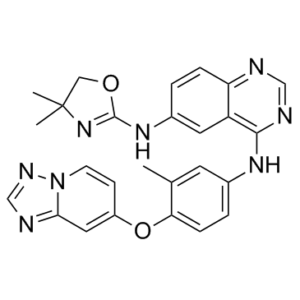
Irbinitinib (formerly known as ARRY-380; ONT-380; Tucatinib; Tukysa) is a potent and selective small molecule HER2 inhibitor that has been given the go-ahead to treat breast cancer. Its IC50 value is 8 nM, its potency against truncated p95-HER2 is equal, and its selectivity for HER2 is 500 times higher than that of EGFR. Irbinitinib works by preventing HER2 and its downstream effector, Akt, from proliferating and becoming phosphorylated. On the other hand, it only marginally suppresses phosphorylation and proliferation in EGFR overexpressing cell lines, suggesting that Irbinitinib may be able to inhibit HER2 signaling without having the deleterious effects of EGFR inhibition. It could therefore be applied as an anticancer agent.
Received its first approval on 17 April 2020 in the USA. Approved for use in combination with trastuzumab and capecitabine for advanced unresectable or metastatic HER2-positive breast cancer, including patients with brain metastases, who have received one or more prior anti-HER2-based regimens. On January 19, 2023, the Food and Drug Administration (FDA) granted accelerated approval to tucatinib (Tukysa, Seagen Inc.) in combination with trastuzumab for RAS wild-type HER2-positive unresectable or metastatic colorectal cancer that has progressed following fluoropyrimidine-, oxaliplatin-, and irinotecan-based chemotherapy.Physicochemical Properties
| Molecular Formula | C26H24N8O2 |
| Molecular Weight | 480.2022 |
| Exact Mass | 480.202 |
| Elemental Analysis | C, 64.99; H, 5.03; N, 23.32; O, 6.66 |
| CAS # | 937263-43-9 |
| Related CAS # | Tucatinib hemiethanolate;1429755-56-5 |
| PubChem CID | 51039094 |
| Appearance | White to yellow solid powder |
| Density | 1.4±0.1 g/cm3 |
| Index of Refraction | 1.729 |
| LogP | 3.62 |
| Hydrogen Bond Donor Count | 2 |
| Hydrogen Bond Acceptor Count | 8 |
| Rotatable Bond Count | 6 |
| Heavy Atom Count | 36 |
| Complexity | 796 |
| Defined Atom Stereocenter Count | 0 |
| SMILES | N1C2C(=CC(NC3OCC(C)(C)N=3)=CC=2)C(NC2C=C(C)C(OC3=CC4N(N=CN=4)C=C3)=CC=2)=NC=1 |
| InChi Key | SDEAXTCZPQIFQM-UHFFFAOYSA-N |
| InChi Code | InChI=1S/C26H24N8O2/c1-16-10-17(5-7-22(16)36-19-8-9-34-23(12-19)28-15-30-34)31-24-20-11-18(4-6-21(20)27-14-29-24)32-25-33-26(2,3)13-35-25/h4-12,14-15H,13H2,1-3H3,(H,32,33)(H,27,29,31) |
| Chemical Name | 6-N-(4,4-dimethyl-5H-1,3-oxazol-2-yl)-4-N-[3-methyl-4-([1,2,4]triazolo[1,5-a]pyridin-7-yloxy)phenyl]quinazoline-4,6-diamine |
| Synonyms | ONT 380; ARRY380; ONT380; ARRY 380; ONT-380; Irbinitinib; ARRY-380; Tukysa; Tucatinib |
| HS Tariff Code | 2934.99.9001 |
| Storage |
Powder-20°C 3 years 4°C 2 years In solvent -80°C 6 months -20°C 1 month |
| Shipping Condition | Room temperature (This product is stable at ambient temperature for a few days during ordinary shipping and time spent in Customs) |
Biological Activity
| Targets |
RETWT (IC50 = 1.29 nM); RETV804M (IC50 = 1.97 nM ); RETV804M (IC50 = 0.99 nM) HER2 (ErbB2):Irbinitinib (ARRY-380; ONT-380; Tucatinib) is a selective inhibitor of HER2 with an IC₅₀ of 8 nM for HER2 kinase activity, showing >1,000-fold selectivity over EGFR (IC₅₀ > 10,000 nM). [2][3] ONT-380 (ARRY-380) is a potent and selective oral inhibitor of HER2/ErbB2 (tyrosine kinase); it is a reversible, ATP-competitive inhibitor with nanomolar potency against ErbB2 in in vitro and cell-based assays [3] ONT-380 (ARRY-380) does not target EGFR [1] |
| ln Vitro |
- Antiproliferative activity:Irbinitinib inhibits the growth of HER2+ breast cancer cell lines (BT-474, SK-BR-3) with IC₅₀ values of 12–25 nM in MTT assays. It has minimal effect on HER2-negative cell lines (MCF-7, IC₅₀ > 1,000 nM). [2][3] - HER2 signaling inhibition:In SK-BR-3 cells, Irbinitinib (100 nM, 4 hours) reduces phosphorylation of HER2 (Tyr1248), AKT (Ser473), and ERK1/2 (Thr202/Tyr204) by 80–90% as measured by Western blot. It also downregulates cyclin D1 and upregulates cleaved caspase-3, indicating induction of apoptosis. [3] ONT-380 has nanomolar activity against purified HER2 enzyme and is approximately 500-fold selective for HER2 versus EGFR in cell-based assays. ONT-380 (ARRY-380) selectively inhibits the receptor tyrosine kinase HER2 relative to EGFR. In HER2 overexpressing cell lines, ONT-380 blocks proliferation and the phosphorylation of HER2 and its downstream effector, Akt. By contrast, in the EGFR overexpressing cell lines, it weakly inhibits phosphorylation and proliferation, demonstrating that ONT-380 may have potential to block HER2 signaling without causing the toxicities of EGFR inhibition. 1. ONT-380 (ARRY-380) exhibits nanomolar potency against ErbB2 in in vitro kinase activity assays and cell-based assays; it acts as a reversible, ATP-competitive inhibitor of ErbB2 tyrosine kinase [3] |
| ln Vivo |
In the ARRY-380-treated-group, 75% of the animals are alive on Day 43. ARRY-380 and its active metabolite causes a significant reduction in brain pErbB2 (80%). ARRY-380 demonstrates significant dose-related tumor growth inhibition (TGI; 50% at 50 mg/kg/d and 96% at 100 mg/kg/d) with numerous partial regressions (>50% reduction from baseline size) at the higher dose level in 9/12 animals. ARRY-380 (50 mg/kg/d) in combination with trastuzumab shows a 98% TGI with complete regressions in 9/12 animals and two partial regressions. At dose of 100 mg/kg/d of ARRY-380 in combination with trastuzumab, there is 100% TGI and all animals have complete responses. - Tumor growth inhibition in xenografts:In BT-474 human breast cancer xenografts in nude mice, oral Irbinitinib (50 mg/kg, twice daily) reduces tumor volume by 60–70% after 21 days. Combination with RP-56976 (a PI3K inhibitor) enhances efficacy, achieving 85% tumor growth inhibition. [3] - Clinical activity in HER2+ MBC:In a Phase 1 expansion cohort, Irbinitinib (300 mg twice daily) shows objective response rates (ORR) of 33% in patients with HER2+ metastatic breast cancer (MBC), with a median duration of response (DOR) of 7.5 months. [1] 1. ONT-380 (ARRY-380) shows excellent single-agent activity in subcutaneous (SC) mouse tumor models: in BT-474 (breast), MDA-MB-453 (breast), SK-OV-3 (ovarian), and N87 (gastric) carcinoma models, it induces dose-dependent tumor growth inhibition (TGI) [2,3] 2. In BT-474 breast cancer xenograft model (female SCID beige mice): ONT-380 (ARRY-380) at 50 mg/kg/d (PO) leads to 50% TGI; at 100 mg/kg/d (PO) leads to 96% TGI, with partial regressions (>50% reduction from baseline) in 9/12 animals and 1 complete response (CR); combination with trastuzumab (20 mg/kg, IP, Q3D/QW) enhances efficacy: 50 mg/kg/d ONT-380 (ARRY-380) + trastuzumab results in 98% TGI (9 CR, 2 partial responses (PR)); 100 mg/kg/d ONT-380 (ARRY-380) + trastuzumab results in 100% TGI (all CR); combination with docetaxel (10 mg/kg, IV, Q3D) leads to 81% TGI and 5 PR (docetaxel alone: 55% TGI, no regressions) [3] 3. In SK-OV-3 ovarian cancer xenograft model (female nude mice): ONT-380 (ARRY-380) at 50 mg/kg (BID, PO) leads to 39% TGI; at 100 mg/kg (BID, PO) leads to 96% TGI (partial regressions in all animals); combination with bevacizumab (10 mg/kg, IP, Q4D×3) leads to 80% TGI (7/8 PR, 1 stable disease (SD); bevacizumab alone: 55% TGI, no regressions) [3] 4. In intracranial ErbB2⁺ xenograft models (female nude mice): - NCI-N87 model: ONT-380 (ARRY-380) at MTD (75 mg/kg, PO, BID) starting on Day 2 post-implantation (treatment for up to 6 weeks) results in 75% survival on Day 43 (vehicle/lapatinib (50 mg/kg, PO, BID) groups: all dead by Day 22); it reduces brain pErbB2 by 80% (PK/PD analysis) [2] - BT-474 model: ONT-380 (ARRY-380) at MTD (75 mg/kg, PO, BID) starting on Day 2 post-implantation (treatment for up to 8 weeks) results in 69% survival on Day 56 (vehicle: 23%, lapatinib: 8%, neratinib (40 mg/kg, PO, QD): 23%) [2] 5. In clinical Phase I study (HER2⁺ advanced solid tumors/MBC): ONT-380 (ARRY-380) at doses ≥ MTD (600 mg BID) in evaluable HER2⁺ MBC patients (n=22) leads to 14% PR rate and 27% clinical benefit rate (PR + SD ≥24 weeks) [1] |
| Enzyme Assay |
Irbinitinib, formerly known as ARRY-380 and ONT-380 or Tucatinib, is a potent and selective small molecule inhibitor of HER2 with IC50 value of 8 nM, it is equally potent against truncated p95-HER2, and is 500-fold more selective for HER2 versus EGFR. Irbinitinib acts by blocking the proliferation and phosphorylation of HER2 and its downstream effector, Akt. By contrast, in the EGFR overexpressing cell lines, it weakly inhibits phosphorylation and proliferation, demonstrating that Irbinitinib may have potential to block HER2 signaling without causing the toxicities of EGFR inhibition. Therefore, it has the potential to be used as an anticancer agent. 1. ErbB2 tyrosine kinase activity assay: Recombinant ErbB2 kinase domain was used to evaluate the inhibitory activity of ONT-380 (ARRY-380); the assay measured ATP-competitive inhibition of kinase activity (reversible binding), with nanomolar potency confirmed (specific experimental conditions: ATP concentration, substrate concentration not specified) [3] |
| Cell Assay |
- Proliferation and signaling assay:
1. HER2+ breast cancer cells (BT-474, SK-BR-3) are seeded in 96-well plates and treated with Irbinitinib (0.1–1,000 nM) for 72 hours.
2. Cell viability is measured by MTT assay to determine IC₅₀ values.
3. For signaling analysis, cells are treated with 100 nM Irbinitinib for 1–24 hours, lysed, and proteins (p-HER2, p-AKT, p-ERK) are detected by Western blot. [2][3] ONT-380 has nanomolar activity against purified HER2 enzyme and is approximately 500-fold selective for HER2 versus EGFR in cell-based assays. In the EGFR overexpressing cell lines, it weakly inhibits phosphorylation and proliferation, demonstrating that Irbinitinib may have potential to block HER2 signaling without causing the toxicities of EGFR inhibition. 1. Tumor cell proliferation/inhibition assay: HER2/ErbB2⁺ tumor cell lines (BT-474, MDA-MB-453, SK-OV-3, N87) were treated with ONT-380 (ARRY-380) at varying concentrations; cell viability/proliferation was measured by standard methods (not explicitly stated), and dose-dependent inhibition of cell growth was confirmed (nanomolar potency) [3] 2. Phosphorylated ErbB2 (pErbB2) detection assay: Brain tissue lysates from N87 intracranial xenograft mice treated with ONT-380 (ARRY-380) were analyzed by western blot; the level of pErbB2 was quantified, showing an 80% reduction compared to controls [2] |
| Animal Protocol |
200 mg/kg/d; oral Mice with SKOV-3 tumor Experimental Design: [1] ONT-380 was administered twice daily (BID) in continuous 28-day cycles. After a modified 3+3 dose-escalation design determined the MTD, the expansion cohort was enrolled. PK properties of ONT-380 and a metabolite were determined. Response was evaluated by Response Evaluation Criteria in Solid Tumors (RECIST). Results: [1] Fifty patients received ONT-380 (escalation = 33; expansion = 17); 43 patients had HER2+ MBC. Median prior anticancer regimens = 5. Dose-limiting toxicities of increased transaminases occurred at 800 mg BID, thus 600 mg BID was the MTD. Common AEs were usually Grade 1/2 in severity and included nausea (56%), diarrhea (52%), fatigue (50%), vomiting (40%) constipation, pain in extremity and cough (20% each). 5 patients (19%) treated at MTD had grade 3 AEs (increased transaminases, rash, night sweats, anemia, and hypokalemia). The half-life of ONT-380 was 5.38 hours and increases in exposure were approximately dose proportional. In evaluable HER2+ MBC (n = 22) treated at doses ≥ MTD, the response rate was 14% [all partial response (PR)] and the clinical benefit rate (PR + stable disease ≥ 24 weeks) was 27%. Breast cancer xenograft model: 1. Female nude mice are implanted with BT-474 cells (5×10⁶) subcutaneously. 2. When tumors reach 100 mm³, mice are randomized to receive Irbinitinib (25–100 mg/kg, oral, twice daily) alone or with RP-56976 (20 mg/kg, oral, daily) for 21 days. 3. Tumor volume is measured twice weekly; at study end, tumors are analyzed for p-HER2 and Ki-67 expression by immunohistochemistry. [3] 1. Subcutaneous xenograft model protocol: - BT-474 model: Female SCID beige mice were implanted with tumor fragments; ONT-380 (ARRY-380) was administered orally (PO) at 50/100 mg/kg/d, trastuzumab at 20 mg/kg (IP, Q3D/QW), docetaxel at 10 mg/kg (IV, Q3D); tumor size was measured regularly, and tumor-free survival was monitored for up to 90 days [3] - SK-OV-3 model: Female nude mice were inoculated with SK-OV-3 cells subcutaneously in the flank; ONT-380 (ARRY-380) was administered orally (PO) at 50/100 mg/kg (BID), bevacizumab at 10 mg/kg (IP, Q4D×3); tumor size was measured regularly [3] 2. Intracranial xenograft model protocol: - NCI-N87/BT-474 model: Female nude mice received intracranial implantation of tumor cells via direct injection into the brain parenchyma (sagittal suture); ONT-380 (ARRY-380) was administered orally (PO) at MTD (75 mg/kg, BID) starting on Day 2 post-implantation (treatment for up to 6/8 weeks); lapatinib (50 mg/kg, PO, BID) or neratinib (40 mg/kg, PO, QD) were used as controls; survival, neurologic outcome, and body weight were monitored; brain PK/PD was evaluated in N87 model [2] |
| ADME/Pharmacokinetics |
Absorption, Distribution and Excretion The Tmax for tucatinib ranges from 1 to 4 hours. One pharmacokinetic study revealed a Cmax of 1120 ng/mL after a dose of 350 mg twice daily with a Tmax ranging from 1 to 3 hours. The AUCtau was reported to be about 7120 hours×ng/mL. In a study of radiolabled tucatinib, about 86% of the total dose was excreted in the feces and 4.1% was found in the urine. About 16% of the tucatinib dose recovered in the feces was identified as unchanged tucatinib. The volume of distribution of tucatinib is about 1670 L. This drug penetrates the blood-brain barrier. The apparent clearance is 148 L/h. Metabolism / Metabolites Tucatinib is metabolized by CYP2C8 with some contributions from CYP3A. Biological Half-Life A pharmacokinetic study revealed a half-life of approximately 5.38 hours. Prescribing information mentions a geometric mean half-life of about 8.21 hours. 1. Clinical PK (Phase I study): ONT-380 (ARRY-380) was administered orally twice daily (BID) in continuous 28-day cycles; its half-life was 5.38 hours, and exposure (AUC/Cmax) increased approximately dose-proportionally; PK properties of ONT-380 (ARRY-380) and its active metabolite were characterized [1] 2. Preclinical PK/ADME: ONT-380 (ARRY-380) has "very good" in vitro and in vivo PK/ADME properties ; in N87 intracranial xenograft model, it penetrates the blood-brain barrier (BBB) and reduces brain pErbB2 by 80% [2,3] |
| Toxicity/Toxicokinetics |
Hepatotoxicity In the prelicensure clinical trials of tucatinib in combination with trastuzumab and capecitabine in patients with metastatic and unresectable HER2 positive breast cancer, liver test abnormalities were frequent although usually self-limited and mild. Some degree of ALT elevations arose in 46% of those receiving tucatinib vs 27% treated with trastuzumab and capecitabine alone. Peak ALT levels rose to above 5 times the upper limit of normal (ULN) in 8% of the tucatinib treated subjects but in less than 1% of controls receiving trastuzumab and capecitabine alone. In a controlled trial enrolling 612 patients with breast cancer, 9 tucatinib treated patients developed ALT elevations and hyperbilirubinemia. Upon further evaluation, however, none of these cases of suspected significant liver injury were considered due to tucatinib, all patients having other possible reasons for liver injury and jaundice. There were no cases of tucatinib-associated liver failure or hepatotoxicity leading to death in any of the prelicensure studies. The product label for tucatinib recommends monitoring for routine liver tests before and every 3 weeks during therapy, and as clinically indicated. Likelihood score: E* (unproven but suspected cause of clinically apparent liver injury). Effects During Pregnancy and Lactation ◉ Summary of Use during Lactation No information is available on the clinical use of tucatinib during breastfeeding. The manufacturer recommends that breastfeeding be discontinued during tucatinib therapy and for 1 week after the last dose. However, tucatinib is used in combination with trastuzumab and capecitabine. It is recommended that breastfeeding be suspended for 7 months after the use of trastuzumab. ◉ Effects in Breastfed Infants Relevant published information was not found as of the revision date. ◉ Effects on Lactation and Breastmilk Relevant published information was not found as of the revision date. Protein Binding Tucatinib is about 97% bound to plasma proteins. 1. Clinical toxicity (Phase I study, n=50): - Dose-limiting toxicities (DLT): increased transaminases at 800 mg BID (MTD defined as 600 mg BID) [1] - Common adverse events (AEs): Grade 1/2 nausea (56%), diarrhea (52%), fatigue (50%), vomiting (40%), constipation/extremity pain/cough (20% each); Grade 3 AEs (19% at MTD): increased transaminases, rash, night sweats, anemia, hypokalemia [1] - Lower incidence/severity of diarrhea and rash compared to dual HER2/EGFR inhibitors [1] 2. Preclinical toxicity: ONT-380 (ARRY-380) was well-tolerated in mouse xenograft models; combination with trastuzumab/docetaxel/bevacizumab showed no additional toxicity [2,3] |
| References |
[1]. Phase 1 Study of ONT-380, a HER2 Inhibitor, in Patients with HER2+ Advanced Solid Tumors, with an Expansion Cohort in HER2+ Metastatic Breast Cancer (MBC). Clin Cancer Res. 2017 Jan 4. pii: clincanres.1496.2016. [2]. Abstract: In: Proceedings of the 103rd Annual Meeting of the American Association for Cancer Research; 2012 Mar 31-Apr 4; Chicago, IL. Philadelphia (PA): AACR; Cancer Res 2012;72(8 Suppl):Abstract nr 852. doi:1538-7445.AM2012-852. [3]. In Vivo Activity of ARRY-380, a Potent, Small Molecule Inhibitor of ErbB2 in Combination with RP-56976. Cancer Research. |
| Additional Infomation |
Tucatinib is a kinase inhibitor drug used with [trastuzumab] and [capecitabine] in the treatment of unresectable or metastatic HER-2 positive breast cancer. It was developed by Seattle Genetics and approved by the FDA on April 17, 2020. Tucatinib is a promising new treatment for patients with metastatic breast cancer who have not responded adequately to other chemotherapy regimens. Tucatinib is a Kinase Inhibitor. The mechanism of action of tucatinib is as a Tyrosine Kinase Inhibitor, and Cytochrome P450 3A Inhibitor, and P-Glycoprotein Inhibitor, and Cytochrome P450 2C8 Inhibitor. Tucatinib is tyrosine kinase inhibitor that targets the human epidermal growth factor receptor 2 (HER2) and is used in combination with other antineoplastic agents in the treatment of refractory, advanced or metastatic HER2 positive breast and colorectal cancer. Serum aminotransferase elevations are common during therapy with tucatinib, but it has not been linked to episodes of clinically apparent liver injury with jaundice. Tucatinib is an orally bioavailable inhibitor of the human epidermal growth factor receptor tyrosine kinase ErbB-2 (also called HER2) with potential antineoplastic activity. Tucatinib selectively binds to and inhibits the phosphorylation of ErbB-2, which may prevent the activation of ErbB-2 signal transduction pathways, resulting in growth inhibition and death of ErbB-2-expressing tumor cells. ErbB-2 is overexpressed in a variety of cancers and plays an important role in cellular proliferation and differentiation. Drug Indication Tucatinib is indicated with [trastuzumab] and [capecitabine] for the treatment of adults diagnosed with advanced unresectable or metastatic HER2-positive breast cancer. This includes patients with brain metastases and those who have received one or more prior anti-HER2-based regimens in the metastatic setting. It is also indicated in combination with trastuzumab for the treatment of adult patients with RAS wild-type HER2-positive unresectable or metastatic colorectal cancer that has progressed following treatment with fluoropyrimidine-, oxaliplatin-, and irinotecan-based chemotherapy. This indication is approved under accelerated approval; thus, it is contingent upon verification and description of clinical benefit in confirmatory trials. Tukysa is indicated in combination with trastuzumab and capecitabine for the treatment of adult patients with HER2âpositive locally advanced or metastatic breast cancer who have received at least 2 prior antiâHER2 treatment regimens. Treatment of solid tumours Treatment of breast malignant neoplasms Mechanism of Action Mutations in the HER-2 gene are observed in some types of breast carcinoma. Tucatinib inhibits the tyrosine kinase enzyme of the HER-2 gene. Mutations of tyrosine kinase in the HER-2 gene lead to cascade effects of increased cell signaling and proliferation, resulting in malignancy. Results of in vitro studies show that tucatinib inhibits the phosphorylation of both HER-2 and HER-3, leading to downstream changes in MAPK and AKT signaling and cell proliferation. Anti-tumor activity occured in the cells that expressed HER-2. In vivo, tucatinib has been shown to inhibit HER-2 expressing tumors, likely by the same mechanism. Pharmacodynamics By inhibiting tyrosine kinase, tucatinib exerts anti-tumor activity, reducing the size of HER-2 positive breast cancer tumors. In clinical trials, the regimen of tucatinib and [trastuzumab] showed enhanced activity both in vitro and in vivo when compared to either drug administered by itself. \n- Mechanism of action:Irbinitinib selectively binds to the HER2 kinase domain, inhibiting autophosphorylation and downstream PI3K/AKT and MAPK pathways, thereby suppressing cell proliferation and inducing apoptosis in HER2+ tumors. [2][3] \n- Indications:Investigated for HER2+ advanced solid tumors, with focus on metastatic breast cancer (MBC), including brain metastases due to blood-brain barrier penetration. [1][3] \n 1. ONT-380 (ARRY-380) is an orally active, potent small molecule HER2/ErbB2 tyrosine kinase inhibitor (reversible, ATP-competitive) under clinical development for HER2⁺ metastatic breast cancer (MBC) [1,2,3] 2. It has superior activity in intracranial ErbB2⁺ xenograft models compared to lapatinib/neratinib, making it a potential treatment for HER2⁺ MBC with brain metastases (a major unmet medical need) [2] 3. In Phase I clinical study, ONT-380 (ARRY-380) showed notable antitumor activity in heavily pretreated HER2⁺ MBC patients (median prior anticancer regimens = 5) [1] 4. It exhibits additive efficacy with trastuzumab, docetaxel, and bevacizumab in preclinical models, with good tolerability [3] |
Solubility Data
| Solubility (In Vitro) |
DMSO: ~96 mg/mL ( ~199.8 mM) Water: <15 mg/mL Ethanol: Insoluble |
| Solubility (In Vivo) |
Solubility in Formulation 1: ≥ 2.62 mg/mL (5.45 mM) (saturation unknown) in 5% DMSO + 40% PEG300 + 5% Tween80 + 50% Saline (add these co-solvents sequentially from left to right, and one by one), clear solution. Preparation of saline: Dissolve 0.9 g of sodium chloride in 100 mL ddH₂ O to obtain a clear solution. Solubility in Formulation 2: ≥ 2.62 mg/mL (5.45 mM) (saturation unknown) in 5% DMSO + 95% (20% SBE-β-CD in Saline) (add these co-solvents sequentially from left to right, and one by one), clear solution. Preparation of 20% SBE-β-CD in Saline (4°C,1 week): Dissolve 2 g SBE-β-CD in 10 mL saline to obtain a clear solution. Solubility in Formulation 3: 2.08 mg/mL (4.33 mM) in 10% DMSO + 40% PEG300 + 5% Tween80 + 45% Saline (add these co-solvents sequentially from left to right, and one by one), suspension solution; with ultrasonication. For example, if 1 mL of working solution is to be prepared, you can add 100 μL of 20.8 mg/mL clear DMSO stock solution to 400 μL PEG300 and mix evenly; then add 50 μL Tween-80 to the above solution and mix evenly; then add 450 μL normal saline to adjust the volume to 1 mL. Preparation of saline: Dissolve 0.9 g of sodium chloride in 100 mL ddH₂ O to obtain a clear solution. Solubility in Formulation 4: 2.08 mg/mL (4.33 mM) in 10% DMSO + 90% (20% SBE-β-CD in Saline) (add these co-solvents sequentially from left to right, and one by one), suspension solution; with ultrasonication. For example, if 1 mL of working solution is to be prepared, you can add 100 μL of 20.8 mg/mL clear DMSO stock solution to 900 μL of 20% SBE-β-CD physiological saline solution and mix evenly. Preparation of 20% SBE-β-CD in Saline (4°C,1 week): Dissolve 2 g SBE-β-CD in 10 mL saline to obtain a clear solution. Solubility in Formulation 5: ≥ 2.08 mg/mL (4.33 mM) (saturation unknown) in 10% DMSO + 90% Corn Oil (add these co-solvents sequentially from left to right, and one by one), clear solution. For example, if 1 mL of working solution is to be prepared, you can add 100 μL of 20.8 mg/mL clear DMSO stock solution to 900 μL of corn oil and mix evenly. Solubility in Formulation 6: 5%DMSO+40%PEG300+5%Tween 80+50%ddH2O:0.8mg/ml Solubility in Formulation 7: 10 mg/mL (20.81 mM) in 30 % SBE-β-CD (add these co-solvents sequentially from left to right, and one by one), Suspension solution; with ultrasonication. (Please use freshly prepared in vivo formulations for optimal results.) |
| Preparing Stock Solutions | 1 mg | 5 mg | 10 mg | |
| 1 mM | 2.0825 mL | 10.4123 mL | 20.8247 mL | |
| 5 mM | 0.4165 mL | 2.0825 mL | 4.1649 mL | |
| 10 mM | 0.2082 mL | 1.0412 mL | 2.0825 mL |