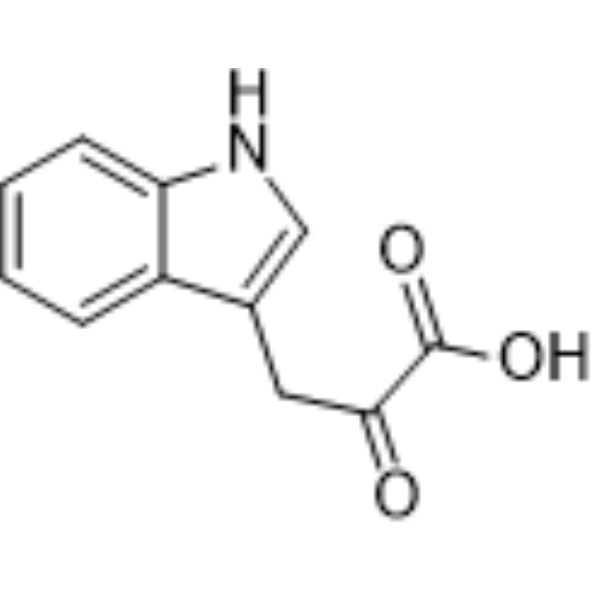
Physicochemical Properties
| Molecular Formula | C11H9NO3 |
| Molecular Weight | 203.19406 |
| Exact Mass | 203.058 |
| CAS # | 392-12-1 |
| PubChem CID | 803 |
| Appearance | Light yellow to brown solid powder |
| Density | 1.4±0.1 g/cm3 |
| Boiling Point | 445.2±28.0 °C at 760 mmHg |
| Melting Point | 215 °C (dec.)(lit.) |
| Flash Point | 223.0±24.0 °C |
| Vapour Pressure | 0.0±1.1 mmHg at 25°C |
| Index of Refraction | 1.685 |
| LogP | 0.46 |
| Hydrogen Bond Donor Count | 2 |
| Hydrogen Bond Acceptor Count | 3 |
| Rotatable Bond Count | 3 |
| Heavy Atom Count | 15 |
| Complexity | 277 |
| Defined Atom Stereocenter Count | 0 |
| InChi Key | RSTKLPZEZYGQPY-UHFFFAOYSA-N |
| InChi Code | InChI=1S/C11H9NO3/c13-10(11(14)15)5-7-6-12-9-4-2-1-3-8(7)9/h1-4,6,12H,5H2,(H,14,15) |
| Chemical Name | 3-(1H-indol-3-yl)-2-oxopropanoic acid |
| HS Tariff Code | 2934.99.9001 |
| Storage |
Powder-20°C 3 years 4°C 2 years In solvent -80°C 6 months -20°C 1 month Note: Please store this product in a sealed and protected environment (e.g. under nitrogen), avoid exposure to moisture and light. |
| Shipping Condition | Room temperature (This product is stable at ambient temperature for a few days during ordinary shipping and time spent in Customs) |
Biological Activity
| ln Vitro | In HepG2 cells, indole-3-pyruvic acid (50 and 250 μM, 24 h) activates AHR[1]. Triole-3-pyruvic acid (50 μM, 4 days) stimulates Tr1 cells but does not prevent Th1 cell elimination [1]. Indole-3-pyruvic acid (1 mM, 24 h) lessens the cytotoxicity of UVB-induced HaCaT [1]. In HaCaT cells, indole-3-pyruvic acid (25 mM, 6 hours) lowers COX-2 levels [2]. |
| ln Vivo | Mice BALB/c are given indole-3-pyruvic acid (face, 0.1% chow; 5 d) to activate their AHR [1]. Indole-3-pyruvic acid (100 μM, dose at skin) protects HR-1 hairless shell from UVB-induced skin damage. Indole-3-pyruvic acid (face, fed MF food (0.1%) for 5 weeks) eliminates T cells [ 2]. mediated long-term inflammation in vaginitis models [1]. -In the elevated plus maze, mice can open their arms for a longer period of time when given pyruvate (ip, 100–200 mg/kg) [3]. |
| Cell Assay |
RT-PCR[2] Cell Types: HaCaT cells Tested Concentrations: 5-25mM Incubation Duration: 6 hrs (hours) Experimental Results: Inhibition of UVB-stimulated mRNA expression of IL-1β, IL-6 and cyclooxygenase 2 (Cox-2). |
| Animal Protocol |
Animal/Disease Models: balb/c (Bagg ALBino) mouse [1] Doses: Fed with MF feed. 0.1% for 5 days. Route of Administration: Oral. Experimental Results: Up-regulated the expression of Cyp1a1 (a biomarker of AHR activation) in the colon. Animal/Disease Models: SCID mouse T cell-mediated colitis model [1] Doses: fed with 0.1% MF feed for 5 consecutive weeks. Route of Administration: oral. Experimental Results: inhibited diarrhea and improved colon inflammation. Downregulates the expression of Th1 and pro-inflammatory cytokines and upregulates the expression of IL-10 in the colon. Animal/Disease Models: HR-1 hairless mice [2] Doses: 100 μM Route of Administration: Skin Dose Experimental Results: Increased epidermal thickness. Attenuation of UVB-induced necrosis was observed in the upper dermis. |
| References |
[1]. Indole-3-Pyruvic Acid, an Aryl Hydrocarbon Receptor Activator, Suppresses Experimental Colitis in Mice. J Immunol. 2018 Dec 15;201(12):3683-3693. [2]. Protective effect of indole-3-pyruvate against ultraviolet b-induced damage to cultured HaCaT keratinocytes and the skin of hairless mice. PLoS One. 2014 May 8;9(5):e96804. [3]. Anxiolytic effect of indole-3-pyruvic acid (IPA) in mice. Pharmacol Res. 1993 Sep;28(2):129-34. |
Solubility Data
| Solubility (In Vitro) |
DMSO : ~166.67 mg/mL (~820.27 mM) H2O : ~20 mg/mL (~98.43 mM) |
| Solubility (In Vivo) |
Solubility in Formulation 1: ≥ 2.08 mg/mL (10.24 mM) (saturation unknown) in 10% DMSO + 40% PEG300 + 5% Tween80 + 45% Saline (add these co-solvents sequentially from left to right, and one by one), clear solution. For example, if 1 mL of working solution is to be prepared, you can add 100 μL of 20.8 mg/mL clear DMSO stock solution to 400 μL PEG300 and mix evenly; then add 50 μL Tween-80 to the above solution and mix evenly; then add 450 μL normal saline to adjust the volume to 1 mL. Preparation of saline: Dissolve 0.9 g of sodium chloride in 100 mL ddH₂ O to obtain a clear solution. Solubility in Formulation 2: ≥ 2.08 mg/mL (10.24 mM) (saturation unknown) in 10% DMSO + 90% (20% SBE-β-CD in Saline) (add these co-solvents sequentially from left to right, and one by one), clear solution. For example, if 1 mL of working solution is to be prepared, you can add 100 μL of 20.8 mg/mL clear DMSO stock solution to 900 μL of 20% SBE-β-CD physiological saline solution and mix evenly. Preparation of 20% SBE-β-CD in Saline (4°C,1 week): Dissolve 2 g SBE-β-CD in 10 mL saline to obtain a clear solution. (Please use freshly prepared in vivo formulations for optimal results.) |
| Preparing Stock Solutions | 1 mg | 5 mg | 10 mg | |
| 1 mM | 4.9215 mL | 24.6075 mL | 49.2150 mL | |
| 5 mM | 0.9843 mL | 4.9215 mL | 9.8430 mL | |
| 10 mM | 0.4922 mL | 2.4608 mL | 4.9215 mL |