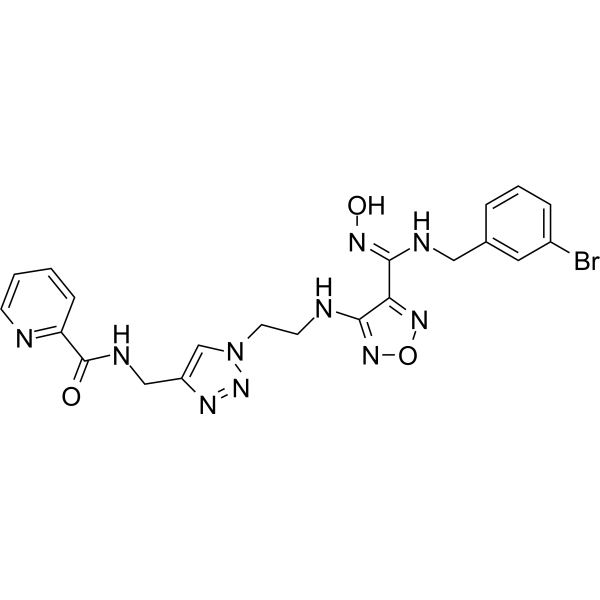
IDO2-IN-1 is a novel and orally bioactive Indoleamine 2,3-dioxygenase 2 (IDO2) inhibitor with the potential to be used for inflammatory and autoimmune diseases. It inhibits IDO with an IC50 value of 112 nM.
Physicochemical Properties
| Molecular Formula | C21H21BRN10O3 |
| Molecular Weight | 541.360641241074 |
| Exact Mass | 540.098 |
| CAS # | 2803768-09-2 |
| PubChem CID | 164946715 |
| Appearance | Off-white to light yellow solid powder |
| LogP | 1.7 |
| Hydrogen Bond Donor Count | 4 |
| Hydrogen Bond Acceptor Count | 10 |
| Rotatable Bond Count | 11 |
| Heavy Atom Count | 35 |
| Complexity | 704 |
| Defined Atom Stereocenter Count | 0 |
| SMILES | BrC1=CC=CC(=C1)C/N=C(/C1C(=NON=1)NCCN1C=C(CNC(C2C=CC=CN=2)=O)N=N1)\NO |
| InChi Key | KIIAYIPXLMATRX-UHFFFAOYSA-N |
| InChi Code | InChI=1S/C21H21BrN10O3/c22-15-5-3-4-14(10-15)11-25-19(28-34)18-20(30-35-29-18)24-8-9-32-13-16(27-31-32)12-26-21(33)17-6-1-2-7-23-17/h1-7,10,13,34H,8-9,11-12H2,(H,24,30)(H,25,28)(H,26,33) |
| Chemical Name | N-[[1-[2-[[4-[N'-[(3-bromophenyl)methyl]-N-hydroxycarbamimidoyl]-1,2,5-oxadiazol-3-yl]amino]ethyl]triazol-4-yl]methyl]pyridine-2-carboxamide |
| HS Tariff Code | 2934.99.9001 |
| Storage |
Powder-20°C 3 years 4°C 2 years In solvent -80°C 6 months -20°C 1 month Note: Please store this product in a sealed and protected environment (e.g. under nitrogen), avoid exposure to moisture and light. |
| Shipping Condition | Room temperature (This product is stable at ambient temperature for a few days during ordinary shipping and time spent in Customs) |
Biological Activity
| ln Vitro | Compared to IDO1 (IC50 = 411 nM), IDO2-IN-1 (compound 22) suppresses IDO2 (IC50 = 112 nM) more potently [1]. IDO2-IN-1 suppressed hIDO1 expression (EC50=633 nM) in an IDO1/kynurenine experiment using HeLa cells, and it was then treated with hIFN-γ (final concentration: 100 ng/mL) to produce N-form acykynurenine[1]. |
| ln Vivo | Models of adjuvant arthritis (AA) and collagen-induced arthritis (CIA) are comparable to human rheumatoid arthritis (RA) in terms of pathogenesis and pathological features. Compound 22, also known as IDO2-IN-1 (100 mg/kg; oral; single dose), has been shown to have better anti-inflammatory activity than naproxen, a prescription medication that eases arthritis-related pain, swelling, and stiffness in the joints [1]. IDO2-IN-1 (intraperitoneal injection; once daily for 19 days; 25, 50, or 100 mg/kg) effectively inhibits mouse paw swelling and has demonstrated efficacy in a collagen-induced arthritis model in mice [ 1]. IDO2-IN-1 (30, 60, or 120 mg/kg; intraperitoneal injection; once daily for 15 days) has the ability to reduce inflammatory responses in the joints and may have a benefit for individuals with autoimmune arthritis [1]. AUC(0-∞) (h·ng/mL) CL (mL/h/kg) Vz (mL/kg) MRT(0-∞) (h) F (%) iv 1 0.69 / / 375.1 2673 2675 0.55 / po 10 2.02 0.75 153.8 670.5 / / 7.48 17.87 are some of the pharmacokinetic characteristics in rats. |
| Cell Assay |
Cell Viability Assay[1] Cell Types: IFN-γ induced HeLa cell line expressing hIDO1 Tested Concentrations: 1 nM-0.1 mM Incubation Duration: 48 hrs (hours) Experimental Results: demonstrated additional potency against IDO1 with an EC50 value of 633 nM. |
| Animal Protocol |
Animal/Disease Models: 2 Toluene-induced ear swelling mouse model (ICR mouse, male, 6 weeks old) [1] Doses: 100 mg/kg Route of Administration: po (oral gavage); one dose; after 1 hour of treatment, apply evenly with 25 μL xylene Apply to right ear. Experimental Results: The ear swelling of mice was Dramatically diminished, and the swelling inhibition rate was as high as 65.32%. Animal/Disease Models: Collagen-induced arthritis (CIA) mouse model (DBA/1J mouse, male, 6 weeks old) [1] Doses: 25, 50, 100 mg/kg Route of Administration: intraperitoneal (ip) injection; one time/day; Chapter Results began on day 19 and day 56 after collagen induction: the expression of inflammatory cytokines IL-18 and IL-33 was diminished. Reduces inflammation and symptoms of cartilage and bone erosion. Animal/Disease Models: Adjuvant arthritis (AA) rat model (SD (SD (Sprague-Dawley)) rat, male, 180±20g) [1] Doses: 30, 60, 120mg/kg Route of Administration: intraperitoneal (ip) injection; one time/day; 15 days , the results started on day 21 after chondroitin induction: IL-6 and TNF-α l |
| References |
[1]. Discovery of the First Selective IDO2 Inhibitor As Novel Immunotherapeutic Avenues for Rheumatoid Arthritis. J Med Chem. 2022 Aug 11. |
Solubility Data
| Solubility (In Vitro) | DMSO : ~140 mg/mL (~258.61 mM) |
| Solubility (In Vivo) |
Note: Listed below are some common formulations that may be used to formulate products with low water solubility (e.g. < 1 mg/mL), you may test these formulations using a minute amount of products to avoid loss of samples. Injection Formulations (e.g. IP/IV/IM/SC) Injection Formulation 1: DMSO : Tween 80: Saline = 10 : 5 : 85 (i.e. 100 μL DMSO stock solution → 50 μL Tween 80 → 850 μL Saline) *Preparation of saline: Dissolve 0.9 g of sodium chloride in 100 mL ddH ₂ O to obtain a clear solution. Injection Formulation 2: DMSO : PEG300 :Tween 80 : Saline = 10 : 40 : 5 : 45 (i.e. 100 μL DMSO → 400 μLPEG300 → 50 μL Tween 80 → 450 μL Saline) Injection Formulation 3: DMSO : Corn oil = 10 : 90 (i.e. 100 μL DMSO → 900 μL Corn oil) Example: Take the Injection Formulation 3 (DMSO : Corn oil = 10 : 90) as an example, if 1 mL of 2.5 mg/mL working solution is to be prepared, you can take 100 μL 25 mg/mL DMSO stock solution and add to 900 μL corn oil, mix well to obtain a clear or suspension solution (2.5 mg/mL, ready for use in animals). Injection Formulation 4: DMSO : 20% SBE-β-CD in saline = 10 : 90 [i.e. 100 μL DMSO → 900 μL (20% SBE-β-CD in saline)] *Preparation of 20% SBE-β-CD in Saline (4°C,1 week): Dissolve 2 g SBE-β-CD in 10 mL saline to obtain a clear solution. Injection Formulation 5: 2-Hydroxypropyl-β-cyclodextrin : Saline = 50 : 50 (i.e. 500 μL 2-Hydroxypropyl-β-cyclodextrin → 500 μL Saline) Injection Formulation 6: DMSO : PEG300 : castor oil : Saline = 5 : 10 : 20 : 65 (i.e. 50 μL DMSO → 100 μLPEG300 → 200 μL castor oil → 650 μL Saline) Injection Formulation 7: Ethanol : Cremophor : Saline = 10: 10 : 80 (i.e. 100 μL Ethanol → 100 μL Cremophor → 800 μL Saline) Injection Formulation 8: Dissolve in Cremophor/Ethanol (50 : 50), then diluted by Saline Injection Formulation 9: EtOH : Corn oil = 10 : 90 (i.e. 100 μL EtOH → 900 μL Corn oil) Injection Formulation 10: EtOH : PEG300:Tween 80 : Saline = 10 : 40 : 5 : 45 (i.e. 100 μL EtOH → 400 μLPEG300 → 50 μL Tween 80 → 450 μL Saline) Oral Formulations Oral Formulation 1: Suspend in 0.5% CMC Na (carboxymethylcellulose sodium) Oral Formulation 2: Suspend in 0.5% Carboxymethyl cellulose Example: Take the Oral Formulation 1 (Suspend in 0.5% CMC Na) as an example, if 100 mL of 2.5 mg/mL working solution is to be prepared, you can first prepare 0.5% CMC Na solution by measuring 0.5 g CMC Na and dissolve it in 100 mL ddH2O to obtain a clear solution; then add 250 mg of the product to 100 mL 0.5% CMC Na solution, to make the suspension solution (2.5 mg/mL, ready for use in animals). Oral Formulation 3: Dissolved in PEG400 Oral Formulation 4: Suspend in 0.2% Carboxymethyl cellulose Oral Formulation 5: Dissolve in 0.25% Tween 80 and 0.5% Carboxymethyl cellulose Oral Formulation 6: Mixing with food powders Note: Please be aware that the above formulations are for reference only. InvivoChem strongly recommends customers to read literature methods/protocols carefully before determining which formulation you should use for in vivo studies, as different compounds have different solubility properties and have to be formulated differently. (Please use freshly prepared in vivo formulations for optimal results.) |
| Preparing Stock Solutions | 1 mg | 5 mg | 10 mg | |
| 1 mM | 1.8472 mL | 9.2360 mL | 18.4720 mL | |
| 5 mM | 0.3694 mL | 1.8472 mL | 3.6944 mL | |
| 10 mM | 0.1847 mL | 0.9236 mL | 1.8472 mL |