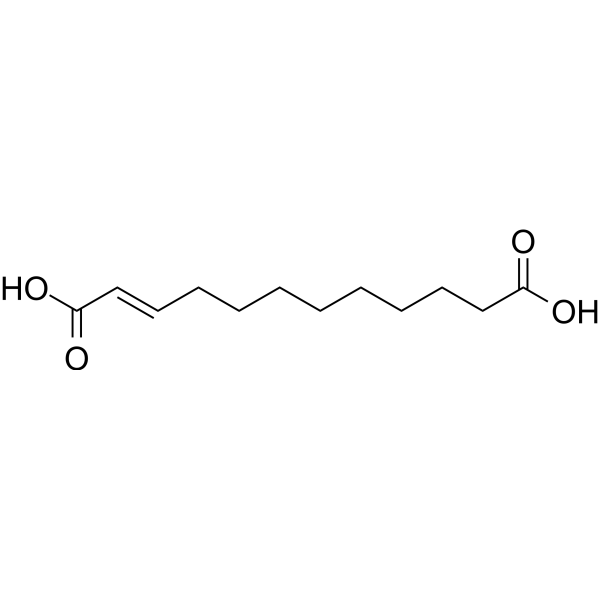
Physicochemical Properties
| Molecular Formula | C12H20O4 |
| Molecular Weight | 228.2848 |
| Exact Mass | 228.136 |
| CAS # | 6402-36-4 |
| PubChem CID | 5283028 |
| Appearance | White to off-white solid powder |
| Density | 1.1±0.1 g/cm3 |
| Boiling Point | 376.4±15.0 °C at 760 mmHg |
| Melting Point | 165-167 °C(lit.) |
| Flash Point | 195.6±16.9 °C |
| Vapour Pressure | 0.0±1.8 mmHg at 25°C |
| Index of Refraction | 1.493 |
| LogP | 2.95 |
| Hydrogen Bond Donor Count | 2 |
| Hydrogen Bond Acceptor Count | 4 |
| Rotatable Bond Count | 10 |
| Heavy Atom Count | 16 |
| Complexity | 233 |
| Defined Atom Stereocenter Count | 0 |
| SMILES | C(CCCCC(=O)O)CCC/C=C/C(=O)O |
| InChi Key | MAZWDMBCPDUFDJ-VQHVLOKHSA-N |
| InChi Code | InChI=1S/C12H20O4/c13-11(14)9-7-5-3-1-2-4-6-8-10-12(15)16/h7,9H,1-6,8,10H2,(H,13,14)(H,15,16)/b9-7+ |
| Chemical Name | (E)-dodec-2-enedioic acid |
| HS Tariff Code | 2934.99.9001 |
| Storage |
Powder-20°C 3 years 4°C 2 years In solvent -80°C 6 months -20°C 1 month Note: Please store this product in a sealed and protected environment, avoid exposure to moisture. |
| Shipping Condition | Room temperature (This product is stable at ambient temperature for a few days during ordinary shipping and time spent in Customs) |
Biological Activity
| ln Vitro | Fibroblast cell count is dramatically increased by wound acid (0.1, 1 µM; 5 days) [1]. In fibroblasts, traumatic acid (0.1, 1 µM; 5 days) decreases glutathione level, increases GPX activity, and lessens membrane phospholipid peroxidation [1]. In fibroblast culture media, traumatizing acid (0.1, 1 µM; 5 days) increases collagen secretion and synthesis [1]. The number of viable cells was dramatically decreased by wound acid (100, 200, 400, and 600 µM; 48 hours), particularly following treatment at 100 µM and 200 µM for 48 hours in MCF-7 cells [2]. In MCF-7 cells, traumatic acid (50–600 µM; 24–48 hours) promotes apoptosis and reduces cell viability in a dose- and time-dependent manner [2]. In MCF-7 cells, traumatic acid (50–200 µM; 24–48 hours) oxidatively damages proteins [2]. The oxidative stress level of MCF-7 cells can be efficiently increased by traumatic acid (100, 200 µM; 24, 48 hours) [2]. |
| Cell Assay |
Cell Proliferation Assay[1] Cell Types: Fibroblasts Tested Concentrations: 0.1, 1 µM Incubation Duration: 5 days Experimental Results: Caused a significant increase in cell number, especially on day 1 at a concentration of 1 µM. Compared to untreated control cells, cell numbers increased by 133% and 118% at concentrations of 1 and 0.1 µM, respectively. Cell viability assay[1] Cell Types: Fibroblasts Tested Concentrations: 0.1, 1 µM Incubation Duration: 5 days Experimental Results: Total protein content increased by 183% and 90% on day 1 compared to controls at concentrations of 1 and 0.1 µM, respectively . Collagen increased compared to control by 72% at 0.1 µM (day 3) and 51% at 1 µM (day 1). Compared to the control, GPX activity increased by 111% and 97% at concentrations of 1 and 0.1 µM, respectively. The diminished glutathione content increased by 86% and 80% at 0.1 µM and 1 µM, respectively. Reduce membrane phospholipid peroxidation. Cell viability assay [2] Cell Types: MCF-7 Cell Tested Concentrations: 100, 200, 400, 600 µM Incubation Duration: 4 |
| References |
[1]. Traumatic Acid Reduces Oxidative Stress and Enhances Collagen Biosynthesis in Cultured Human Skin Fibroblasts.Lipids. 2016 Sep;51(9):1021-35. [2]. Traumatic acid toxicity mechanisms in human breast cancer MCF-7 cells. Regul Toxicol Pharmacol. 2019 Aug;106:137-146. |
| Additional Infomation |
Traumatic acid is a monounsaturated straight-chain dicarboxylic acid with the double bond at C-2; a plant wound-healing hormone. It has a role as a plant hormone. Traumatic acid has been reported in Meehania urticifolia with data available. |
Solubility Data
| Solubility (In Vitro) | DMSO : ~250 mg/mL (~1095.15 mM) |
| Solubility (In Vivo) |
Solubility in Formulation 1: ≥ 2.08 mg/mL (9.11 mM) (saturation unknown) in 10% DMSO + 40% PEG300 + 5% Tween80 + 45% Saline (add these co-solvents sequentially from left to right, and one by one), clear solution. For example, if 1 mL of working solution is to be prepared, you can add 100 μL of 20.8 mg/mL clear DMSO stock solution to 400 μL PEG300 and mix evenly; then add 50 μL Tween-80 to the above solution and mix evenly; then add 450 μL normal saline to adjust the volume to 1 mL. Preparation of saline: Dissolve 0.9 g of sodium chloride in 100 mL ddH₂ O to obtain a clear solution. Solubility in Formulation 2: ≥ 2.08 mg/mL (9.11 mM) (saturation unknown) in 10% DMSO + 90% (20% SBE-β-CD in Saline) (add these co-solvents sequentially from left to right, and one by one), clear solution. For example, if 1 mL of working solution is to be prepared, you can add 100 μL of 20.8 mg/mL clear DMSO stock solution to 900 μL of 20% SBE-β-CD physiological saline solution and mix evenly. Preparation of 20% SBE-β-CD in Saline (4°C,1 week): Dissolve 2 g SBE-β-CD in 10 mL saline to obtain a clear solution. Solubility in Formulation 3: ≥ 2.08 mg/mL (9.11 mM) (saturation unknown) in 10% DMSO + 90% Corn Oil (add these co-solvents sequentially from left to right, and one by one), clear solution. For example, if 1 mL of working solution is to be prepared, you can add 100 μL of 20.8 mg/mL clear DMSO stock solution to 900 μL of corn oil and mix evenly. (Please use freshly prepared in vivo formulations for optimal results.) |
| Preparing Stock Solutions | 1 mg | 5 mg | 10 mg | |
| 1 mM | 4.3806 mL | 21.9029 mL | 43.8059 mL | |
| 5 mM | 0.8761 mL | 4.3806 mL | 8.7612 mL | |
| 10 mM | 0.4381 mL | 2.1903 mL | 4.3806 mL |