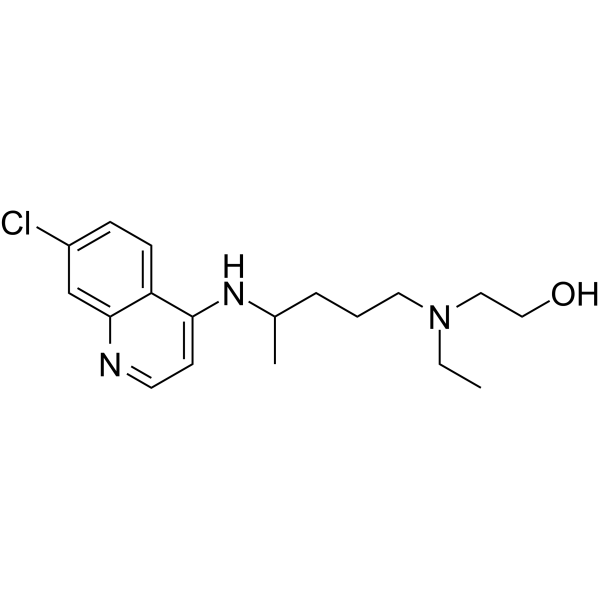
Physicochemical Properties
| Molecular Formula | C18H26N3OCL |
| Molecular Weight | 335.87154 |
| Exact Mass | 335.176 |
| CAS # | 118-42-3 |
| Related CAS # | Hydroxychloroquine sulfate;747-36-4;Hydroxychloroquine-d4-1 sulfate;1216432-56-2;Hydroxychloroquine-d5 |
| PubChem CID | 3652 |
| Appearance | White to off-white solid powder |
| Density | 1.176 g/cm3 |
| Boiling Point | 516.7ºC at 760 mmHg |
| Melting Point | 89-91° |
| Flash Point | 266.3ºC |
| Vapour Pressure | 1.68E-11mmHg at 25°C |
| Index of Refraction | 1.5790 (estimate) |
| LogP | 3.856 |
| Hydrogen Bond Donor Count | 2 |
| Hydrogen Bond Acceptor Count | 4 |
| Rotatable Bond Count | 9 |
| Heavy Atom Count | 23 |
| Complexity | 331 |
| Defined Atom Stereocenter Count | 0 |
| SMILES | CCN(CCCC(C)NC1=C2C=CC(=CC2=NC=C1)Cl)CCO |
| InChi Key | XXSMGPRMXLTPCZ-UHFFFAOYSA-N |
| InChi Code | InChI=1S/C18H26ClN3O/c1-3-22(11-12-23)10-4-5-14(2)21-17-8-9-20-18-13-15(19)6-7-16(17)18/h6-9,13-14,23H,3-5,10-12H2,1-2H3,(H,20,21) |
| Chemical Name | 2-[4-[(7-chloroquinolin-4-yl)amino]pentyl-ethylamino]ethanol |
| HS Tariff Code | 2934.99.9001 |
| Storage |
Powder-20°C 3 years 4°C 2 years In solvent -80°C 6 months -20°C 1 month |
| Shipping Condition | Room temperature (This product is stable at ambient temperature for a few days during ordinary shipping and time spent in Customs) |
Biological Activity
| ADME/Pharmacokinetics |
Absorption, Distribution and Excretion Hydroxychloroquine is 67-74% bioavailable. Bioavailability of the R and S enantiomers were not significantly different. Following a single 200 mg oral dose of hydroxychloroquine to healthy male volunteers, whole blood hydroxychloroquine Cmax was 129.6 ng/mL (plasma Cmax was 50.3 ng/mL) with Tmax of 3.3 hours (plasma Tmax 3.7 hours). Following a single oral hydroxychloroquine dose of 200 mg, the mean fraction of the dose absorbed was 0.74 (compared to the administration of 155 mg of hydroxychloroquine intravenous infusion). Peak blood concentrations of metabolites were observed at the same time as peak levels of hydroxychloroquine. After administration of single 155 mg and 310 mg intravenous doses, peak blood concentrations ranged from 1161 ng/mL to 2436 ng/mL (mean 1918 ng/mL) following the 155 mg infusion and 6 months following the 310 mg infusion. Pharmacokinetic parameters were not significantly different over the therapeutic dose range of 155 mg and 310 mg indicating linear kinetics. In patients with rheumatoid arthritis, there was large variability as to the fraction of the dose absorbed (i.e. 30 to 100%), and mean hydroxychloroquine levels were significantly higher in patients with less disease activity. 40-50% of hydroxychloroquine is excreted renally, while only 16-21% of a dose is excreted in the urine as unchanged drug. 5% of a dose is sloughed off in skin and 24-25% is eliminated through the feces. Hydroxychloroquine is extensively distributed to tissues; it has a volume of distribution of 5522L from blood and 44,257L from plasma. The clearance of hydroxychloroquine is 96mL/min. Renal clearance of unchanged drug was approximately 16% to 30%. Metabolism / Metabolites Hydroxychloroquine is N-dealkylated by CYP3A4 to the active metabolite desethylhydroxychloroquine, as well as the inactive metabolites desethylchloroquine and bidesethylchloroquine. Desethylhydroxychloroquine is the major metabolite. Partially hepatic, to active de-ethylated metabolites. Half Life: Terminal elimination half-life In blood is approximately 50 days. In plasma it is approximately 32 days. Biological Half-Life A half-life of 123.5 days in plasma was observed following a single 200 mg oral PLAQUENIL dose to healthy male volunteers. Urine hydroxychloroquine levels were still detectable after 3 months with approximately 10% of the dose excreted as the parent drug. Results following a single dose of a 200 mg tablet versus i.v. infusion (155 mg), demonstrated a half-life of about 40 days and a large volume of distribution. Following chronic oral administration of hydroxychloroquine, the absorption half-life was approximately 3 to 4 hours and the terminal half-life ranged from 40 to 50 days. |
| Toxicity/Toxicokinetics |
Toxicity Summary Although the exact mechanism of action is unknown, it may be based on ability of hydroxychloroquine to bind to and alter DNA. Hydroxychloroquine has also has been found to be taken up into the acidic food vacuoles of the parasite in the erythrocyte. This increases the pH of the acid vesicles, interfering with vesicle functions and possibly inhibiting phospholipid metabolism. In suppressive treatment, hydroxychloroquine inhibits the erythrocytic stage of development of plasmodia. In acute attacks of malaria, it interrupts erythrocytic schizogony of the parasite. Its ability to concentrate in parasitized erythrocytes may account for their selective toxicity against the erythrocytic stages of plasmodial infection. As an antirheumatic, hydroxychloroquine is thought to act as a mild immunosuppressant, inhibiting the production of rheumatoid factor and acute phase reactants. It also accumulates in white blood cells, stabilizing lysosomal membranes and inhibiting the activity of many enzymes, including collagenase and the proteases that cause cartilage breakdown. |
| Additional Infomation |
Pharmacodynamics Hydroxychloroquine affects the function of lysosomes in humans as well as plasmodia. Altering the pH of the lysosomes reduces low-affinity self-antigen presentation in autoimmune diseases and interferes with the ability of plasmodia to proteolyze hemoglobin for their energy requirements. Hydroxychloroquine has a long duration of action as it may be taken on a weekly basis for some indications. Hydroxychloroquine may lead to severe hypoglycemia and so diabetic patients are advised to monitor their blood glucose levels. Hydroxychloroquine is active against the erythrocytic forms of chloroquine-sensitive strains of P. falciparum, P. malariae, P. vivax, and P. ovale. Hydroxychloroquine is not active against the gametocytes and exoerythrocytic forms including the hypnozoite liver stage forms of P. vivax and P. ovale. Hydroxychloroquine is not effective against malaria in areas where chloroquine resistance has been reported. |
Solubility Data
| Solubility (In Vitro) |
DMSO : ≥ 100 mg/mL (~297.73 mM) 1M HCl : 100 mg/mL (~297.73 mM) H2O : ~1.67 mg/mL (~4.97 mM) |
| Solubility (In Vivo) |
Note: Listed below are some common formulations that may be used to formulate products with low water solubility (e.g. < 1 mg/mL), you may test these formulations using a minute amount of products to avoid loss of samples. Injection Formulations (e.g. IP/IV/IM/SC) Injection Formulation 1: DMSO : Tween 80: Saline = 10 : 5 : 85 (i.e. 100 μL DMSO stock solution → 50 μL Tween 80 → 850 μL Saline) *Preparation of saline: Dissolve 0.9 g of sodium chloride in 100 mL ddH ₂ O to obtain a clear solution. Injection Formulation 2: DMSO : PEG300 :Tween 80 : Saline = 10 : 40 : 5 : 45 (i.e. 100 μL DMSO → 400 μLPEG300 → 50 μL Tween 80 → 450 μL Saline) Injection Formulation 3: DMSO : Corn oil = 10 : 90 (i.e. 100 μL DMSO → 900 μL Corn oil) Example: Take the Injection Formulation 3 (DMSO : Corn oil = 10 : 90) as an example, if 1 mL of 2.5 mg/mL working solution is to be prepared, you can take 100 μL 25 mg/mL DMSO stock solution and add to 900 μL corn oil, mix well to obtain a clear or suspension solution (2.5 mg/mL, ready for use in animals). Injection Formulation 4: DMSO : 20% SBE-β-CD in saline = 10 : 90 [i.e. 100 μL DMSO → 900 μL (20% SBE-β-CD in saline)] *Preparation of 20% SBE-β-CD in Saline (4°C,1 week): Dissolve 2 g SBE-β-CD in 10 mL saline to obtain a clear solution. Injection Formulation 5: 2-Hydroxypropyl-β-cyclodextrin : Saline = 50 : 50 (i.e. 500 μL 2-Hydroxypropyl-β-cyclodextrin → 500 μL Saline) Injection Formulation 6: DMSO : PEG300 : castor oil : Saline = 5 : 10 : 20 : 65 (i.e. 50 μL DMSO → 100 μLPEG300 → 200 μL castor oil → 650 μL Saline) Injection Formulation 7: Ethanol : Cremophor : Saline = 10: 10 : 80 (i.e. 100 μL Ethanol → 100 μL Cremophor → 800 μL Saline) Injection Formulation 8: Dissolve in Cremophor/Ethanol (50 : 50), then diluted by Saline Injection Formulation 9: EtOH : Corn oil = 10 : 90 (i.e. 100 μL EtOH → 900 μL Corn oil) Injection Formulation 10: EtOH : PEG300:Tween 80 : Saline = 10 : 40 : 5 : 45 (i.e. 100 μL EtOH → 400 μLPEG300 → 50 μL Tween 80 → 450 μL Saline) Oral Formulations Oral Formulation 1: Suspend in 0.5% CMC Na (carboxymethylcellulose sodium) Oral Formulation 2: Suspend in 0.5% Carboxymethyl cellulose Example: Take the Oral Formulation 1 (Suspend in 0.5% CMC Na) as an example, if 100 mL of 2.5 mg/mL working solution is to be prepared, you can first prepare 0.5% CMC Na solution by measuring 0.5 g CMC Na and dissolve it in 100 mL ddH2O to obtain a clear solution; then add 250 mg of the product to 100 mL 0.5% CMC Na solution, to make the suspension solution (2.5 mg/mL, ready for use in animals). Oral Formulation 3: Dissolved in PEG400 Oral Formulation 4: Suspend in 0.2% Carboxymethyl cellulose Oral Formulation 5: Dissolve in 0.25% Tween 80 and 0.5% Carboxymethyl cellulose Oral Formulation 6: Mixing with food powders Note: Please be aware that the above formulations are for reference only. InvivoChem strongly recommends customers to read literature methods/protocols carefully before determining which formulation you should use for in vivo studies, as different compounds have different solubility properties and have to be formulated differently. (Please use freshly prepared in vivo formulations for optimal results.) |
| Preparing Stock Solutions | 1 mg | 5 mg | 10 mg | |
| 1 mM | 2.9773 mL | 14.8867 mL | 29.7734 mL | |
| 5 mM | 0.5955 mL | 2.9773 mL | 5.9547 mL | |
| 10 mM | 0.2977 mL | 1.4887 mL | 2.9773 mL |