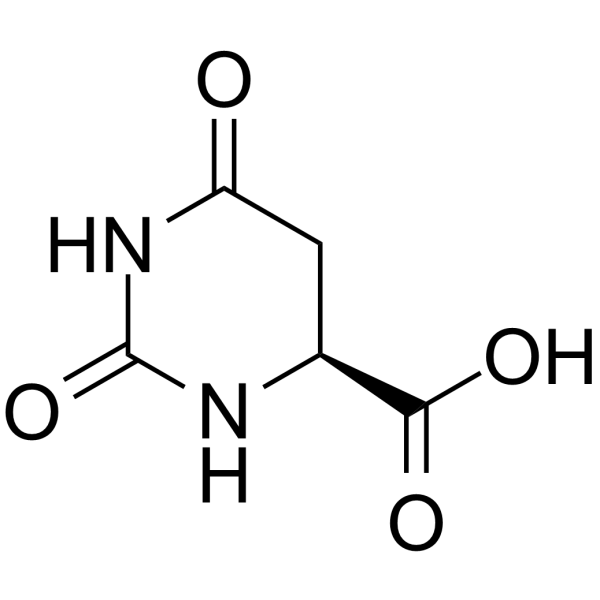
Physicochemical Properties
| Molecular Formula | C5H6N2O4 |
| Molecular Weight | 158.1121 |
| Exact Mass | 158.032 |
| CAS # | 5988-19-2 |
| PubChem CID | 439216 |
| Appearance | White to off-white solid powder |
| Density | 1.9±0.1 g/cm3 |
| Boiling Point | 524.0±60.0 °C at 760 mmHg |
| Melting Point | 254-255 °C (dec.)(lit.) |
| Flash Point | 270.7±32.9 °C |
| Vapour Pressure | 0.0±3.1 mmHg at 25°C |
| Index of Refraction | 1.714 |
| LogP | -2.29 |
| Hydrogen Bond Donor Count | 3 |
| Hydrogen Bond Acceptor Count | 4 |
| Rotatable Bond Count | 1 |
| Heavy Atom Count | 11 |
| Complexity | 225 |
| Defined Atom Stereocenter Count | 1 |
| SMILES | C1[C@H](NC(=O)NC1=O)C(=O)O |
| InChi Key | UFIVEPVSAGBUSI-REOHCLBHSA-N |
| InChi Code | InChI=1S/C5H6N2O4/c8-3-1-2(4(9)10)6-5(11)7-3/h2H,1H2,(H,9,10)(H2,6,7,8,11)/t2-/m0/s1 |
| Chemical Name | (4S)-2,6-dioxo-1,3-diazinane-4-carboxylic acid |
| HS Tariff Code | 2934.99.9001 |
| Storage |
Powder-20°C 3 years 4°C 2 years In solvent -80°C 6 months -20°C 1 month |
| Shipping Condition | Room temperature (This product is stable at ambient temperature for a few days during ordinary shipping and time spent in Customs) |
Biological Activity
| References |
[1]. ENZYMATIC SYNTHESIS AND BREAKDOWN OF A PYRIMIDINE, OROTIC ACID.October 28, 1953. |
| Additional Infomation |
(S)-dihydroorotic acid is the (S)-enantiomer of dihydroorotic acid that is an intermediate in the metabolism of pyridine. It has a role as a Saccharomyces cerevisiae metabolite, a human metabolite, an Escherichia coli metabolite and a mouse metabolite. It is a conjugate acid of a (S)-dihydroorotate. It is an enantiomer of a (R)-dihydroorotic acid. L-Dihydroorotic acid has been reported in Arabidopsis thaliana, Homo sapiens, and other organisms with data available. L-Dihydroorotic acid is a metabolite found in or produced by Saccharomyces cerevisiae. |
Solubility Data
| Solubility (In Vitro) |
DMF : 33.33 mg/mL (~210.80 mM) DMSO : ~25 mg/mL (~158.12 mM) H2O : ~5 mg/mL (~31.62 mM) |
| Solubility (In Vivo) |
Solubility in Formulation 1: ≥ 2.5 mg/mL (15.81 mM) (saturation unknown) in 10% DMSO + 40% PEG300 + 5% Tween80 + 45% Saline (add these co-solvents sequentially from left to right, and one by one), clear solution. For example, if 1 mL of working solution is to be prepared, you can add 100 μL of 25.0 mg/mL clear DMSO stock solution to 400 μL PEG300 and mix evenly; then add 50 μL Tween-80 to the above solution and mix evenly; then add 450 μL normal saline to adjust the volume to 1 mL. Preparation of saline: Dissolve 0.9 g of sodium chloride in 100 mL ddH₂ O to obtain a clear solution. Solubility in Formulation 2: ≥ 2.5 mg/mL (15.81 mM) (saturation unknown) in 10% DMSO + 90% (20% SBE-β-CD in Saline) (add these co-solvents sequentially from left to right, and one by one), clear solution. For example, if 1 mL of working solution is to be prepared, you can add 100 μL of 25.0 mg/mL clear DMSO stock solution to 900 μL of 20% SBE-β-CD physiological saline solution and mix evenly. Preparation of 20% SBE-β-CD in Saline (4°C,1 week): Dissolve 2 g SBE-β-CD in 10 mL saline to obtain a clear solution. Solubility in Formulation 3: ≥ 2.5 mg/mL (15.81 mM) (saturation unknown) in 10% DMSO + 90% Corn Oil (add these co-solvents sequentially from left to right, and one by one), clear solution. For example, if 1 mL of working solution is to be prepared, you can add 100 μL of 25.0 mg/mL clear DMSO stock solution to 900 μL of corn oil and mix evenly. Solubility in Formulation 4: ≥ 2.5 mg/mL (15.81 mM) (saturation unknown) in 10% DMF 40% PEG300 + 5% Tween80 + 45% Saline (add these co-solvents sequentially from left to right, and one by one), clear solution. Preparation of saline: Dissolve 0.9 g of sodium chloride in 100 mL ddH₂ O to obtain a clear solution. Solubility in Formulation 5: ≥ 2.5 mg/mL (15.81 mM) (saturation unknown) in 10% DMF 90% (20% SBE-β-CD in Saline) (add these co-solvents sequentially from left to right, and one by one), clear solution. Preparation of 20% SBE-β-CD in Saline (4°C,1 week): Dissolve 2 g SBE-β-CD in 10 mL saline to obtain a clear solution. Solubility in Formulation 6: 7.69 mg/mL (48.64 mM) in PBS (add these co-solvents sequentially from left to right, and one by one), clear solution; with ultrasonication (<60°C). (Please use freshly prepared in vivo formulations for optimal results.) |
| Preparing Stock Solutions | 1 mg | 5 mg | 10 mg | |
| 1 mM | 6.3247 mL | 31.6236 mL | 63.2471 mL | |
| 5 mM | 1.2649 mL | 6.3247 mL | 12.6494 mL | |
| 10 mM | 0.6325 mL | 3.1624 mL | 6.3247 mL |