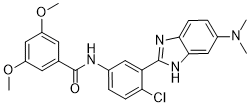
HhAntag is a novel and potent GLI1-mediated transcription inhibitor and SMO antagonist with anticancer activity. It inhibits GLI1-mediated transcription, which is an essential down-stream element of the Hedgehog (Hh) pathway.
Physicochemical Properties
| Molecular Formula | C24H23CLN4O3 |
| Molecular Weight | 450.92 |
| Exact Mass | 450.146 |
| CAS # | 496794-70-8 |
| PubChem CID | 9911630 |
| Appearance | Light yellow to yellow solid powder |
| LogP | 5.602 |
| Hydrogen Bond Donor Count | 2 |
| Hydrogen Bond Acceptor Count | 5 |
| Rotatable Bond Count | 6 |
| Heavy Atom Count | 32 |
| Complexity | 626 |
| Defined Atom Stereocenter Count | 0 |
| InChi Key | UBHJFPVTEATUFS-UHFFFAOYSA-N |
| InChi Code | InChI=1S/C24H23ClN4O3/c1-29(2)16-6-8-21-22(12-16)28-23(27-21)19-11-15(5-7-20(19)25)26-24(30)14-9-17(31-3)13-18(10-14)32-4/h5-13H,1-4H3,(H,26,30)(H,27,28) |
| Chemical Name | N-[4-chloro-3-[6-(dimethylamino)-1H-benzimidazol-2-yl]phenyl]-3,5-dimethoxybenzamide |
| Synonyms | Hh Antag Hh-Antag HhAntag |
| HS Tariff Code | 2934.99.9001 |
| Storage |
Powder-20°C 3 years 4°C 2 years In solvent -80°C 6 months -20°C 1 month |
| Shipping Condition | Room temperature (This product is stable at ambient temperature for a few days during ordinary shipping and time spent in Customs) |
Biological Activity
| ln Vitro | HhAntag (2-30 µM; 72 hours) inhibits Hh signaling pathway-sensitive cells with IC50 values ranging from 2 µM to >30 µM[1]. It is ten times more powerful than the natural product SMO antagonist cyclopamine in suppressing Hh pathway activity. With IC50 values of 30 µM, 5.4 µM, and 5.8 µM, HhAntag inhibits AsPC-1, BXPC-3, CFPAC, HPAC, HPAF-II, KP4, Panc 03.27, PA-TU-8902, PSN-1, and SU.86.86 cells. These are 2.7 µM, 6.2 µM, 10.3 µM, 2.5 µM, 2.9 µM, 5.8 µM, and 2.7 µM[1]. A Hh-responsive human mesenchymal cell line (HEPM) expressing GLI luciferase reporter construct (HEPM-rep) requires 100 nM of HhAntag to completely inhibit Hh signaling; this is greater than the value required for inhibition, which is 400 times lower, and in the most sensitive cancer cell line (1.9 μM), cell growth increases by 50% [1]. |
| ln Vivo | In HT55 and HT-29 colorectal cell line xenograft models, HhAntag (oral treatment; 75 mg/kg or 100 mg/kg; twice daily; 25 days) significantly slowed tumor growth, with an average tumor growth inhibition rate of 29% and 48%, respectively. DLD-1 xenograft development is unaffected by HhAntag [1]. |
| Animal Protocol |
Animal/Disease Models: Primary human xenografts (DLD-1, HT55 and HT-29 cells) from 6-8 week old female CD1 nu/nu (nude) mice [1] Doses: 75 mg/kg or 100 mg/kg twice (two times) daily ; 25-day Experimental Results: Caused growth delay in HT55 and HT-29 xenografts, but had no effect on DLD-1 xenografts. |
| References |
[1]. Amide conjugates of ketoprofen and indole as inhibitors of Gli1-mediated transcription in the Hedgehog pathway. Bioorg Med Chem. 2010 Jul 1;18(13):4801-11. |
Solubility Data
| Solubility (In Vitro) | DMSO : ≥ 100 mg/mL (~221.77 mM) |
| Solubility (In Vivo) |
Solubility in Formulation 1: ≥ 3 mg/mL (6.65 mM) (saturation unknown) in 10% DMSO + 40% PEG300 + 5% Tween80 + 45% Saline (add these co-solvents sequentially from left to right, and one by one), clear solution. For example, if 1 mL of working solution is to be prepared, you can add 100 μL of 30.0 mg/mL clear DMSO stock solution to 400 μL PEG300 and mix evenly; then add 50 μL Tween-80 to the above solution and mix evenly; then add 450 μL normal saline to adjust the volume to 1 mL. Preparation of saline: Dissolve 0.9 g of sodium chloride in 100 mL ddH₂ O to obtain a clear solution. Solubility in Formulation 2: ≥ 3 mg/mL (6.65 mM) (saturation unknown) in 10% DMSO + 90% Corn Oil (add these co-solvents sequentially from left to right, and one by one), clear solution. For example, if 1 mL of working solution is to be prepared, you can add 100 μL of 30.0 mg/mL clear DMSO stock solution to 900 μL of corn oil and mix evenly. (Please use freshly prepared in vivo formulations for optimal results.) |
| Preparing Stock Solutions | 1 mg | 5 mg | 10 mg | |
| 1 mM | 2.2177 mL | 11.0884 mL | 22.1769 mL | |
| 5 mM | 0.4435 mL | 2.2177 mL | 4.4354 mL | |
| 10 mM | 0.2218 mL | 1.1088 mL | 2.2177 mL |