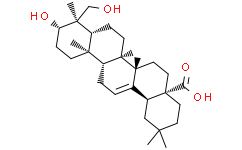
Physicochemical Properties
| Molecular Formula | C30H48O4 |
| Molecular Weight | 472.71 |
| Exact Mass | 472.355 |
| Elemental Analysis | C, 76.23; H, 10.24; O, 13.54 |
| CAS # | 465-99-6 |
| Related CAS # | 465-99-6 |
| PubChem CID | 73299 |
| Appearance | White to off-white solid powder |
| Density | 1.1±0.1 g/cm3 |
| Boiling Point | 589.4±50.0 °C at 760 mmHg |
| Melting Point | 332 - 334ºC |
| Flash Point | 324.3±26.6 °C |
| Vapour Pressure | 0.0±3.8 mmHg at 25°C |
| Index of Refraction | 1.569 |
| LogP | 7.41 |
| Hydrogen Bond Donor Count | 3 |
| Hydrogen Bond Acceptor Count | 4 |
| Rotatable Bond Count | 2 |
| Heavy Atom Count | 34 |
| Complexity | 908 |
| Defined Atom Stereocenter Count | 9 |
| SMILES | C1(C)(C)C[C@@]2([H])C3=CC[C@]4([H])[C@@]5(C)CC[C@H](O)[C@@](C)(CO)[C@]5([H])CC[C@@]4(C)[C@]3(C)CC[C@@]2(C(O)=O)CC1 |
| InChi Key | PGOYMURMZNDHNS-MYPRUECHSA-N |
| InChi Code | InChI=1S/C30H48O4/c1-25(2)13-15-30(24(33)34)16-14-28(5)19(20(30)17-25)7-8-22-26(3)11-10-23(32)27(4,18-31)21(26)9-12-29(22,28)6/h7,20-23,31-32H,8-18H2,1-6H3,(H,33,34)/t20-,21+,22+,23-,26-,27-,28+,29+,30-/m0/s1 |
| Chemical Name | (4aS,6aR,6aS,6bR,8aR,9R,10S,12aR,14bS)-10-hydroxy-9-(hydroxymethyl)-2,2,6a,6b,9,12a-hexamethyl-1,3,4,5,6,6a,7,8,8a,10,11,12,13,14b-tetradecahydropicene-4a-carboxylic acid |
| Synonyms | Astrantiagenin E; Hederagenin; Hederagenol; NSC 24954; Caulosapogenin |
| HS Tariff Code | 2934.99.9001 |
| Storage |
Powder-20°C 3 years 4°C 2 years In solvent -80°C 6 months -20°C 1 month |
| Shipping Condition | Room temperature (This product is stable at ambient temperature for a few days during ordinary shipping and time spent in Customs) |
Biological Activity
| Targets | iNOS; COX-2; NF-κB |
| ln Vitro | Hederagenin could induce apoptosis of LoVo cells through the mitochondrial apoptotic pathway. Hederagenin may cause procaspase-9, procaspase-3, and proPARP cleavage in addition to the up-regulation of Bax and the down-regulation of Bcl-2, Bcl-xL, and Survivin[1]. In LPS-induced RAW264.7 cells, hederagenin inhibits the pathways of NF-B, which results in a decrease in the production of pro-inflammatory mediators (NO, PGE2, TNF-α, IL-1β, and IL-6)[2]. |
| ln Vivo | In NCI-H1299 xenograft mice, hederin alone (25 mg/kg; p.o.; 11 days) had no effect on tumor growth. When combined with cisplatin (1 mg/kg), it inhibits tumor growth in a synergistic manner [4]. In mice, hederagenin (50 mg/kg; oral; once daily for 21 days) decreases 25% ethanol-induced liver damage and has anti-inflammatory and anti-apoptotic effects [5]. |
| Cell Assay | At a density of 10,000 cells per well, LoVo cells are seeded into 96-well plates. The medium is discarded and then treated with 20 μl MTT (5 mg/ml) after having been exposed to 0.25, 0.5, 1.0, 2.0, and 4.0 M hederagenin for 24 or 48 hours. The 100 μl DMSO is added to each well after the incubation period of 4 h at 37°C in order to dissolve the formed formazan crystals. At 490 nm, absorption is discovered. |
| References |
[1]. Experimental Study of Antiatherosclerosis Effects with Hederagenin in Rats. Evid Based Complement Alternat Med, 2015, Oct 19. [2]. Hederagenin as a triterpene template for the development of new antitumor compounds. Eur J Med Chem, 2015 Nov 13, 105:57-62. [3]. Hederagenin, a major component of Clematis mandshurica Ruprecht root, attenuates inflammatory responses in RAW 264.7 cells and in mice. Int Immunopharmacol, 2015 Dec, 29(2):528-37. [4]. Hederagenin from the leaves of ivy (Hedera helix L.) induces apoptosis in human LoVo colon cells through the mitochondrial pathway. BMC Complement Altern Med. 2014 Oct 24;14:412. [5]. Hederagenin Supplementation Alleviates the Pro-Inflammatory and Apoptotic Response to Alcohol in Rats. Nutrients. 2017 Jan 6;9(1):41. [6]. Hederagenin potentiated cisplatin- and paclitaxel-mediated cytotoxicity by impairing autophagy in lung cancer cells. Cell Death Dis. 2020 Aug 13;11(8):611. |
| Additional Infomation |
Hederagenin is a sapogenin that is olean-12-en-28-oic acid substituted by hydroxy groups at positions 3 and 23 (the 3beta stereoisomer). It has a role as a plant metabolite. It is a pentacyclic triterpenoid, a dihydroxy monocarboxylic acid and a sapogenin. It is functionally related to an oleanolic acid. It is a conjugate acid of a hederagenin(1-). It derives from a hydride of an oleanane. Hederagenin has been reported in Rosa laevigata, Dipsacus inermis, and other organisms with data available. See also: Paeonia lactiflora root (part of); Medicago sativa whole (part of); Caulophyllum robustum Root (part of). |
Solubility Data
| Solubility (In Vitro) | DMSO: 50~94 mg/mL (105.8~198.9 mM) |
| Solubility (In Vivo) |
Solubility in Formulation 1: ≥ 2.5 mg/mL (5.29 mM) (saturation unknown) in 10% DMSO + 90% (20% SBE-β-CD in Saline) (add these co-solvents sequentially from left to right, and one by one), clear solution. For example, if 1 mL of working solution is to be prepared, you can add 100 μL of 25.0 mg/mL clear DMSO stock solution to 900 μL of 20% SBE-β-CD physiological saline solution and mix evenly. Preparation of 20% SBE-β-CD in Saline (4°C,1 week): Dissolve 2 g SBE-β-CD in 10 mL saline to obtain a clear solution. Solubility in Formulation 2: ≥ 2.5 mg/mL (5.29 mM) (saturation unknown) in 10% DMSO + 90% Corn Oil (add these co-solvents sequentially from left to right, and one by one), clear solution. For example, if 1 mL of working solution is to be prepared, you can add 100 μL of 25.0 mg/mL clear DMSO stock solution to 900 μL of corn oil and mix evenly. (Please use freshly prepared in vivo formulations for optimal results.) |
| Preparing Stock Solutions | 1 mg | 5 mg | 10 mg | |
| 1 mM | 2.1155 mL | 10.5773 mL | 21.1546 mL | |
| 5 mM | 0.4231 mL | 2.1155 mL | 4.2309 mL | |
| 10 mM | 0.2115 mL | 1.0577 mL | 2.1155 mL |