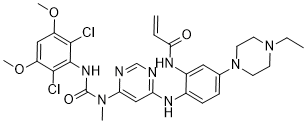
H3B-6527 is a potent, highly selective, orally bioavailable, covalent FGFR4 inhibitor with IC50 value of ~1.2 nM. The IC50 values for FGFR1/2/3 are 1,290, 320, and 1,060 nM, respectively, indicating that it is at least 250 times more selective for FGFR4 than for FGFR1-3. H3B-6527 may be utilized as an anticancer drug because it is an FGFR4 inhibitor. When administered, H3B-6527 selectively binds to and inhibits FGFR4, preventing FGFR4 from being activated. This stops FGFR4-mediated signaling from occurring, which in turn stops FGFR4-overexpressing tumor cells from proliferating.
Physicochemical Properties
| Molecular Formula | C29H34CL2N8O4 | |
| Molecular Weight | 629.54 | |
| Exact Mass | 628.208 | |
| Elemental Analysis | C, 55.33; H, 5.44; Cl, 11.26; N, 17.80; O, 10.17 | |
| CAS # | 1702259-66-2 | |
| Related CAS # |
|
|
| PubChem CID | 118029202 | |
| Appearance | White to khaki solid powder | |
| Density | 1.4±0.1 g/cm3 | |
| Boiling Point | 832.1±65.0 °C at 760 mmHg | |
| Flash Point | 457.0±34.3 °C | |
| Vapour Pressure | 0.0±3.1 mmHg at 25°C | |
| Index of Refraction | 1.665 | |
| LogP | 4.76 | |
| Hydrogen Bond Donor Count | 3 | |
| Hydrogen Bond Acceptor Count | 9 | |
| Rotatable Bond Count | 10 | |
| Heavy Atom Count | 43 | |
| Complexity | 913 | |
| Defined Atom Stereocenter Count | 0 | |
| SMILES | ClC1C(=CC(=C(C=1NC(N(C)C1C=C(N=CN=1)NC1C=CC(=CC=1NC(C=C)=O)N1CCN(CC)CC1)=O)Cl)OC)OC |
|
| InChi Key | MBWRLLRCTIYXDW-UHFFFAOYSA-N | |
| InChi Code | InChI=1S/C29H34Cl2N8O4/c1-6-25(40)35-20-14-18(39-12-10-38(7-2)11-13-39)8-9-19(20)34-23-16-24(33-17-32-23)37(3)29(41)36-28-26(30)21(42-4)15-22(43-5)27(28)31/h6,8-9,14-17H,1,7,10-13H2,2-5H3,(H,35,40)(H,36,41)(H,32,33,34) | |
| Chemical Name | N-[2-[[6-[(2,6-dichloro-3,5-dimethoxyphenyl)carbamoyl-methylamino]pyrimidin-4-yl]amino]-5-(4-ethylpiperazin-1-yl)phenyl]prop-2-enamide | |
| Synonyms |
|
|
| HS Tariff Code | 2934.99.9001 | |
| Storage |
Powder-20°C 3 years 4°C 2 years In solvent -80°C 6 months -20°C 1 month |
|
| Shipping Condition | Room temperature (This product is stable at ambient temperature for a few days during ordinary shipping and time spent in Customs) |
Biological Activity
| Targets |
FGFR4 (IC50 <1.2 nM)
The target of H3B-6527 is fibroblast growth factor receptor 4 (FGFR4), and it acts as a highly selective covalent inhibitor of FGFR4. [1] |
| ln Vitro |
H3B-6527 exhibits at least 250-fold selectivity over FGFR1-3 (IC50 values of 320, 1,290, and 1,060 nmol/L, respectively) and strong inhibition of the target kinase FGFR4 with an IC50 value of <1.2 nmol/L. Additionally, with IC50 values of 690, >10,000, and >10,000 nmol/L, respectively, TAOK2, JNK2, and CSF1R are less sensitive to H3B-6527 treatment. In an HCC cell line, H3B-6527 suppresses FGFR4 signaling, promotes cell division, and causes apoptosis. Treatment of Hep3B cells results in concentration-dependent, strong activation of the apoptotic marker caspase-3/7, suggesting that H3B-6527-induced FGFR4 inhibition causes cell death in HCC cell lines. Across all cancer kinds, H3B-6527 exhibits both selectivity and selective dependence on FGFR4[1]. 1. Cell line screening assay: Experiments were conducted on a panel of 40 hepatocellular carcinoma (HCC) cell lines. The results showed that the expression level of FGF19 is a predictive biomarker for the response of HCC cells to H3B-6527. Specifically, HCC cell lines with increased FGF19 expression exhibited a more sensitive response to H3B-6527, while cell lines with low or no FGF19 expression showed poor response to the drug [1] 2. Mechanism-related detection: As a covalent inhibitor of FGFR4, H3B-6527 can specifically bind to FGFR4, thereby inhibiting the activation of the FGFR4 signaling pathway driven by FGF19. This inhibition further affects the downstream signaling cascades involved in HCC cell proliferation and survival [1] |
| ln Vivo |
H3B-6527 exhibits dose-proportional plasma exposures and greater than dose-proportional tumor exposures within the dose range evaluated (30, 100, and 300 mg/kg) in the Hep3B human HCC xenograft mouse model. The CYP7A1 mRNA and pERK1/2 protein levels measure the dose-dependent pharmacodynamic response of H3B-6527, with higher doses producing longer-lasting effects. In nude mice, oral administration of H3B-6527 twice a day inhibits xenograft growth in a dose-dependent manner. In the subcutaneous xenograft model, tumor growth is significantly inhibited and tumor regressions occur when the dose is 300 or 100 mg/kg twice a day. In the JHH-7 model, where H3B-6527 alone can only cause tumor stasis, palbociclib can increase H3B-6527 efficacy and encourage tumor regression[1]. 1. Patient-derived xenograft (PDX) model study: Experiments were performed on 30 HCC PDX models. Consistent with the in vitro cell line results, H3B-6527 showed efficacy in PDX models with high FGF19 expression. However, the literature did not provide specific data such as the degree of tumor growth inhibition rate or tumor volume reduction in these models [1] 2. Combination therapy study in xenograft models: In a xenograft model of HCC, co-administration of H3B-6527 with the CDK4/6 inhibitor palbociclib effectively triggered tumor regression. The literature indicated that this combination therapy had a synergistic effect in inhibiting HCC tumor growth, but no specific quantitative data (such as the percentage of tumor regression or the comparison of tumor growth curves between the combination group and the single-drug group) were detailed [1] |
| Enzyme Assay |
A kinase activity assay was conducted to evaluate the selectivity of H3B-6527 for FGFR4. The assay involved measuring the inhibitory effect of H3B-6527 on the kinase activity of FGFR4 and other related kinases (such as FGFR1-3). The results demonstrated that H3B-6527 exhibited high selectivity for FGFR4, with minimal inhibitory effects on FGFR1-3. However, the literature did not provide detailed experimental procedures such as the specific reaction system components (e.g., substrate concentration, ATP concentration), reaction conditions (e.g., temperature, incubation time), or the detection method used to measure kinase activity [1] |
| Cell Assay |
The levels of pERK1/2 are determined after Hep3B cells are treated with H3B-6527 at 100 and 300 nmol/L for 0.5, 1, 2, 4, 8, and 24 hours. 1. HCC cell viability assay: HCC cells from the 40-cell line panel were seeded in appropriate culture plates and cultured under standard conditions. After adherence, different concentrations of H3B-6527 were added to the culture medium, and the cells were further incubated for a specific period (the literature did not specify the exact incubation time). Subsequently, a cell viability detection method (the specific method was not mentioned) was used to determine the effect of H3B-6527 on HCC cell viability. The assay results were used to analyze the correlation between FGF19 expression and cell sensitivity to H3B-6527 [1] 2. FGF19 expression detection in HCC cells: To confirm the predictive role of FGF19 expression for H3B-6527 response, FGF19 expression levels in the 40 HCC cell lines were detected. The detection method (e.g., PCR for mRNA expression or western blot for protein expression) was not detailed in the literature. The expression data were then correlated with the cell viability assay results to verify that FGF19 expression could predict the response of HCC cells to H3B-6527 [1] |
| Animal Protocol |
BALB/c nu/nu female mice 30, 100, and 300 mg/kg orally 1. HCC PDX model experiment: HCC tissue samples from patients were implanted into immunodeficient mice (the specific strain of immunodeficient mice, such as nude mice or NOD/SCID mice, was not specified) to establish PDX models. Once the tumors reached a certain volume (the specific volume was not mentioned), H3B-6527 was administered to the mice. The literature did not provide details on the drug dissolution formula/vehicle, administration route (e.g., oral, intravenous), or administration frequency. Tumor volume and mouse body weight were monitored regularly during the experiment to evaluate the efficacy and potential toxicity of H3B-6527 [1] 2. HCC xenograft combination therapy experiment: HCC cells (the specific cell line was not specified) were inoculated into immunodeficient mice to establish xenograft models. When the tumors grew to a predetermined size (the specific size was not mentioned), the mice were divided into three groups: H3B-6527 single-drug group, palbociclib single-drug group, and combination therapy group. The literature did not detail the drug preparation methods for either H3B-6527 or palbociclib, nor the specific administration routes and frequencies. Tumor growth was monitored continuously, and the experiment was terminated at a specific time point (not specified) to analyze the tumor regression effect of the combination therapy [1] |
| References |
[1]. H3B-6527 Is a Potent and Selective Inhibitor of FGFR4 in FGF19-Driven HepatocellularCarcinoma. Cancer Res. 2017 Dec 15;77(24):6999-7013. |
| Additional Infomation |
H3B-6527 is under investigation in clinical trial NCT03424577 (A Study to Evaluate the Food-Effect of H3B-6527). FGFR4 Inhibitor H3B-6527 is an orally bioavailable inhibitor of human fibroblast growth factor receptor 4 (FGFR4), with potential antineoplastic activity. Upon administration, H3B-6527 specifically binds to and blocks FGFR4. This prevents the activation of FGFR4, inhibits FGFR4-mediated signaling and leads to an inhibition of cell proliferation in FGFR4-overexpressing tumor cells. FGFR4, a receptor tyrosine kinase overexpressed by certain tumor cell types, is involved in tumor cell proliferation, differentiation, angiogenesis, and survival; FGFR4 expression is associated with poor prognosis. 1. Background and development rationale: Activation of FGFR4 by FGF19 drives the development and progression of HCC, and current treatment options for this type of HCC are limited. Although several pan-FGFR inhibitors are under clinical evaluation, their application in FGF19-driven HCC may be restricted by dose-limiting toxicities mediated by FGFR1-3. To address this limitation, H3B-6527, a highly selective covalent FGFR4 inhibitor, was developed through structure-guided drug design [1] 2. Clinical potential: Preclinical studies (including in vitro cell line experiments and in vivo PDX and xenograft models) have provided proof of concept for H3B-6527 as a candidate therapeutic agent for FGF19-overexpressing HCC. The identification of FGF19 as a predictive biomarker also supports the potential for personalized treatment of HCC patients with H3B-6527 [1] |
Solubility Data
| Solubility (In Vitro) |
|
|||
| Solubility (In Vivo) |
|
| Preparing Stock Solutions | 1 mg | 5 mg | 10 mg | |
| 1 mM | 1.5885 mL | 7.9423 mL | 15.8846 mL | |
| 5 mM | 0.3177 mL | 1.5885 mL | 3.1769 mL | |
| 10 mM | 0.1588 mL | 0.7942 mL | 1.5885 mL |