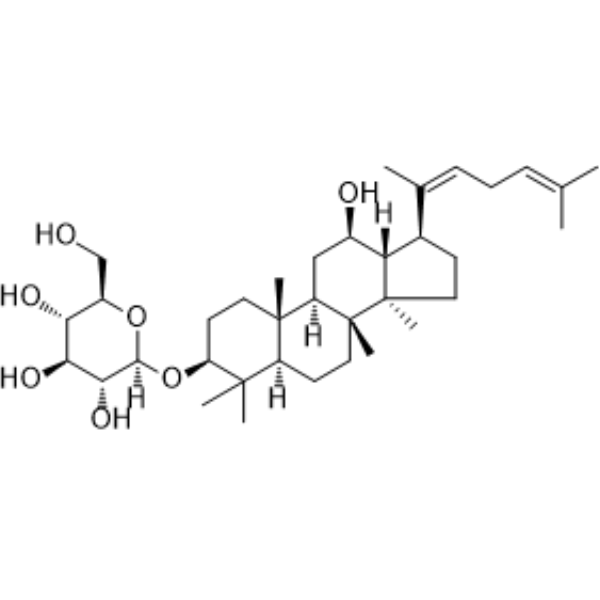
Physicochemical Properties
| Molecular Formula | C36H60O7 |
| Molecular Weight | 604.8574 |
| Exact Mass | 604.433 |
| CAS # | 105558-26-7 |
| PubChem CID | 20839223 |
| Appearance | White to off-white solid powder |
| Density | 1.2±0.1 g/cm3 |
| Boiling Point | 695.0±55.0 °C at 760 mmHg |
| Flash Point | 374.1±31.5 °C |
| Vapour Pressure | 0.0±4.9 mmHg at 25°C |
| Index of Refraction | 1.570 |
| LogP | 7.1 |
| Hydrogen Bond Donor Count | 5 |
| Hydrogen Bond Acceptor Count | 7 |
| Rotatable Bond Count | 6 |
| Heavy Atom Count | 43 |
| Complexity | 1080 |
| Defined Atom Stereocenter Count | 14 |
| SMILES | CC(=CC/C=C(/C)\[C@H]1CC[C@@]2([C@@H]1[C@@H](C[C@H]3[C@]2(CC[C@@H]4[C@@]3(CC[C@@H](C4(C)C)O[C@H]5[C@@H]([C@H]([C@@H]([C@H](O5)CO)O)O)O)C)C)O)C)C |
| InChi Key | PHLXREOMFNVWOH-YAGNRYSRSA-N |
| InChi Code | InChI=1S/C36H60O7/c1-20(2)10-9-11-21(3)22-12-16-36(8)28(22)23(38)18-26-34(6)15-14-27(33(4,5)25(34)13-17-35(26,36)7)43-32-31(41)30(40)29(39)24(19-37)42-32/h10-11,22-32,37-41H,9,12-19H2,1-8H3/b21-11-/t22-,23-,24-,25+,26-,27+,28+,29-,30+,31-,32+,34+,35-,36-/m1/s1 |
| Chemical Name | (2R,3S,4S,5R,6R)-2-(hydroxymethyl)-6-[[(3S,5R,8R,9R,10R,12R,13R,14R,17S)-12-hydroxy-4,4,8,10,14-pentamethyl-17-[(2Z)-6-methylhepta-2,5-dien-2-yl]-2,3,5,6,7,9,11,12,13,15,16,17-dodecahydro-1H-cyclopenta[a]phenanthren-3-yl]oxy]oxane-3,4,5-triol |
| HS Tariff Code | 2934.99.9001 |
| Storage |
Powder-20°C 3 years 4°C 2 years In solvent -80°C 6 months -20°C 1 month |
| Shipping Condition | Room temperature (This product is stable at ambient temperature for a few days during ordinary shipping and time spent in Customs) |
Biological Activity
| ln Vitro | Ginsenoside Rh3 prevents UV-induced oxidative damage in retinal cells by stimulating the nuclear factor-E2-related factor 2 (Nrf2) signaling pathway. Ginsenoside Rh3 treatment in retinal cells activates Nrf2. Ginsenoside Rh3's potential activity on Nrf2 signaling is investigated in retinal pigment epithelium cells (RPEs). The qRT-PCR results show that treatment with Ginsenoside Rh3 increases mRNA transcription and expression of important Nrf2-regulated genes such as HO1, NQO1, and GCLC in a dose-dependent manner. Ginsenoside Rh3 (3-10 μM) treatment significantly increases the expression of Nrf2-dependent genes (HO1, NQO1, and GCLC) in RPEs. Notably, whereas Nrf2 mRNA levels remain unaltered following Ginsenoside Rh3 treatment, Rh3 considerably increases Nrf2 protein levels[1]. The EZ-Cytox assay is used to determine the effect of ginsenoside-Rh3 on SP 1-keratinocyte viability. Ginsenoside Rh3 (0.01, 0.1, 1, and 10 μM) has no cytotoxic impact at any concentration [2]. |
| ln Vivo | Using the light-induced retinal injury paradigm, the possible impact of ginsenoside Rh3 is investigated on the retina of mice. A 30-minute pre-treatment intravitreal injection of ginsenoside Rh3 (5 mg/kg body weight) considerably reduces the decrease in amplitude of both the a- and b-waves caused by light. After exposure to light, the electroretinography (ERG) a-wave falls to 46.03±1.62% of the control level; however, treatment of ginsenoside Rh3 restores the a-wave to 71.84±7.51%. After being exposed to light, the b-wave drops to 40.19±3.34% of the control level; an intravitreal injection of Rh3 raises the level back to 80.01±2.37%[1]. |
| References |
[1]. Activation of Nrf2 by Ginsenoside Rh3 protects retinal pigment epithelium cells and retinal ganglion cells from UV. Free Radic Biol Med. 2018 Mar;117:238-246. [2]. Inhibitory mechanism of Korean Red Ginseng on GM-CSF expression in UVB-irradiated keratinocytes. J Ginseng Res. 2015 Oct;39(4):322-30. |
| Additional Infomation |
Ginsenoside Rh3 is a triterpenoid saponin. Ginsenoside Rh3 has been reported in Panax notoginseng and Panax ginseng with data available. |
Solubility Data
| Solubility (In Vitro) | DMSO : ~6.67 mg/mL (~11.03 mM) |
| Solubility (In Vivo) |
Solubility in Formulation 1: 0.67 mg/mL (1.11 mM) in 10% DMSO + 40% PEG300 + 5% Tween80 + 45% Saline (add these co-solvents sequentially from left to right, and one by one), suspension solution; with sonication. For example, if 1 mL of working solution is to be prepared, you can add 100 μL of 6.7 mg/mL clear DMSO stock solution to 400 μL PEG300 and mix evenly; then add 50 μL Tween-80 to the above solution and mix evenly; then add 450 μL normal saline to adjust the volume to 1 mL. Preparation of saline: Dissolve 0.9 g of sodium chloride in 100 mL ddH₂ O to obtain a clear solution. Solubility in Formulation 2: ≥ 0.67 mg/mL (1.11 mM) (saturation unknown) in 10% DMSO + 90% Corn Oil (add these co-solvents sequentially from left to right, and one by one), clear solution. For example, if 1 mL of working solution is to be prepared, you can add 100 μL of 6.7 mg/mL clear DMSO stock solution to 900 μL of corn oil and mix evenly. (Please use freshly prepared in vivo formulations for optimal results.) |
| Preparing Stock Solutions | 1 mg | 5 mg | 10 mg | |
| 1 mM | 1.6533 mL | 8.2664 mL | 16.5328 mL | |
| 5 mM | 0.3307 mL | 1.6533 mL | 3.3066 mL | |
| 10 mM | 0.1653 mL | 0.8266 mL | 1.6533 mL |