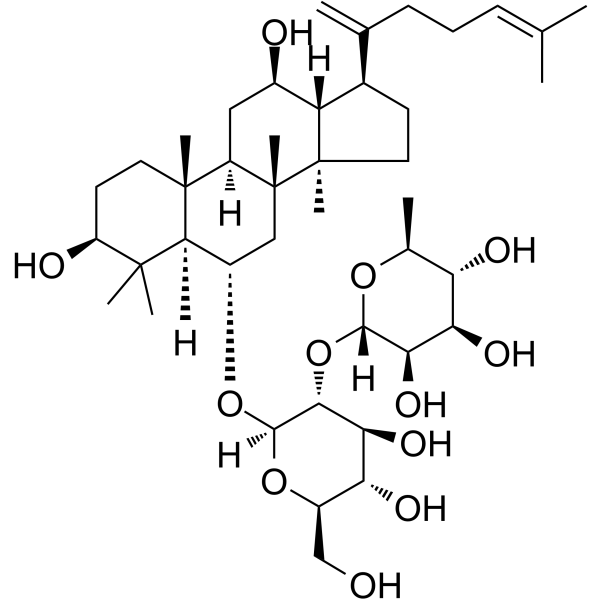
Physicochemical Properties
| Molecular Formula | C42H70O12 |
| Molecular Weight | 766.9980 |
| Exact Mass | 766.486 |
| CAS # | 147419-93-0 |
| PubChem CID | 91895489 |
| Appearance | White to off-white solid powder |
| Density | 1.3±0.1 g/cm3 |
| Boiling Point | 850.6±65.0 °C at 760 mmHg |
| Flash Point | 468.2±34.3 °C |
| Vapour Pressure | 0.0±0.6 mmHg at 25°C |
| Index of Refraction | 1.589 |
| LogP | 8.2 |
| Hydrogen Bond Donor Count | 8 |
| Hydrogen Bond Acceptor Count | 12 |
| Rotatable Bond Count | 9 |
| Heavy Atom Count | 54 |
| Complexity | 1380 |
| Defined Atom Stereocenter Count | 20 |
| SMILES | C[C@H]1[C@@H]([C@H]([C@H]([C@@H](O1)O[C@@H]2[C@H]([C@@H]([C@H](O[C@H]2O[C@H]3C[C@@]4([C@H](C[C@H]([C@H]5[C@]4(CC[C@@H]5C(=C)CCC=C(C)C)C)O)[C@@]6([C@@H]3C([C@H](CC6)O)(C)C)C)C)CO)O)O)O)O)O |
| InChi Key | ZVTVWDXRNMHGNY-JOGTXEPTSA-N |
| InChi Code | InChI=1S/C42H70O12/c1-20(2)11-10-12-21(3)23-13-16-41(8)29(23)24(44)17-27-40(7)15-14-28(45)39(5,6)36(40)25(18-42(27,41)9)52-38-35(33(49)31(47)26(19-43)53-38)54-37-34(50)32(48)30(46)22(4)51-37/h11,22-38,43-50H,3,10,12-19H2,1-2,4-9H3/t22-,23+,24+,25-,26+,27+,28-,29-,30-,31+,32+,33-,34+,35+,36-,37-,38+,40+,41+,42+/m0/s1 |
| Chemical Name | (2S,3R,4R,5R,6S)-2-[(2R,3R,4S,5S,6R)-2-[[(3S,5R,6S,8R,9R,10R,12R,13R,14R,17S)-3,12-dihydroxy-4,4,8,10,14-pentamethyl-17-(6-methylhepta-1,5-dien-2-yl)-2,3,5,6,7,9,11,12,13,15,16,17-dodecahydro-1H-cyclopenta[a]phenanthren-6-yl]oxy]-4,5-dihydroxy-6-(hydroxymethyl)oxan-3-yl]oxy-6-methyloxane-3,4,5-triol |
| HS Tariff Code | 2934.99.9001 |
| Storage |
Powder-20°C 3 years 4°C 2 years In solvent -80°C 6 months -20°C 1 month Note: This product requires protection from light (avoid light exposure) during transportation and storage. |
| Shipping Condition | Room temperature (This product is stable at ambient temperature for a few days during ordinary shipping and time spent in Customs) |
Biological Activity
| ln Vitro | Ginsenoside Rg6 suppresses TNF-α-induced NF-κB transcriptional activity in SK-Hep1 cells with an IC50 of 25.12±1.04 μM, comparable with the data in HepG2 cells [1]. Ginsenoside Rg6 showed obvious anti-proliferation and apoptosis-inducing actions when administered to JK cells in vitro. Ginsenoside Rg6 prevents S arrest in the cell cycle. The CCK-8 method indicated that with the administration of ginsenoside Rg6, multiple groups at different concentrations can significantly limit the proliferation of JK cells in human lymphoma, and it has a clear dose dependence. According to IC50 estimate, the median inhibitory concentration of ginsenoside Rg6 is 83.08 μM[2]. |
| References |
[1]. Inhibition of TNF-α-Mediated NF-κB Transcriptional Activity by Dammarane-Type Ginsenosidesfrom Steamed Flower Buds of Panax ginseng in HepG2 and SK-Hep1 Cells. Biomol Ther (Seoul). 2014 Jan;22(1):55-61. [2]. Apoptosis-inducing effect of ginsenoside Rg6 on human lymphocytoma JK cells. Molecules. 2013 Jul 9;18(7):8109-19. |
| Additional Infomation |
Ginsenoside Rg6 is a triterpenoid. Ginsenoside Rg6 has been reported in Panax ginseng with data available. |
Solubility Data
| Solubility (In Vitro) | DMSO : ~100 mg/mL (~130.38 mM) |
| Solubility (In Vivo) |
Solubility in Formulation 1: ≥ 2.5 mg/mL (3.26 mM) (saturation unknown) in 10% DMSO + 40% PEG300 + 5% Tween80 + 45% Saline (add these co-solvents sequentially from left to right, and one by one), clear solution. For example, if 1 mL of working solution is to be prepared, you can add 100 μL of 25.0 mg/mL clear DMSO stock solution to 400 μL PEG300 and mix evenly; then add 50 μL Tween-80 to the above solution and mix evenly; then add 450 μL normal saline to adjust the volume to 1 mL. Preparation of saline: Dissolve 0.9 g of sodium chloride in 100 mL ddH₂ O to obtain a clear solution. Solubility in Formulation 2: ≥ 2.5 mg/mL (3.26 mM) (saturation unknown) in 10% DMSO + 90% (20% SBE-β-CD in Saline) (add these co-solvents sequentially from left to right, and one by one), clear solution. For example, if 1 mL of working solution is to be prepared, you can add 100 μL of 25.0 mg/mL clear DMSO stock solution to 900 μL of 20% SBE-β-CD physiological saline solution and mix evenly. Preparation of 20% SBE-β-CD in Saline (4°C,1 week): Dissolve 2 g SBE-β-CD in 10 mL saline to obtain a clear solution. Solubility in Formulation 3: ≥ 2.5 mg/mL (3.26 mM) (saturation unknown) in 10% DMSO + 90% Corn Oil (add these co-solvents sequentially from left to right, and one by one), clear solution. For example, if 1 mL of working solution is to be prepared, you can add 100 μL of 25.0 mg/mL clear DMSO stock solution to 900 μL of corn oil and mix evenly. (Please use freshly prepared in vivo formulations for optimal results.) |
| Preparing Stock Solutions | 1 mg | 5 mg | 10 mg | |
| 1 mM | 1.3038 mL | 6.5189 mL | 13.0378 mL | |
| 5 mM | 0.2608 mL | 1.3038 mL | 2.6076 mL | |
| 10 mM | 0.1304 mL | 0.6519 mL | 1.3038 mL |