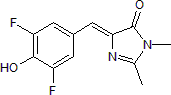
DFHBI is a mimic of green fluorescent protein (GFP) fluorophore for imaging RNA in living cells. Fluorescence is activated by binding to Spinach2 or Broccoli aptamers. Exhibits peak excitation maxima of 447 nm and peak fluorescence emission of 501 nm when bound to Spinach2.
Physicochemical Properties
| Molecular Formula | C12H10F2N2O2 |
| Molecular Weight | 252.216809749603 |
| Exact Mass | 252.071 |
| CAS # | 1241390-29-3 |
| PubChem CID | 70808995 |
| Appearance | Light yellow to yellow solid powder |
| Density | 1.4±0.1 g/cm3 |
| Boiling Point | 326.2±52.0 °C at 760 mmHg |
| Flash Point | 151.1±30.7 °C |
| Vapour Pressure | 0.0±0.7 mmHg at 25°C |
| Index of Refraction | 1.579 |
| LogP | 1.66 |
| Hydrogen Bond Donor Count | 1 |
| Hydrogen Bond Acceptor Count | 5 |
| Rotatable Bond Count | 1 |
| Heavy Atom Count | 18 |
| Complexity | 410 |
| Defined Atom Stereocenter Count | 0 |
| SMILES | CC1=N/C(=C\C2=CC(=C(C(=C2)F)O)F)/C(=O)N1C |
| InChi Key | ZDDIJYXDUBFLID-YHYXMXQVSA-N |
| InChi Code | InChI=1S/C12H10F2N2O2/c1-6-15-10(12(18)16(6)2)5-7-3-8(13)11(17)9(14)4-7/h3-5,17H,1-2H3/b10-5- |
| Chemical Name | (5Z)-5-[(3,5-difluoro-4-hydroxyphenyl)methylidene]-2,3-dimethylimidazol-4-one |
| HS Tariff Code | 2934.99.9001 |
| Storage |
Powder-20°C 3 years 4°C 2 years In solvent -80°C 6 months -20°C 1 month Note: This product requires protection from light (avoid light exposure) during transportation and storage. |
| Shipping Condition | Room temperature (This product is stable at ambient temperature for a few days during ordinary shipping and time spent in Customs) |
Biological Activity
| ln Vitro | When excited at 447 nm, these RNAs interact with DFHBI to create blue-green fluorescence emission (501 nm). Two RNA aptamers called spinach and spinach2 can be used to genetically encode fluorescent RNA. The fluorescence of DFHBI is bound and activated by Spinach2, which permits imaging of the dynamic location of Spinach2-tagged RNA in living cells. Due to its blue-green fluorescence and lack of optimization for filters typically used in fluorescence microscopy, DFHBI limits the spectral properties of Spinach2. When Spinach and Spinach2 are coupled with DFHBI, their maximum fluorescence excitation is 447 nm, and their peak fluorescence emission is 501 nm [1]. The broccoli-binding fluorophore DFHBI can be used to dye the gel after gel electrophoresis to identify broccoli-labeled RNA in total cellular RNA with selectivity. Spinach is an RNA aptamer, 98 nt in length, that binds to DFHBI and activates its fluorescence. When unbound, DFHBI and spinach are both virtually nonfluorescent, however the complex of DFHBI and spinach fluoresces brightly in both vitro and living cells. DFHBI needs to be shielded from light. It is recommended to store all DFHBI stock solutions in opaque tubes or covered with foil. Wrapped in foil and kept in the dark, plates holding cultures cultured with DFHBI should be kept [2]. |
| References |
[1]. Plug-and-play fluorophores extend the spectral properties of Spinach. J Am Chem Soc. 2014 Jan 29;136(4):1198-201. [2]. Using Spinach-based sensors for fluorescence imaging of intracellular metabolites and proteins in living bacteria. Nat Protoc. 2014 Jan;9(1):146-55. |
Solubility Data
| Solubility (In Vitro) | DMSO : ≥ 83.33 mg/mL (~330.39 mM) |
| Solubility (In Vivo) |
Solubility in Formulation 1: ≥ 1.43 mg/mL (5.67 mM) (saturation unknown) in 10% DMSO + 40% PEG300 + 5% Tween80 + 45% Saline (add these co-solvents sequentially from left to right, and one by one), clear solution. For example, if 1 mL of working solution is to be prepared, you can add 100 μL of 14.3 mg/mL clear DMSO stock solution to 400 μL PEG300 and mix evenly; then add 50 μL Tween-80 to the above solution and mix evenly; then add 450 μL normal saline to adjust the volume to 1 mL. Preparation of saline: Dissolve 0.9 g of sodium chloride in 100 mL ddH₂ O to obtain a clear solution. Solubility in Formulation 2: ≥ 1.43 mg/mL (5.67 mM) (saturation unknown) in 10% DMSO + 90% (20% SBE-β-CD in Saline) (add these co-solvents sequentially from left to right, and one by one), clear solution. For example, if 1 mL of working solution is to be prepared, you can add 100 μL of 14.3 mg/mL clear DMSO stock solution to 900 μL of 20% SBE-β-CD physiological saline solution and mix evenly. Preparation of 20% SBE-β-CD in Saline (4°C,1 week): Dissolve 2 g SBE-β-CD in 10 mL saline to obtain a clear solution. Solubility in Formulation 3: ≥ 1.43 mg/mL (5.67 mM) (saturation unknown) in 10% DMSO + 90% Corn Oil (add these co-solvents sequentially from left to right, and one by one), clear solution. For example, if 1 mL of working solution is to be prepared, you can add 100 μL of 14.3 mg/mL clear DMSO stock solution to 900 μL of corn oil and mix evenly. (Please use freshly prepared in vivo formulations for optimal results.) |
| Preparing Stock Solutions | 1 mg | 5 mg | 10 mg | |
| 1 mM | 3.9648 mL | 19.8240 mL | 39.6479 mL | |
| 5 mM | 0.7930 mL | 3.9648 mL | 7.9296 mL | |
| 10 mM | 0.3965 mL | 1.9824 mL | 3.9648 mL |