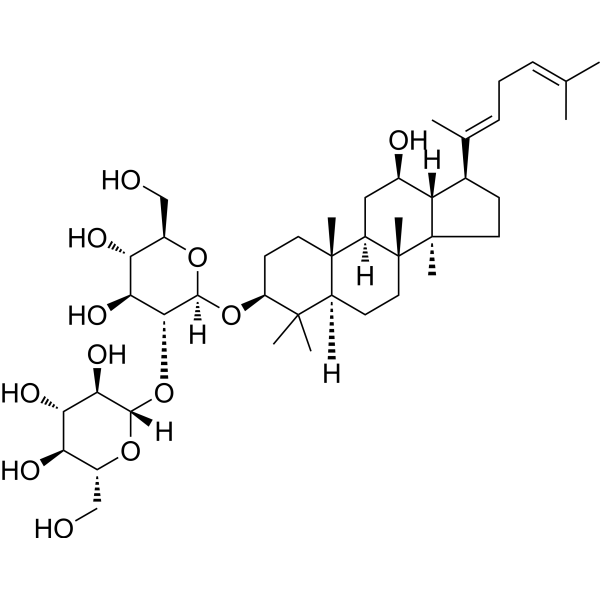
Physicochemical Properties
| Molecular Formula | C42H70O12 |
| Molecular Weight | 766.9980 |
| Exact Mass | 766.486 |
| CAS # | 186763-78-0 |
| PubChem CID | 11550001 |
| Appearance | White to off-white solid powder |
| Density | 1.3±0.1 g/cm3 |
| Boiling Point | 855.6±65.0 °C at 760 mmHg |
| Flash Point | 471.2±34.3 °C |
| Vapour Pressure | 0.0±0.6 mmHg at 25°C |
| Index of Refraction | 1.592 |
| LogP | 6.81 |
| Hydrogen Bond Donor Count | 8 |
| Hydrogen Bond Acceptor Count | 12 |
| Rotatable Bond Count | 9 |
| Heavy Atom Count | 54 |
| Complexity | 1380 |
| Defined Atom Stereocenter Count | 19 |
| SMILES | CC(=CC/C=C(\C)/[C@H]1CC[C@@]2([C@@H]1[C@@H](C[C@H]3[C@]2(CC[C@@H]4[C@@]3(CC[C@@H](C4(C)C)O[C@H]5[C@@H]([C@H]([C@@H]([C@H](O5)CO)O)O)O[C@H]6[C@@H]([C@H]([C@@H]([C@H](O6)CO)O)O)O)C)C)O)C)C |
| InChi Key | NJUXRKMKOFXMRX-RNCAKNGISA-N |
| InChi Code | InChI=1S/C42H70O12/c1-21(2)10-9-11-22(3)23-12-16-42(8)30(23)24(45)18-28-40(6)15-14-29(39(4,5)27(40)13-17-41(28,42)7)53-38-36(34(49)32(47)26(20-44)52-38)54-37-35(50)33(48)31(46)25(19-43)51-37/h10-11,23-38,43-50H,9,12-20H2,1-8H3/b22-11+/t23-,24-,25-,26-,27+,28-,29+,30+,31-,32-,33+,34+,35-,36-,37+,38+,40+,41-,42-/m1/s1 |
| Chemical Name | (2S,3R,4S,5S,6R)-2-[(2R,3R,4S,5S,6R)-4,5-dihydroxy-6-(hydroxymethyl)-2-[[(3S,5R,8R,9R,10R,12R,13R,14R,17S)-12-hydroxy-4,4,8,10,14-pentamethyl-17-[(2E)-6-methylhepta-2,5-dien-2-yl]-2,3,5,6,7,9,11,12,13,15,16,17-dodecahydro-1H-cyclopenta[a]phenanthren-3-yl]oxy]oxan-3-yl]oxy-6-(hydroxymethyl)oxane-3,4,5-triol |
| HS Tariff Code | 2934.99.9001 |
| Storage |
Powder-20°C 3 years 4°C 2 years In solvent -80°C 6 months -20°C 1 month |
| Shipping Condition | Room temperature (This product is stable at ambient temperature for a few days during ordinary shipping and time spent in Customs) |
Biological Activity
| Targets | Ginsenoside Rg5 is an IGF-1R-angiogenic agent. Ginsenoside Rg5 exhibits angiogenic activity, which can be reduced by IGF-1R knockdown. Docking analysis was used to investigate the potential interaction of ginsenoside Rg5 with IGF-1R. The docking results indicated that ginsenoside Rg5 may interact with IGF-1R, and docking analysis was carried out. Rg5 binds to the cysteine-docking domain of IGF-1R at two locations, A and B, with Kd values of 20 and 27 nM, respectively. Using Rg5 as a transferable label for IGF-1 and HUVEC, the IC50 value was ~90 μM, which was higher than the IC50 value of ~1.4 nM for unlabeled IGF-1 [1]. The MTT assay results revealed that after 24, 48, and 72 hours of treatment with ginsenoside Rg5, dose-related parameters influenced MCF-7 cell growth. Various concentrations (0, 25, 50, and 100 μM) of ginsenoside Rg5 influenced MCF-7 cell cycle-related cosmetics. The induced cell cycle appears to be in the G0/G1 phase [3]. |
| ln Vitro |
Ginsenoside Rg5 is an IGF-1R-angiogenic agent. Ginsenoside Rg5 exhibits angiogenic activity, which can be reduced by IGF-1R knockdown. Docking analysis was used to investigate the potential interaction of ginsenoside Rg5 with IGF-1R. The docking results indicated that ginsenoside Rg5 may interact with IGF-1R, and docking analysis was carried out. Rg5 binds to the cysteine-docking domain of IGF-1R at two locations, A and B, with Kd values of 20 and 27 nM, respectively. Using Rg5 as a transferable label for IGF-1 and HUVEC, the IC50 value was ~90 μM, which was higher than the IC50 value of ~1.4 nM for unlabeled IGF-1 [1]. The MTT assay results revealed that after 24, 48, and 72 hours of treatment with ginsenoside Rg5, dose-related parameters influenced MCF-7 cell growth. Various concentrations (0, 25, 50, and 100 μM) of ginsenoside Rg5 influenced MCF-7 cell cycle-related cosmetics. The induced cell cycle appears to be in the G0/G1 phase [3]. Ginsenoside Rg5 stimulates human umbilical vein endothelial cell (HUVEC) proliferation in a dose-dependent manner, with 20 μM Rg5 showing stronger activity than 10 ng/mL VEGF. It promotes HUVEC chemotactic migration and tube formation on Matrigel. Rg5 increases phosphorylation of ERK, Akt, eNOS, Src, FAK, and paxillin in a time-dependent manner. It elevates intracellular NO and cGMP levels, which are inhibited by L-NAME (NOS inhibitor) and IGF-1R knockdown. Rg5 enhances eNOS dimerization and Ca²⁺ mobilization via Gi protein and PLC-γ1 pathways. It does not increase VEGF mRNA expression, promoter activity, or vascular inflammation markers (ICAM-1, VCAM-1). Rg5 does not promote monocyte adhesion to endothelial cells or increase endothelial permeability. [1] |
| ln Vivo |
By blocking NF-κB p65's ability to bind DNA in response to lipopolysaccharide (LPS) stimulation in BV2 astrocytes, ginsenoside Rg5 suppresses the mRNA expression of COX-2. COX-2 and NF-κB p65 expression in the Rg5 model group. Acute cellular respiration occurred and renal tubular injury was evident in the group treated with low-dose ginsenoside Rg5 (10 mg/kg). Nevertheless, while appearing to have histologically normal renal tubules, no inflammation or cast formation was seen in the renal tissue in another group of ginsenoside Rg5 (20 mg/kg) [2]. Ginsenoside Rg5 promotes neovascularization in a Matrigel plug assay in mice, with increased hemoglobin content indicating blood vessel formation. It enhances vessel sprouting in ex vivo rat aortic ring assays. In a mouse hind limb ischemia model, Rg5 improves blood flow recovery and increases capillary density in ischemic muscle. Rg5 induces vasorelaxation in aortic rings from wild-type and high-cholesterol-fed ApoE⁻/⁻ mice, but not in eNOS⁻/⁻ mice. It does not increase vascular permeability in a Miles assay. [1] |
| Enzyme Assay |
IGF-1 binding assay: HUVECs were pretreated with Rg5 (10⁻⁷–5×10⁻² M) for 20 min, followed by incubation with ¹²⁵I-labeled IGF-1 for 10 min. Cell-bound radioactivity was measured by scintillation counting. Rg5 inhibited IGF-1 binding with an IC₅₀ of ~90 nmol/L. [1] Molecular docking simulation: Blind docking of Rg5 to IGF-1R (PDB: 11GR) was performed using Autodock 4.2 with a Lamarckian genetic algorithm. The grid box covered the entire IGF-1R molecule, and 50 million energy evaluations were performed. Binding sites and interactions were visualized using Chimera software. [1] |
| Cell Assay |
Cell proliferation: HUVECs were treated with Rg5 or VEGF for 30 h, then pulsed with ³H-thymidine for 6 h. Incorporated radioactivity was measured by scintillation counting. Cell migration: HUVECs were placed in Transwell inserts coated with gelatin. Rg5 or VEGF was added to the lower chamber. After 4 h, migrated cells were stained and counted. Tube formation: HUVECs were plated on growth factor-reduced Matrigel and treated with Rg5 or VEGF. Tube networks were imaged and quantified after 20 h. NO measurement: HUVECs were loaded with DAF-FM diacetate, treated with Rg5 ± L-NAME, and fluorescence was measured by confocal microscopy. Ca²⁺ measurement: HUVECs were loaded with Fluo-4 AM, treated with Rg5 ± inhibitors, and Ca²⁺ flux was monitored by confocal microscopy. Western blot and immunoprecipitation: Phosphorylation of signaling proteins and eNOS dimerization were analyzed using specific antibodies and low-temperature SDS-PAGE. VEGF expression: VEGF mRNA was measured by RT-PCR, and promoter activity was assessed using a luciferase reporter assay. [1] |
| Animal Protocol |
Matrigel plug assay: C57BL/6 mice were injected subcutaneously with 400 μL Matrigel containing 200 nmol Rg5 or 100 ng VEGF. After 7 days, plugs were excised and hemoglobin content was measured. Hind limb ischemia model: C57BL/6 mice underwent femoral artery ligation, followed by intramuscular injection of Rg5 (300 μmol/100 μL per mouse). Blood flow was monitored by laser-Doppler perfusion imaging at days 7, 14, and 21. Aortic ring vasorelaxation assay: Thoracic aortas from mice were cut into rings and mounted in a myograph system. Rings were preconstricted with U46619 or phenylephrine, then treated with Rg5 or acetylcholine. Relaxation responses were recorded. Miles permeability assay: Evans blue dye was injected intravenously into mice, followed by intradermal injection of Rg5 or VEGF. Dye leakage in skin was quantified spectrophotometrically. [1] |
| References |
[1]. Specific activation of insulin-like growth factor-1 receptor by ginsenoside Rg5 promotes angiogenesis and vasorelaxation. J Biol Chem. 2015 Jan 2;290(1):467-77. [2]. Ginsenoside Rg5 Ameliorates Cisplatin-Induced Nephrotoxicity in Mice through Inhibition of Inflammation, Oxidative Stress, and Apoptosis. Nutrients. 2016 Sep 13;8(9). pii: E566. [3]. Anti-breast cancer activity of Fine Black ginseng (Panax ginseng Meyer) and ginsenoside Rg5. J Ginseng Res. 2015 Apr;39(2):125-34. |
| Additional Infomation |
Ginsenoside Rg5 is a triterpenoid saponin. It has a role as a metabolite. Ginsenoside Rg5 has been reported in Panax notoginseng and Centella asiatica with data available. Ginsenoside Rg5 is a ginsenoside synthesized during the steaming process of ginseng. It acts as a novel non-biological agonist of IGF-1R, promoting angiogenesis and vasorelaxation without the adverse effects associated with VEGF therapy. Its effects are mediated through multiple signaling pathways: PI3K/Akt/eNOS, MEK/ERK, Src/FAK/paxillin, and Gi/PLC/Ca²⁺/eNOS dimerization. It may have therapeutic potential for ischemic vascular diseases and hypertension. [1] |
Solubility Data
| Solubility (In Vitro) | DMSO : ~50 mg/mL (~65.19 mM) |
| Solubility (In Vivo) |
Solubility in Formulation 1: ≥ 2.5 mg/mL (3.26 mM) (saturation unknown) in 10% DMSO + 40% PEG300 + 5% Tween80 + 45% Saline (add these co-solvents sequentially from left to right, and one by one), clear solution. For example, if 1 mL of working solution is to be prepared, you can add 100 μL of 25.0 mg/mL clear DMSO stock solution to 400 μL PEG300 and mix evenly; then add 50 μL Tween-80 to the above solution and mix evenly; then add 450 μL normal saline to adjust the volume to 1 mL. Preparation of saline: Dissolve 0.9 g of sodium chloride in 100 mL ddH₂ O to obtain a clear solution. Solubility in Formulation 2: ≥ 2.5 mg/mL (3.26 mM) (saturation unknown) in 10% DMSO + 90% (20% SBE-β-CD in Saline) (add these co-solvents sequentially from left to right, and one by one), clear solution. For example, if 1 mL of working solution is to be prepared, you can add 100 μL of 25.0 mg/mL clear DMSO stock solution to 900 μL of 20% SBE-β-CD physiological saline solution and mix evenly. Preparation of 20% SBE-β-CD in Saline (4°C,1 week): Dissolve 2 g SBE-β-CD in 10 mL saline to obtain a clear solution. Solubility in Formulation 3: ≥ 2.5 mg/mL (3.26 mM) (saturation unknown) in 10% DMSO + 90% Corn Oil (add these co-solvents sequentially from left to right, and one by one), clear solution. For example, if 1 mL of working solution is to be prepared, you can add 100 μL of 25.0 mg/mL clear DMSO stock solution to 900 μL of corn oil and mix evenly. (Please use freshly prepared in vivo formulations for optimal results.) |
| Preparing Stock Solutions | 1 mg | 5 mg | 10 mg | |
| 1 mM | 1.3038 mL | 6.5189 mL | 13.0378 mL | |
| 5 mM | 0.2608 mL | 1.3038 mL | 2.6076 mL | |
| 10 mM | 0.1304 mL | 0.6519 mL | 1.3038 mL |