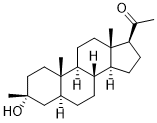
Ganaxolone (CCD-1042; C-1042; Ztalmy) is a novel, CNS-active and potent GABAA modulator. As of March 2022, the US FDA has approved Ztalmy (ganaxolone) to treat seizures associated with cyclin-dependent kinase-like 5 (CDKL5) deficiency disorder (CDD) in patients 2 years of age and older. This is the first treatment for seizures associated with CDD and the first treatment specifically for CDD. Ganaxolone acts on well-characterized targets in the brain known to have anxiolytic and anticonvulsant effects.
Physicochemical Properties
| Molecular Formula | C22H36O2 |
| Molecular Weight | 332.528 |
| Exact Mass | 332.272 |
| CAS # | 38398-32-2 |
| PubChem CID | 6918305 |
| Appearance | Typically exists as solid at room temperature |
| Density | 1.036g/cm3 |
| Boiling Point | 434.8ºC at 760mmHg |
| Melting Point | 190-198C |
| Flash Point | 185.4ºC |
| Index of Refraction | 1.517 |
| LogP | 4.985 |
| Hydrogen Bond Donor Count | 1 |
| Hydrogen Bond Acceptor Count | 2 |
| Rotatable Bond Count | 1 |
| Heavy Atom Count | 24 |
| Complexity | 542 |
| Defined Atom Stereocenter Count | 8 |
| SMILES | O([H])[C@]1(C([H])([H])[H])C([H])([H])C([H])([H])[C@@]2(C([H])([H])[H])[C@]([H])(C1([H])[H])C([H])([H])C([H])([H])[C@@]1([H])[C@]3([H])C([H])([H])C([H])([H])[C@]([H])(C(C([H])([H])[H])=O)[C@@]3(C([H])([H])[H])C([H])([H])C([H])([H])[C@@]12[H] |
| InChi Key | PGTVWKLGGCQMBR-FLBATMFCSA-N |
| InChi Code | InChI=1S/C22H36O2/c1-14(23)17-7-8-18-16-6-5-15-13-20(2,24)11-12-21(15,3)19(16)9-10-22(17,18)4/h15-19,24H,5-13H2,1-4H3/t15-,16-,17+,18-,19-,20+,21-,22+/m0/s1 |
| Chemical Name | 1-((3R,5S,8R,9S,10S,13S,14S,17S)-3-hydroxy-3,10,13-trimethylhexadecahydro-1H-cyclopenta[a]phenanthren-17-yl)ethan-1-one |
| Synonyms | CCD-1042; CCD 1042; C1042; GANAXOLONE; 38398-32-2; 3alpha-Hydroxy-3beta-methyl-5alpha-pregnan-20-one; ganaxolona; UNII-98WI44OHIQ; 98WI44OHIQ; DTXSID6046503; CCD1042; CCD-1042; Ztalmy Ganaxolone |
| HS Tariff Code | 2934.99.9001 |
| Storage |
Powder-20°C 3 years 4°C 2 years In solvent -80°C 6 months -20°C 1 month |
| Shipping Condition | Room temperature (This product is stable at ambient temperature for a few days during ordinary shipping and time spent in Customs) |
Biological Activity
| Targets |
Target: [1] Ganaxolone acts as a positive allosteric modulator of GABAA receptors, binding to neurosteroid sites with highest affinity for synaptic δ-subunit-containing receptors (EC50 = 0.28 μM for α1β2δ receptors). |
| ln Vivo |
In Vivo: [1] In adult male rat anxiety models (elevated plus maze), acute intraperitoneal injection of Ganaxolone (10 mg/kg) increased open-arm exploration time by 75% (p<0.01) and reduced anxiety scores by 40% compared to vehicle controls. In juvenile rat maternal separation models, chronic oral administration of Ganaxolone (5 mg/kg/day for 14 days) normalized stress-induced HPA axis dysregulation, reducing corticosterone levels by 35% (p<0.05) and reversing social interaction deficits. [2] |
| Animal Protocol |
Animal Protocol: [1] Acute anxiety studies: Ganaxolone was dissolved in 20% β-cyclodextrin and administered intraperitoneally at 5, 10, or 20 mg/kg 30 min pre-test. Behavioral assessments included elevated plus maze and open field tests. Developmental studies: Oral suspension of Ganaxolone (2.5 or 5 mg/kg) in 0.5% methylcellulose was given daily via gavage to postnatal day 21-35 rats. Plasma and brain tissue collected 1 h post-final dose. [2] |
| ADME/Pharmacokinetics |
Absorption, Distribution and Excretion Following oral administration, maximum plasma concentrations are reached within 2 to 3 hours. Following a single oral dose of radiolabeled ganaxolone in healthy male subjects, 55% of the administered radioactivity was recovered in the feces (2% as unchanged parent drug) and 18% was recovered in the urine (none of which comprised unchanged parent drug). Both ganaxolone and its metabolites are widely distributed into tissues following oral administration, with a typical tissue-to-plasma ratio >5:1. Metabolism / Metabolites Ganaxolone is extensively metabolized, primarily by CYP3A4/5 and, to a lesser extent, CYP2B6, CYP2C19, and CYP2D6. While data regarding ganaxolone metabolism are lacking, a 16-OH metabolite generated via CYP3A4 metabolism has been identified as one of its major metabolites. Biological Half-Life The terminal half-life of ganaxolone is 34 hours. ADME/Pharmacokinetics: [1] Peak plasma concentration (Cmax) reached 850 ng/mL at 30 min post-IP injection (10 mg/kg) in rats; brain-to-plasma ratio was 2.3, indicating preferential CNS accumulation. Oral bioavailability was 92% in juvenile rats with dose-proportional exposure; elimination half-life (t½) was 1.8 h. [2] |
| Toxicity/Toxicokinetics |
Effects During Pregnancy and Lactation ◉ Summary of Use during Lactation No published information is available on the clinical use of ganaxolone during breastfeeding. However, a study by the manufacturer indicates that amounts in breastmilk appear to be low and would not be expected to cause any adverse effects in breastfed infants. ◉ Effects in Breastfed Infants Relevant published information was not found as of the revision date. ◉ Effects on Lactation and Breastmilk Relevant published information was not found as of the revision date. Protein Binding Ganaxolone is approximately 99% protein-bound in serum. Toxicity/Toxicokinetics: [1] No motor impairment at anxiolytic doses (rotarod test, ≤20 mg/kg). Plasma protein binding >98%. Chronic exposure caused no weight loss or organ toxicity; however, 5 mg/kg/day reduced juvenile play behavior by 20% (p<0.05), suggesting dose-dependent behavioral effects. [2] |
| References |
[1]. Psychopharmacology (Berl). 2015 Apr;232(8):1415-26. [2]. Dev Psychobiol. 2024 Nov;66(7):e22554. |
| Additional Infomation |
Additional Info: [1] Ganaxolone is a synthetic analog of allopregnanolone developed for treatment-resistant epilepsy and anxiety disorders. Phase 2 trials demonstrated 35% seizure reduction in CDKL5 deficiency disorder. It modulates GABAergic inhibition without benzodiazepine-like tolerance. FDA-approved in 2022 for cyclin-dependent kinase-like 5 (CDKL5) deficiency disorder-related seizures.[2] Ganaxolone is a corticosteroid hormone. Ganaxolone is a DEA Schedule V controlled substance. Substances in the DEA Schedule V have a low potential for abuse relative to substances listed in Schedule IV and consist primarily of preparations containing limited quantities of certain narcotics. It is a Depressants substance. Ganaxolone is the 3β-methylated synthetic analog of [allopregnanolone], a metabolite of [progesterone]. Ganaxolone belongs to a class of compounds referred to as neurosteroids. Endogenous neurosteroids, which comprise certain metabolites of progesterone and deoxycorticosterone, bind potently and specifically to GABAA receptors to enhance their inhibitory effects, and are thus known to have anxiolytic, analgesic, anticonvulsant, sedative, hypnotic, and anesthetic properties. Ganaxolone, similar to its endogenous counterparts, is a positive allosteric modulator of GABAA receptors. It was approved under the brand name ZTALMY by the US FDA in March 2022 for the treatment of seizures associated with CDKL5 deficiency disorder (CDD), becoming the first FDA-approved treatment indicated specifically for CDD. In July 2023, ganaxolone was also approved under the same brand name and for the same indication by the EMA. Ganaxolone is a Neuroactive Steroid Gamma-Aminobutyric Acid A Receptor Positive Modulator. The mechanism of action of ganaxolone is as a GABA A Receptor Positive Modulator. Ganaxolone is an orally bioavailable synthetic analog of the neuroactive steroid allopregnanolone and positive allosteric modulator of the gamma-aminobutyric acid (GABA)-A receptor, with anxiolytic, sedative, antidepressant and anticonvulsant activities. Upon oral administration, ganaxolone specifically targets and binds to the allosteric sites of the synaptic and extrasynaptic GABA-A receptor-chloride ionophore complex in the central nervous system (CNS). This leads to an increase in the opening of chloride channels, membrane hyperpolarization, increases the inhibitory effect of GABA on the CNS, and inhibits neurotransmission. This blocks seizure propagation and elevates seizure thresholds. Drug Indication Ganaxolone is indicated for the treatment of seizures associated with cyclin-dependent kinase-like 5 (CDKL5) deficiency disorder (CDD) in patients ≥2 years old by the FDA. It is also approved as an adjuvant treatment for the same condition in patients aged 2 to 17, although it may be continued in patients 18 years old or older, by the EMA. Ztalmy is indicated for the adjunctive treatment of epileptic seizures associated with cyclin-dependent kinase-like 5 (CDKL5) deficiency disorder (CDD) in patients 2 to 17 years of age. Ztalmy may be continued in patients 18 years of age and older. Treatment of cyclin-dependent kinase-like 5 deficiency disorder Mechanism of Action Ganaxolone belongs to a novel class of neuroactive steroids sometimes referred to as "epalons", which are potent and specific positive allosteric modulators of γ-aminobutyric acid type A (GABAA) receptors in the central nervous system (CNS). It binds GABAA at one of several potential binding sites, all of which are distinct from the benzodiazepine binding site. By enhancing the inhibitory effects of GABAA receptors, endogenous and exogenous neurosteroids have been associated with anxiolytic, sedative, and anticonvulsant effects, amongst others. While the precise mechanism of action of ganaxolone in the treatment of seizures associated with CDD is unknown, its anticonvulsant effects are likely due to positive allosteric GABAA modulation Pharmacodynamics Ganaxolone - like other neurosteroids - lacks classical hormonal activity, and instead appears to exert its effects directly via modulation of GABAA receptors. Similar to other antiepileptic drugs, ganaxolone has been associated with significant somnolence and sedation - patients should be instructed to use caution when operating heavy machinery (e.g. driving). In addition, antiepileptic drugs may increase the risk of suicidal behaviour and ideation, although this risk has not been documented directly in patients taking ganaxolone. When considering ganaxolone therapy, clinicians should balance the risk of suicidal thoughts or behaviours with the risk of untreated illness. Ganaxolone drug scheduling is currently under review by the US Drug Enforcement Administration (DEA), but it appears to carry some potential for abuse. Clinicians should consider assessing for a history of drug abuse when deciding to initiate therapy with ganaxolone. |
Solubility Data
| Solubility (In Vitro) | May dissolve in DMSO (in most cases), if not, try other solvents such as H2O, Ethanol, or DMF with a minute amount of products to avoid loss of samples |
| Solubility (In Vivo) |
Note: Listed below are some common formulations that may be used to formulate products with low water solubility (e.g. < 1 mg/mL), you may test these formulations using a minute amount of products to avoid loss of samples. Injection Formulations (e.g. IP/IV/IM/SC) Injection Formulation 1: DMSO : Tween 80: Saline = 10 : 5 : 85 (i.e. 100 μL DMSO stock solution → 50 μL Tween 80 → 850 μL Saline) *Preparation of saline: Dissolve 0.9 g of sodium chloride in 100 mL ddH ₂ O to obtain a clear solution. Injection Formulation 2: DMSO : PEG300 :Tween 80 : Saline = 10 : 40 : 5 : 45 (i.e. 100 μL DMSO → 400 μLPEG300 → 50 μL Tween 80 → 450 μL Saline) Injection Formulation 3: DMSO : Corn oil = 10 : 90 (i.e. 100 μL DMSO → 900 μL Corn oil) Example: Take the Injection Formulation 3 (DMSO : Corn oil = 10 : 90) as an example, if 1 mL of 2.5 mg/mL working solution is to be prepared, you can take 100 μL 25 mg/mL DMSO stock solution and add to 900 μL corn oil, mix well to obtain a clear or suspension solution (2.5 mg/mL, ready for use in animals). Injection Formulation 4: DMSO : 20% SBE-β-CD in saline = 10 : 90 [i.e. 100 μL DMSO → 900 μL (20% SBE-β-CD in saline)] *Preparation of 20% SBE-β-CD in Saline (4°C,1 week): Dissolve 2 g SBE-β-CD in 10 mL saline to obtain a clear solution. Injection Formulation 5: 2-Hydroxypropyl-β-cyclodextrin : Saline = 50 : 50 (i.e. 500 μL 2-Hydroxypropyl-β-cyclodextrin → 500 μL Saline) Injection Formulation 6: DMSO : PEG300 : castor oil : Saline = 5 : 10 : 20 : 65 (i.e. 50 μL DMSO → 100 μLPEG300 → 200 μL castor oil → 650 μL Saline) Injection Formulation 7: Ethanol : Cremophor : Saline = 10: 10 : 80 (i.e. 100 μL Ethanol → 100 μL Cremophor → 800 μL Saline) Injection Formulation 8: Dissolve in Cremophor/Ethanol (50 : 50), then diluted by Saline Injection Formulation 9: EtOH : Corn oil = 10 : 90 (i.e. 100 μL EtOH → 900 μL Corn oil) Injection Formulation 10: EtOH : PEG300:Tween 80 : Saline = 10 : 40 : 5 : 45 (i.e. 100 μL EtOH → 400 μLPEG300 → 50 μL Tween 80 → 450 μL Saline) Oral Formulations Oral Formulation 1: Suspend in 0.5% CMC Na (carboxymethylcellulose sodium) Oral Formulation 2: Suspend in 0.5% Carboxymethyl cellulose Example: Take the Oral Formulation 1 (Suspend in 0.5% CMC Na) as an example, if 100 mL of 2.5 mg/mL working solution is to be prepared, you can first prepare 0.5% CMC Na solution by measuring 0.5 g CMC Na and dissolve it in 100 mL ddH2O to obtain a clear solution; then add 250 mg of the product to 100 mL 0.5% CMC Na solution, to make the suspension solution (2.5 mg/mL, ready for use in animals). Oral Formulation 3: Dissolved in PEG400 Oral Formulation 4: Suspend in 0.2% Carboxymethyl cellulose Oral Formulation 5: Dissolve in 0.25% Tween 80 and 0.5% Carboxymethyl cellulose Oral Formulation 6: Mixing with food powders Note: Please be aware that the above formulations are for reference only. InvivoChem strongly recommends customers to read literature methods/protocols carefully before determining which formulation you should use for in vivo studies, as different compounds have different solubility properties and have to be formulated differently. (Please use freshly prepared in vivo formulations for optimal results.) |
| Preparing Stock Solutions | 1 mg | 5 mg | 10 mg | |
| 1 mM | 3.0072 mL | 15.0362 mL | 30.0725 mL | |
| 5 mM | 0.6014 mL | 3.0072 mL | 6.0145 mL | |
| 10 mM | 0.3007 mL | 1.5036 mL | 3.0072 mL |