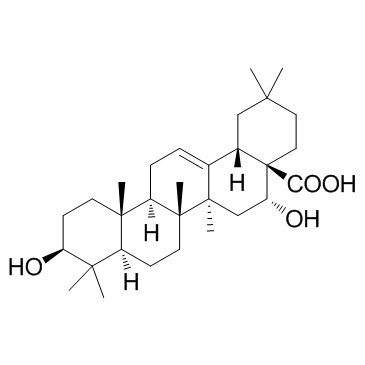
Echinocystic acid is a naturally occurring pentacyclic triterpene found in the fruits of Gleditsia sinensis Lam with antioxidant, anti-inflammatory and anticancer pactivities.
Physicochemical Properties
| Molecular Formula | C30H48O4 |
| Molecular Weight | 472.6997 |
| Exact Mass | 472.355 |
| CAS # | 510-30-5 |
| PubChem CID | 73309 |
| Appearance | White to off-white solid powder |
| Density | 1.1±0.1 g/cm3 |
| Boiling Point | 585.0±50.0 °C at 760 mmHg |
| Melting Point | 299-300ºC |
| Flash Point | 321.6±26.6 °C |
| Vapour Pressure | 0.0±3.7 mmHg at 25°C |
| Index of Refraction | 1.568 |
| LogP | 7.58 |
| Hydrogen Bond Donor Count | 3 |
| Hydrogen Bond Acceptor Count | 4 |
| Rotatable Bond Count | 1 |
| Heavy Atom Count | 34 |
| Complexity | 919 |
| Defined Atom Stereocenter Count | 9 |
| SMILES | C[C@]12CC[C@@H](C([C@@H]1CC[C@@]3([C@@H]2CC=C4[C@]3(C[C@H]([C@@]5([C@H]4CC(CC5)(C)C)C(=O)O)O)C)C)(C)C)O |
| InChi Key | YKOPWPOFWMYZJZ-PRIAQAIDSA-N |
| InChi Code | InChI=1S/C30H48O4/c1-25(2)14-15-30(24(33)34)19(16-25)18-8-9-21-27(5)12-11-22(31)26(3,4)20(27)10-13-28(21,6)29(18,7)17-23(30)32/h8,19-23,31-32H,9-17H2,1-7H3,(H,33,34)/t19-,20-,21+,22-,23+,27-,28+,29+,30+/m0/s1 |
| Chemical Name | (4aR,5R,6aR,6aS,6bR,8aR,10S,12aR,14bS)-5,10-dihydroxy-2,2,6a,6b,9,9,12a-heptamethyl-1,3,4,5,6,6a,7,8,8a,10,11,12,13,14b-tetradecahydropicene-4a-carboxylic acid |
| HS Tariff Code | 2934.99.9001 |
| Storage |
Powder-20°C 3 years 4°C 2 years In solvent -80°C 6 months -20°C 1 month |
| Shipping Condition | Room temperature (This product is stable at ambient temperature for a few days during ordinary shipping and time spent in Customs) |
Biological Activity
| Targets |
- Echinocystic acid targets cyclooxygenase-2 (COX-2) and inducible nitric oxide synthase (iNOS) [1] |
| ln Vitro |
Echinocystic acid (2.5–10 μM; 1 hour off) suppresses the activation of NF-κB and MAPK caused by IL-1β [1]. Echinacetic acid exhibits dose-dependent inhibition of MMP-13, NO, and PGE2 produced by IL-1β. COX-2 and iNOS are upregulated in response to IL-1β, and echinocystic acid inhibits this upregulation [1]. - In human osteoarthritis chondrocytes treated with interleukin-1β (IL-1β), Echinocystic acid dose-dependently inhibited the expression of COX-2 and iNOS at both mRNA and protein levels. It also suppressed IL-1β-induced activation of nuclear factor-kappa B (NF-κB) and mitogen-activated protein kinase (MAPK) signaling pathways, which are involved in the regulation of COX-2 and iNOS expression [1] |
| ln Vivo |
In a dyad model of pain and depression generated by reserpine, echinocystic acid (5 mg/kg daily for 5 days) had antidepressant effects [2]. - In reserpine-induced pain/depression dyad model in mice, Echinocystic acid (administered at specific doses) alleviated pain responses, as evidenced by increased latency in tail flick test and hot plate test. It also reduced depressive-like behaviors, shown by decreased immobility time in forced swimming test and tail suspension test. Additionally, Echinocystic acid reversed reserpine-induced reductions in brain levels of serotonin (5-HT) and norepinephrine (NE), and inhibited increases in serum levels of pro-inflammatory cytokines (e.g., tumor necrosis factor-alpha [TNF-α], interleukin-6 [IL-6]) [2] |
| Cell Assay |
Western Blot Analysis [1] Cell Types: Chondrocytes Tested Concentrations: 2.5 μM, 5 μM, 10 μM Incubation Duration: Pretreatment for 1 hour, then stimulated with IL-1β for 30 minutes. Experimental Results: IL-1β-induced NF-κB and MAPK activation was inhibited. - Human osteoarthritis chondrocytes were isolated and cultured in appropriate medium. Cells were divided into control group, IL-1β (10 ng/mL) treatment group, and Echinocystic acid (at concentrations of 1, 5, 10 μM) + IL-1β co-treatment groups. After 24 hours of incubation, total RNA was extracted to detect COX-2 and iNOS mRNA expression via reverse transcription-polymerase chain reaction (RT-PCR). Total protein was extracted to determine COX-2 and iNOS protein levels, as well as phosphorylation levels of NF-κB p65 and MAPK (p38, extracellular signal-regulated kinase [ERK], c-Jun N-terminal kinase [JNK]) via Western blot analysis [1] |
| Animal Protocol |
Animal/Disease Models: Male adult C57BL/6 mice (8-10 weeks old; 18 to 22 g) with reserpine injection [2] Doses: 5 mg/kg Route of Administration: Intragastric; one time/day for 5 days Experimental Results: Partially alleviates the pain/depression binary effects of reserpine by modulating biogenic amine levels and GluN2B receptors in the hippocampus. - Male mice were randomly divided into control group, reserpine model group (1 mg/kg, intraperitoneal injection once daily for 3 days), and Echinocystic acid treatment groups (10, 20, 40 mg/kg, intragastric administration once daily for 7 days, with reserpine co-administered on days 5-7). Pain-related behaviors were evaluated using tail flick test (measuring latency to tail withdrawal from heat stimulus) and hot plate test (measuring latency to paw licking or jumping). Depressive-like behaviors were assessed via forced swimming test (recording immobility time within 5 minutes) and tail suspension test (recording immobility time within 6 minutes). After behavioral tests, mice were sacrificed to collect brain tissues for detecting 5-HT and NE levels, and serum for measuring TNF-α and IL-6 levels [2] |
| References |
[1]. Echinocystic Acid Inhibits IL-1β-Induced COX-2 and iNOS Expression in Human Osteoarthritis Chondrocytes. Inflammation. 2016 Apr;39(2):543-9. [2]. Echinocystic acid reduces reserpine-induced pain/depression dyad in mice. Metab Brain Dis. 2016 Apr;31(2):455-63. |
| Additional Infomation |
Echinocystic acid is a triterpenoid. Echinocystic acid has been reported in Gleditsia sinensis, Eclipta alba, and other organisms with data available. - Echinocystic acid exerts anti-inflammatory effects in human osteoarthritis chondrocytes by targeting COX-2/iNOS and regulating NF-κB/MAPK pathways, which may provide a potential therapeutic strategy for osteoarthritis [1] - Echinocystic acid ameliorates reserpine-induced pain/depression dyad in mice by modulating monoamine neurotransmitters (5-HT, NE) and inhibiting systemic inflammation, suggesting its potential in treating comorbid pain and depression [2] |
Solubility Data
| Solubility (In Vitro) | DMSO : ~50 mg/mL (~105.78 mM) |
| Solubility (In Vivo) |
Solubility in Formulation 1: ≥ 2.75 mg/mL (5.82 mM) (saturation unknown) in 10% DMSO + 90% Corn Oil (add these co-solvents sequentially from left to right, and one by one), clear solution. For example, if 1 mL of working solution is to be prepared, you can add 100 μL of 27.5 mg/mL clear DMSO stock solution to 900 μL of corn oil and mix evenly. (Please use freshly prepared in vivo formulations for optimal results.) |
| Preparing Stock Solutions | 1 mg | 5 mg | 10 mg | |
| 1 mM | 2.1155 mL | 10.5775 mL | 21.1551 mL | |
| 5 mM | 0.4231 mL | 2.1155 mL | 4.2310 mL | |
| 10 mM | 0.2116 mL | 1.0578 mL | 2.1155 mL |