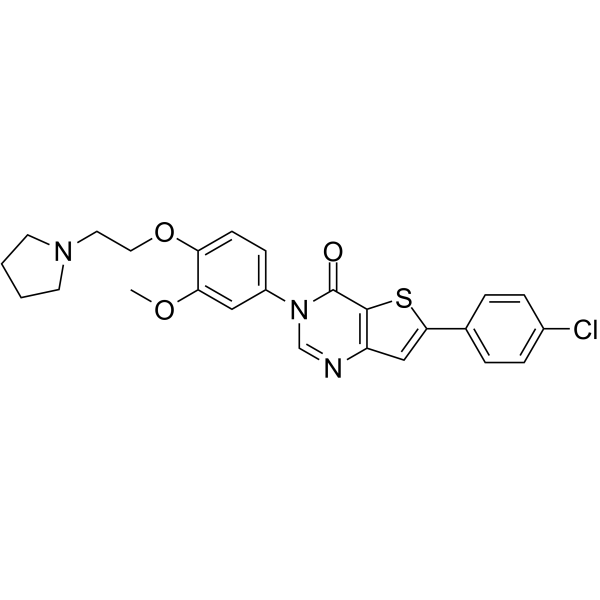
Physicochemical Properties
| Molecular Formula | C25H24CLN3O3S |
| Molecular Weight | 481.995 |
| Exact Mass | 481.123 |
| Elemental Analysis | C, 62.30; H, 5.02; Cl, 7.35; N, 8.72; O, 9.96; S, 6.65 |
| CAS # | 515141-51-2 |
| PubChem CID | 9826520 |
| Appearance | Off-white to yellow solid powder |
| LogP | 5.188 |
| Hydrogen Bond Donor Count | 0 |
| Hydrogen Bond Acceptor Count | 6 |
| Rotatable Bond Count | 7 |
| Heavy Atom Count | 33 |
| Complexity | 698 |
| Defined Atom Stereocenter Count | 0 |
| InChi Key | MWULMTACIBZPGN-UHFFFAOYSA-N |
| InChi Code | InChI=1S/C25H24ClN3O3S/c1-31-22-14-19(8-9-21(22)32-13-12-28-10-2-3-11-28)29-16-27-20-15-23(33-24(20)25(29)30)17-4-6-18(26)7-5-17/h4-9,14-16H,2-3,10-13H2,1H3 |
| Chemical Name | 6-(4-chlorophenyl)-3-[3-methoxy-4-(2-pyrrolidin-1-ylethoxy)phenyl]thieno[3,2-d]pyrimidin-4-one |
| Synonyms | GW803430; GW 803430; 515141-51-2; GW-3430; Thieno[3,2-d]pyrimidin-4(3H)-one, 6-(4-chlorophenyl)-3-[3-methoxy-4-[2-(1-pyrrolidinyl)ethoxy]phenyl]-; 6-(4-chlorophenyl)-3-(3-methoxy-4-(2-(pyrrolidin-1-yl)ethoxy)phenyl)thieno[3,2-d]pyrimidin-4(3H)-one; GW803430; GW3430; CHEMBL214957; GW-803430 |
| HS Tariff Code | 2934.99.9001 |
| Storage |
Powder-20°C 3 years 4°C 2 years In solvent -80°C 6 months -20°C 1 month |
| Shipping Condition | Room temperature (This product is stable at ambient temperature for a few days during ordinary shipping and time spent in Customs) |
Biological Activity
| Targets | MCH R1/melanin-concentrating hormone receptor 1 (pIC50 = 9.3) |
| ln Vitro | The MCH-induced MCHR1 receptor is highly active against GW-803430, with an IC50 value of about 13 nM [2]. |
| ln Vivo | In comparison to the vehicle control, GW-803430 (0.3, 3, and 15 mg/kg; oral; once daily) produced a sustained dose-dependent weight decrease [1]. Because of its favorable pharmacokinetic characteristics in mice (bioavailability = 31%, t1/2 = 11 h) and brain penetration (6:1 brain:plasma concentration), GW-803430 is an appropriate molecule [1]. |
| Enzyme Assay |
Melanin Concentrating Hormone Receptor (MCHR 1 ) Assay. [2] Antagonistic potential of N. nucifera extracts on MCHR1 receptor was studied using MCHR1 Gi coupled CHO-K1 cells. Cell density of 3 × 10⁴ cells/well was plated in 96-well tissue culture plates containing cell plating reagent and incubated for 24 h. After incubation, the entire medium was aspirated and 45 μL of cell assay buffer and antibody mixture was added to each well. N. nucifera or reference antagonist (GW 803430) was added to the respective wells and incubated for 15 min at 37°C and 5% CO2. Agonist compound (MCH—62.5 nM + Forskolin 20 μM) was added to the respective wells and incubated for 30 min. 60 μL of prepared detection reagent solution and cAMP solution D was added to each well and incubated for 60 min at room temperature in the dark. 60 μL of cAMP Solution A was added and incubated for 3 hr at room temperature in the dark. Plate was read using luminescence plate reader (FLUOstar). |
| Cell Assay | The compounds were assayed for MCH R1 functional antagonist activity as described in WO 2004/092181 A1 (corrected version), pp 215–216. CHO cells expressing an elkgal4-luc+ reporter gene (host) were transfected with human MCH R1. The ability of the antagonists to inhibit an EC80 response of MCH was assessed via a TopCount microplate scintillation counter (Packard) and the specificity of the MCH R1 response was determined by measuring the ability of the antagonists to inhibit an EC80 thrombin response in the host cells. All compounds were assayed with n ⩾ 4. [1] |
| Animal Protocol |
Animal/Disease Models: High-fat diet-induced obese AKR/J mice [1] Doses: 0.3, 3, and 15 mg/kg Route of Administration: Orally, one time/day for 12 days Experimental Results: Result in sustained dose-dependent weight loss of -6.2 %, relative to vehicle control, were -12.1% and -13.1% respectively. |
| References |
[1]. The discovery and optimization of pyrimidinone-containing MCH R1 antagonists. Bioorg Med Chem Lett. 2006 Sep 15;16(18):4723-7. [2]. Effect of Nelumbo nucifera Petal Extracts on Lipase, Adipogenesis, Adipolysis, and Central Receptors of Obesity. Evid Based Complement Alternat Med. 2013;2013:145925. |
| Additional Infomation |
Optimization of a series of constrained melanin-concentrating hormone receptor 1 (MCH R1) antagonists has provided compounds with potent and selective MCH R1 activity. Details of the optimization process are provided and the use of one of the compounds in an animal model of diet-induced obesity is presented. [1] N. nucifera is one among the important medicinal plants assessed for its antiobesity action in various preclinical models. The present study was aimed at investigating the antiobesity effect of methanol and successive water extracts of petals of N. nucifera by studying its effect on adipogenesis, adipolysis, lipase, serotonin (5-HT2C), cannabinoid (CNR2), melanocyte concentrating hormone (MCHR1), and melanocortin (MC4R) receptors. Both methanol and successive water extracts of N. nucifera petals had an effect on inhibition of lipid storage in adipocytes and on increasing lipolysis. N. nucifera petal methanol extract exhibited the concentration-dependent inhibitory effect on lipase activity with an IC50 value of 47 µg/mL. N. nucifera petal extracts showed evident agonist and antagonist activity towards 5-HT2C and CNR2 receptors, respectively, while it showed no effect towards MCHR1 and MC4R receptors. Overall, methanol extract of N. nucifera petals showed better activity than successive water extract. [2] |
Solubility Data
| Solubility (In Vitro) | May dissolve in DMSO (in most cases), if not, try other solvents such as H2O, Ethanol, or DMF with a minute amount of products to avoid loss of samples |
| Solubility (In Vivo) |
Note: Listed below are some common formulations that may be used to formulate products with low water solubility (e.g. < 1 mg/mL), you may test these formulations using a minute amount of products to avoid loss of samples. Injection Formulations (e.g. IP/IV/IM/SC) Injection Formulation 1: DMSO : Tween 80: Saline = 10 : 5 : 85 (i.e. 100 μL DMSO stock solution → 50 μL Tween 80 → 850 μL Saline) *Preparation of saline: Dissolve 0.9 g of sodium chloride in 100 mL ddH ₂ O to obtain a clear solution. Injection Formulation 2: DMSO : PEG300 :Tween 80 : Saline = 10 : 40 : 5 : 45 (i.e. 100 μL DMSO → 400 μLPEG300 → 50 μL Tween 80 → 450 μL Saline) Injection Formulation 3: DMSO : Corn oil = 10 : 90 (i.e. 100 μL DMSO → 900 μL Corn oil) Example: Take the Injection Formulation 3 (DMSO : Corn oil = 10 : 90) as an example, if 1 mL of 2.5 mg/mL working solution is to be prepared, you can take 100 μL 25 mg/mL DMSO stock solution and add to 900 μL corn oil, mix well to obtain a clear or suspension solution (2.5 mg/mL, ready for use in animals). Injection Formulation 4: DMSO : 20% SBE-β-CD in saline = 10 : 90 [i.e. 100 μL DMSO → 900 μL (20% SBE-β-CD in saline)] *Preparation of 20% SBE-β-CD in Saline (4°C,1 week): Dissolve 2 g SBE-β-CD in 10 mL saline to obtain a clear solution. Injection Formulation 5: 2-Hydroxypropyl-β-cyclodextrin : Saline = 50 : 50 (i.e. 500 μL 2-Hydroxypropyl-β-cyclodextrin → 500 μL Saline) Injection Formulation 6: DMSO : PEG300 : castor oil : Saline = 5 : 10 : 20 : 65 (i.e. 50 μL DMSO → 100 μLPEG300 → 200 μL castor oil → 650 μL Saline) Injection Formulation 7: Ethanol : Cremophor : Saline = 10: 10 : 80 (i.e. 100 μL Ethanol → 100 μL Cremophor → 800 μL Saline) Injection Formulation 8: Dissolve in Cremophor/Ethanol (50 : 50), then diluted by Saline Injection Formulation 9: EtOH : Corn oil = 10 : 90 (i.e. 100 μL EtOH → 900 μL Corn oil) Injection Formulation 10: EtOH : PEG300:Tween 80 : Saline = 10 : 40 : 5 : 45 (i.e. 100 μL EtOH → 400 μLPEG300 → 50 μL Tween 80 → 450 μL Saline) Oral Formulations Oral Formulation 1: Suspend in 0.5% CMC Na (carboxymethylcellulose sodium) Oral Formulation 2: Suspend in 0.5% Carboxymethyl cellulose Example: Take the Oral Formulation 1 (Suspend in 0.5% CMC Na) as an example, if 100 mL of 2.5 mg/mL working solution is to be prepared, you can first prepare 0.5% CMC Na solution by measuring 0.5 g CMC Na and dissolve it in 100 mL ddH2O to obtain a clear solution; then add 250 mg of the product to 100 mL 0.5% CMC Na solution, to make the suspension solution (2.5 mg/mL, ready for use in animals). Oral Formulation 3: Dissolved in PEG400 Oral Formulation 4: Suspend in 0.2% Carboxymethyl cellulose Oral Formulation 5: Dissolve in 0.25% Tween 80 and 0.5% Carboxymethyl cellulose Oral Formulation 6: Mixing with food powders Note: Please be aware that the above formulations are for reference only. InvivoChem strongly recommends customers to read literature methods/protocols carefully before determining which formulation you should use for in vivo studies, as different compounds have different solubility properties and have to be formulated differently. (Please use freshly prepared in vivo formulations for optimal results.) |
| Preparing Stock Solutions | 1 mg | 5 mg | 10 mg | |
| 1 mM | 2.0747 mL | 10.3734 mL | 20.7469 mL | |
| 5 mM | 0.4149 mL | 2.0747 mL | 4.1494 mL | |
| 10 mM | 0.2075 mL | 1.0373 mL | 2.0747 mL |