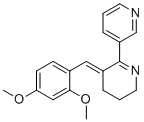
GTS-21 is a novel and potent alpha7nAChR nicotinic receptor agonist
Physicochemical Properties
| Molecular Formula | C19H20N2O2 |
| Molecular Weight | 308.381 |
| Exact Mass | 308.152 |
| CAS # | 148372-04-7 |
| PubChem CID | 5310985 |
| Appearance | Typically exists as solid at room temperature |
| LogP | 3.2 |
| Hydrogen Bond Donor Count | 0 |
| Hydrogen Bond Acceptor Count | 4 |
| Rotatable Bond Count | 4 |
| Heavy Atom Count | 23 |
| Complexity | 447 |
| Defined Atom Stereocenter Count | 0 |
| SMILES | COC1=CC=C(/C=C/2\CCCN=C2C3=CN=CC=C3)C(=C1)OC |
| InChi Key | RPYWXZCFYPVCNQ-RVDMUPIBSA-N |
| InChi Code | InChI=1S/C19H20N2O2/c1-22-17-8-7-14(18(12-17)23-2)11-15-5-4-10-21-19(15)16-6-3-9-20-13-16/h3,6-9,11-13H,4-5,10H2,1-2H3/b15-11+ |
| Chemical Name | 3-[(5E)-5-[(2,4-dimethoxyphenyl)methylidene]-3,4-dihydro-2H-pyridin-6-yl]pyridine |
| Synonyms | GTS21 GTS 21GTS-21 DMXB-A |
| HS Tariff Code | 2934.99.9001 |
| Storage |
Powder-20°C 3 years 4°C 2 years In solvent -80°C 6 months -20°C 1 month |
| Shipping Condition | Room temperature (This product is stable at ambient temperature for a few days during ordinary shipping and time spent in Customs) |
Biological Activity
| ADME/Pharmacokinetics |
Absorption, Distribution and Excretion Rapidly and extensively absorbed after oral administration. In rat, GTS-21 showed linear pharmacokinetics over doses ranging from 1 to 10 mg/kg with an absolute bioavailability of 23%. In dog, the absolute bioavailability was 27% at an oral dose of 3 mg/kg. Metabolism / Metabolites GTS-21 was O-demethylated to yield compounds that were then subject to glucuronidation. Three of the metabolites in rat urine were isolated and characterized as 4-OH-GTS-21, 4-OH-GTS-21 glucuronide and 2-OH-GTS-21 glucuronide. The major urinary metabolites were 4-OH-GTS-21 glucuronide and 2-OH-GTS-21 glucuronide. In vitro chemical inhibition of cytochrome P450 in human liver microsomes indicated that CYPIA2 and CYP2E1 were the isoforms primarily responsible for the O-demethylation of GTS-21, with some contribution from CYP3A. Gts-21 has known human metabolites that include 2-hydroxy-GTS-21 and 4-hydroxy-GTS-21. |
| References |
[1]. Functional characterization of the novel neuronal nicotinic acetylcholine receptor ligand GTS-21 in vitro and in vivo. Pharmacol Biochem Behav. 1997;57(1-2):231-241. [2]. N-terminal domains in mouse and human 5-hydroxytryptamine3A receptors confer partial agonist and antagonist properties to benzylidene analogs of anabaseine. J Pharmacol Exp Ther. 2006;317(3):1276-1284. [3]. α7 nAchR agonist GTS 21 reduces radiation induced lung injury. Oncol Rep. 2018;40(4):2287-2297. |
| Additional Infomation |
DMXB-A is a dimethoxybenzene. GTS-21 (also known as DMBX-A), is a novel, small-molecule, orally active and selective alpha-7 nicotinic acetylcholine (nACh) receptor agonist that has demonstrated memory and cognition enhancement activity in human clinical trials. Athenagen licensed the exclusive rights to the compound and a related library of analogs as part of the acquisition of Osprey Pharmaceutical Company in April 2006. GTS-21 has been studied in multiple Phase I studies in healthy volunteers and one Phase I/II study in schizophrenic patients. In all studies, the compound was well tolerated. In a Phase I multi-dose, double-blind, placebo controlled study in healthy adults, GTS-21 also demonstrated cognitive enhancement across all doses, with a statistically significant improvement in attention related and memory related tasks (Kitagawa, et al. Neuropsychopharmacology (2003), 28, 542-551). See also: 3-(2,4-Dimethoxybenzylidene)Anabaseine (annotation moved to). Drug Indication Investigated for use/treatment in alzheimer's disease and schizophrenia and schizoaffective disorders. Mechanism of Action Auditory sensory gating, a biological measurement of the ability to suppress the evoked response to the second of two auditory stimuli, is diminished in people with schizophrenia. Deficits in sensory gating are associated with attentional impairment, and may contribute to cognitive symptoms and perceptual disturbances. This inhibitory process, which involves the alpha(7) nicotinic receptor mediated release of gamma-aminobutyric acid (GABA) by hippocampal interneurons, represents a potential new target for therapeutic intervention in schizophrenia. GTS-21 is an orally active alpha-7 nicotinic acetylcholine (nACh) receptor agonist. |
Solubility Data
| Solubility (In Vitro) | May dissolve in DMSO (in most cases), if not, try other solvents such as H2O, Ethanol, or DMF with a minute amount of products to avoid loss of samples |
| Solubility (In Vivo) |
Note: Listed below are some common formulations that may be used to formulate products with low water solubility (e.g. < 1 mg/mL), you may test these formulations using a minute amount of products to avoid loss of samples. Injection Formulations (e.g. IP/IV/IM/SC) Injection Formulation 1: DMSO : Tween 80: Saline = 10 : 5 : 85 (i.e. 100 μL DMSO stock solution → 50 μL Tween 80 → 850 μL Saline) *Preparation of saline: Dissolve 0.9 g of sodium chloride in 100 mL ddH ₂ O to obtain a clear solution. Injection Formulation 2: DMSO : PEG300 :Tween 80 : Saline = 10 : 40 : 5 : 45 (i.e. 100 μL DMSO → 400 μLPEG300 → 50 μL Tween 80 → 450 μL Saline) Injection Formulation 3: DMSO : Corn oil = 10 : 90 (i.e. 100 μL DMSO → 900 μL Corn oil) Example: Take the Injection Formulation 3 (DMSO : Corn oil = 10 : 90) as an example, if 1 mL of 2.5 mg/mL working solution is to be prepared, you can take 100 μL 25 mg/mL DMSO stock solution and add to 900 μL corn oil, mix well to obtain a clear or suspension solution (2.5 mg/mL, ready for use in animals). Injection Formulation 4: DMSO : 20% SBE-β-CD in saline = 10 : 90 [i.e. 100 μL DMSO → 900 μL (20% SBE-β-CD in saline)] *Preparation of 20% SBE-β-CD in Saline (4°C,1 week): Dissolve 2 g SBE-β-CD in 10 mL saline to obtain a clear solution. Injection Formulation 5: 2-Hydroxypropyl-β-cyclodextrin : Saline = 50 : 50 (i.e. 500 μL 2-Hydroxypropyl-β-cyclodextrin → 500 μL Saline) Injection Formulation 6: DMSO : PEG300 : castor oil : Saline = 5 : 10 : 20 : 65 (i.e. 50 μL DMSO → 100 μLPEG300 → 200 μL castor oil → 650 μL Saline) Injection Formulation 7: Ethanol : Cremophor : Saline = 10: 10 : 80 (i.e. 100 μL Ethanol → 100 μL Cremophor → 800 μL Saline) Injection Formulation 8: Dissolve in Cremophor/Ethanol (50 : 50), then diluted by Saline Injection Formulation 9: EtOH : Corn oil = 10 : 90 (i.e. 100 μL EtOH → 900 μL Corn oil) Injection Formulation 10: EtOH : PEG300:Tween 80 : Saline = 10 : 40 : 5 : 45 (i.e. 100 μL EtOH → 400 μLPEG300 → 50 μL Tween 80 → 450 μL Saline) Oral Formulations Oral Formulation 1: Suspend in 0.5% CMC Na (carboxymethylcellulose sodium) Oral Formulation 2: Suspend in 0.5% Carboxymethyl cellulose Example: Take the Oral Formulation 1 (Suspend in 0.5% CMC Na) as an example, if 100 mL of 2.5 mg/mL working solution is to be prepared, you can first prepare 0.5% CMC Na solution by measuring 0.5 g CMC Na and dissolve it in 100 mL ddH2O to obtain a clear solution; then add 250 mg of the product to 100 mL 0.5% CMC Na solution, to make the suspension solution (2.5 mg/mL, ready for use in animals). Oral Formulation 3: Dissolved in PEG400 Oral Formulation 4: Suspend in 0.2% Carboxymethyl cellulose Oral Formulation 5: Dissolve in 0.25% Tween 80 and 0.5% Carboxymethyl cellulose Oral Formulation 6: Mixing with food powders Note: Please be aware that the above formulations are for reference only. InvivoChem strongly recommends customers to read literature methods/protocols carefully before determining which formulation you should use for in vivo studies, as different compounds have different solubility properties and have to be formulated differently. (Please use freshly prepared in vivo formulations for optimal results.) |
| Preparing Stock Solutions | 1 mg | 5 mg | 10 mg | |
| 1 mM | 3.2428 mL | 16.2138 mL | 32.4275 mL | |
| 5 mM | 0.6486 mL | 3.2428 mL | 6.4855 mL | |
| 10 mM | 0.3243 mL | 1.6214 mL | 3.2428 mL |