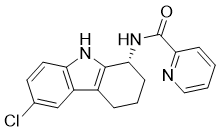
GSK-983 (GSK983) is a potent inhibitor of dihydroorotate dehydrogenase (DHODH) with antiviral activity. As an antiviral agent, it blocks RNA virus replication with EC50 values of 10–40 nM, and also blocks cell proliferation.
Physicochemical Properties
| Molecular Formula | C18H16CLN3O |
| Molecular Weight | 325.79 |
| Exact Mass | 325.098 |
| Elemental Analysis | C, 66.36; H, 4.95; Cl, 10.88; N, 12.90; O, 4.91 |
| CAS # | 827591-02-6 |
| PubChem CID | 11416123 |
| Appearance | White to light yellow solid powder |
| LogP | 4.598 |
| Hydrogen Bond Donor Count | 2 |
| Hydrogen Bond Acceptor Count | 2 |
| Rotatable Bond Count | 2 |
| Heavy Atom Count | 23 |
| Complexity | 446 |
| Defined Atom Stereocenter Count | 1 |
| SMILES | C1C[C@H](C2=C(C1)C3=C(N2)C=CC(=C3)Cl)NC(=O)C4=CC=CC=N4 |
| InChi Key | WJQBOBGVBBZLJU-OAHLLOKOSA-N |
| InChi Code | InChI=1S/C18H16ClN3O/c19-11-7-8-14-13(10-11)12-4-3-6-15(17(12)21-14)22-18(23)16-5-1-2-9-20-16/h1-2,5,7-10,15,21H,3-4,6H2,(H,22,23)/t15-/m1/s1 |
| Chemical Name | (R)-N-(6-Chloro-2,3,4,9-tetrahydro-1H-carbazol-1-yl)picolinamide |
| Synonyms | GSK-983; GSK983; RefChem:782742; 110-656-0; 827591-02-6; (R)-N-(6-chloro-2,3,4,9-tetrahydro-1H-carbazol-1-yl)picolinamide; 2-Pyridinecarboxamide,N-[(1R)-6-chloro-2,3,4,9-tetrahydro-1H-carbazol-1-yl]-; N-[(1R)-6-chloro-2,3,4,9-tetrahydro-1H-carbazol-1-yl]pyridine-2-carboxamide; CHEMBL551051; GSK983 |
| HS Tariff Code | 2934.99.9001 |
| Storage |
Powder-20°C 3 years 4°C 2 years In solvent -80°C 6 months -20°C 1 month |
| Shipping Condition | Room temperature (This product is stable at ambient temperature for a few days during ordinary shipping and time spent in Customs) |
Biological Activity
| Targets | DHODH; antiviral |
| ln Vitro |
GSK983 (0-10000 nM; 2 h) attenuates polyomavirus SV40 in Vero cells and adenovirus 5 (Ad-5) in primary human fibroblasts (HFF) with a median effect concentration (K) of 21, respectively. Cell lines immortalized by viral infection are inhibited in growth by GSK983 (0-10000 nM; 72 h); the maximal inhibition rate (I max) is 99% and 88%, respectively. The cell lines are infected with IM9 (EBV) at nM and 7.5 nM. the MT4 (HTLV1) and B-LCL 5/2/1 (EBV) cells' median effect concentrations (K) are 7.5 nM, 16, and 14, respectively [1]. Interferon-stimulated gene expression is induced in W12, HKC cells by GSK983 (10, 100 nM; 24, 48 h) [1].
- Viral replication inhibition: 1. Broad-spectrum antiviral activity: GSK983 inhibited replication of adenovirus (Ad-5), polyomavirus (SV-40), human papillomavirus (HPV), and Epstein-Barr virus (EBV) in vitro with EC50 values of 5–20 nM. Herpes simplex virus (HSV-1), human immunodeficiency virus (HIV), and lytic EBV replication were resistant at concentrations <1 μM [1] 2. Episomal maintenance suppression: In HPV- and EBV-immortalized cells, GSK983 (10–40 nM) blocked episomal genome maintenance, leading to reduced viral gene expression [1] - Cell growth inhibition: 1. Selective cytotoxicity: GSK983 suppressed proliferation of virus-immortalized cell lines (HTLV-1, EBV, HPV, SV40, Ad-5) with EC50 values of 10–40 nM. Primary keratinocytes, fibroblasts, lymphocytes, endothelial cells, and bone marrow progenitors showed CC50 >10 μM [1] 2. Apoptosis induction: At concentrations >20 nM, GSK983 induced apoptosis in sensitive cell lines (e.g., HeLa, A549) as confirmed by caspase-3 activation and Annexin V staining [1] - Mechanism of action: 1. Interferon pathway activation: GSK983 upregulated expression of interferon-stimulated genes (ISGs) such as OAS1, MX1, and PKR in treated cells, indicating host-mediated antiviral activity [1] |
| Cell Assay |
RT-PCR[1] Cell Types: W12, HKC cells Tested Concentrations: 10, 100 nM Incubation Duration: 24, 48 hrs (hours) Experimental Results: Induced the expression of interferon-stimulated genes in infected cells and immortalized cells, increased CSF2, IFIT1 (ISG56 ), IL6, ISG15, OAS1, OAS2, OASL, and TNFSF10 (TRAIL) gene expression. - Viral replication assay: 1. Virus infection: Cells (e.g., HEK293, Vero) were infected with viruses (MOI=0.1–1) and treated with GSK983 (0.1–10 μM) 2 hours post-infection. 2. Viral titer quantification: Supernatants were collected at 48–72 hours post-infection, and viral titers were determined by plaque assay or TCID50 [1] - Cell viability assay: 1. MTT reduction: Cells were seeded in 96-well plates (5×10³ cells/well) and treated with GSK983 (0.01–100 μM) for 72 hours. MTT solution (0.5 mg/mL) was added, and absorbance at 570 nm was measured [1] 2. Annexin V/PI staining: Treated cells were stained with Annexin V-FITC and propidium iodide, followed by flow cytometry to quantify apoptotic cells [1] |
| Toxicity/Toxicokinetics |
- In vitro toxicity: 1. Normal cell selectivity: GSK983 showed >250-fold selectivity for virus-immortalized cells over primary cells (CC50 ratio: 10–40 nM vs. >10 μM) [1] 2. Cytostatic effects: At sub-apoptotic concentrations (5–10 nM), GSK983 induced G1/S cell cycle arrest in sensitive cell lines [1] - In vivo toxicity: No animal toxicity data were provided [1] |
| References |
[1]. GSK983: a novel compound with broad-spectrum antiviral activity. Antiviral Res. 2009 Apr;82(1):1-11. |
| Additional Infomation |
- Development background: GSK983 is a tetrahydrocarbazole derivative identified through high-throughput screening for broad-spectrum antiviral activity [1] - Therapeutic potential: The compound demonstrated activity against oncogenic viruses (HPV, EBV) and DNA viruses (adenovirus, polyomavirus), suggesting applications in antiviral and oncology settings [1] - Mode of action: Unlike direct-acting antivirals, GSK983 acts through host interferon pathway activation, reducing the likelihood of viral resistance development [1] |
Solubility Data
| Solubility (In Vitro) | DMSO : ≥ 10 mg/mL (~30.69 mM) |
| Solubility (In Vivo) |
Note: Listed below are some common formulations that may be used to formulate products with low water solubility (e.g. < 1 mg/mL), you may test these formulations using a minute amount of products to avoid loss of samples. Injection Formulations (e.g. IP/IV/IM/SC) Injection Formulation 1: DMSO : Tween 80: Saline = 10 : 5 : 85 (i.e. 100 μL DMSO stock solution → 50 μL Tween 80 → 850 μL Saline) *Preparation of saline: Dissolve 0.9 g of sodium chloride in 100 mL ddH ₂ O to obtain a clear solution. Injection Formulation 2: DMSO : PEG300 :Tween 80 : Saline = 10 : 40 : 5 : 45 (i.e. 100 μL DMSO → 400 μLPEG300 → 50 μL Tween 80 → 450 μL Saline) Injection Formulation 3: DMSO : Corn oil = 10 : 90 (i.e. 100 μL DMSO → 900 μL Corn oil) Example: Take the Injection Formulation 3 (DMSO : Corn oil = 10 : 90) as an example, if 1 mL of 2.5 mg/mL working solution is to be prepared, you can take 100 μL 25 mg/mL DMSO stock solution and add to 900 μL corn oil, mix well to obtain a clear or suspension solution (2.5 mg/mL, ready for use in animals). Injection Formulation 4: DMSO : 20% SBE-β-CD in saline = 10 : 90 [i.e. 100 μL DMSO → 900 μL (20% SBE-β-CD in saline)] *Preparation of 20% SBE-β-CD in Saline (4°C,1 week): Dissolve 2 g SBE-β-CD in 10 mL saline to obtain a clear solution. Injection Formulation 5: 2-Hydroxypropyl-β-cyclodextrin : Saline = 50 : 50 (i.e. 500 μL 2-Hydroxypropyl-β-cyclodextrin → 500 μL Saline) Injection Formulation 6: DMSO : PEG300 : castor oil : Saline = 5 : 10 : 20 : 65 (i.e. 50 μL DMSO → 100 μLPEG300 → 200 μL castor oil → 650 μL Saline) Injection Formulation 7: Ethanol : Cremophor : Saline = 10: 10 : 80 (i.e. 100 μL Ethanol → 100 μL Cremophor → 800 μL Saline) Injection Formulation 8: Dissolve in Cremophor/Ethanol (50 : 50), then diluted by Saline Injection Formulation 9: EtOH : Corn oil = 10 : 90 (i.e. 100 μL EtOH → 900 μL Corn oil) Injection Formulation 10: EtOH : PEG300:Tween 80 : Saline = 10 : 40 : 5 : 45 (i.e. 100 μL EtOH → 400 μLPEG300 → 50 μL Tween 80 → 450 μL Saline) Oral Formulations Oral Formulation 1: Suspend in 0.5% CMC Na (carboxymethylcellulose sodium) Oral Formulation 2: Suspend in 0.5% Carboxymethyl cellulose Example: Take the Oral Formulation 1 (Suspend in 0.5% CMC Na) as an example, if 100 mL of 2.5 mg/mL working solution is to be prepared, you can first prepare 0.5% CMC Na solution by measuring 0.5 g CMC Na and dissolve it in 100 mL ddH2O to obtain a clear solution; then add 250 mg of the product to 100 mL 0.5% CMC Na solution, to make the suspension solution (2.5 mg/mL, ready for use in animals). Oral Formulation 3: Dissolved in PEG400 Oral Formulation 4: Suspend in 0.2% Carboxymethyl cellulose Oral Formulation 5: Dissolve in 0.25% Tween 80 and 0.5% Carboxymethyl cellulose Oral Formulation 6: Mixing with food powders Note: Please be aware that the above formulations are for reference only. InvivoChem strongly recommends customers to read literature methods/protocols carefully before determining which formulation you should use for in vivo studies, as different compounds have different solubility properties and have to be formulated differently. (Please use freshly prepared in vivo formulations for optimal results.) |
| Preparing Stock Solutions | 1 mg | 5 mg | 10 mg | |
| 1 mM | 3.0695 mL | 15.3473 mL | 30.6946 mL | |
| 5 mM | 0.6139 mL | 3.0695 mL | 6.1389 mL | |
| 10 mM | 0.3069 mL | 1.5347 mL | 3.0695 mL |