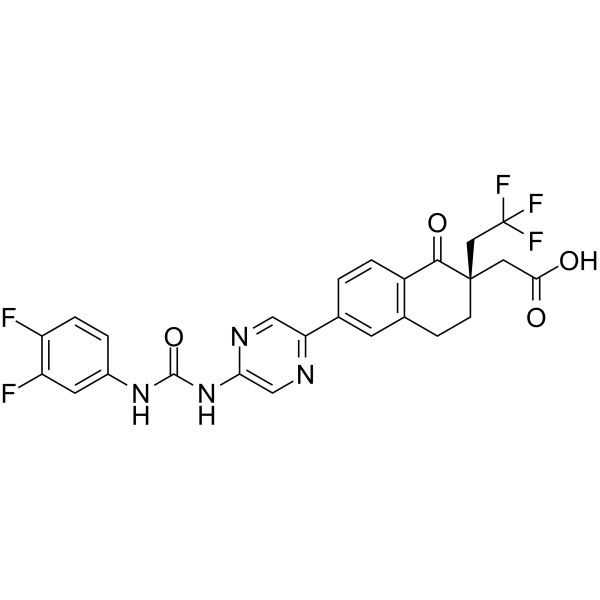
GSK2973980A is a novel, potent and selective inhibitor of Acyl-CoA:diacylglycerol acyltransferase 1 (DGAT1) with an IC50 of 3 nM. DGAT1 plays an important role in triglyceride synthesis and is a target of interest for the treatment of metabolic disorders. GSK2973980A has excellent DMPK profiles and in vivo efficacy in a postprandial lipid excursion model in mice. Based on the overall biological and developability profiles and acceptable safety profiles in the 7-day toxicity studies in rats and dogs, GSK2973980A was selected as a candidate compound for further development in the treatment of metabolic disorders.
Physicochemical Properties
| Molecular Formula | C25H19F5N4O4 |
| Molecular Weight | 534.434783220291 |
| Exact Mass | 534.132 |
| CAS # | 1414797-35-5 |
| Appearance | Typically exists as solid at room temperature |
| Density | 1.5±0.1 g/cm3 |
| Boiling Point | 600.5±55.0 °C at 760 mmHg |
| Flash Point | 317.0±31.5 °C |
| Vapour Pressure | 0.0±1.8 mmHg at 25°C |
| Index of Refraction | 1.605 |
| LogP | 5.15 |
| SMILES | C1(=O)C2=C(C=C(C3=NC=C(NC(NC4=CC=C(F)C(F)=C4)=O)N=C3)C=C2)CCC1(CC(F)(F)F)CC(O)=O |
| InChi Key | OTKTZEZTFCAULO-DEOSSOPVSA-N |
| InChi Code | InChI=1S/C25H19F5N4O4/c26-17-4-2-15(8-18(17)27)33-23(38)34-20-11-31-19(10-32-20)14-1-3-16-13(7-14)5-6-24(22(16)37,9-21(35)36)12-25(28,29)30/h1-4,7-8,10-11H,5-6,9,12H2,(H,35,36)(H2,32,33,34,38)/t24-/m0/s1 |
| Chemical Name | (S)-2-(6-(5-(3-(3,4-difluorophenyl)ureido)pyrazin-2-yl)-1-oxo-2-(2,2,2-trifluoroethyl)-1,2,3,4-tetrahydronaphthalen-2-yl)acetic acid |
| Synonyms | GSK2973980A; GSK-2973980A; GSK 2973980A |
| HS Tariff Code | 2934.99.9001 |
| Storage |
Powder-20°C 3 years 4°C 2 years In solvent -80°C 6 months -20°C 1 month |
| Shipping Condition | Room temperature (This product is stable at ambient temperature for a few days during ordinary shipping and time spent in Customs) |
Biological Activity
| ln Vivo | GSK2973980A was confirmed to be nonmutagenic . Since GSK2973980A was a potent human DGAT1 inhibitor with good solubility, pharmacokinetic properties, and in vivo efficacy, additional selectivity and developability data were generated to evaluate its suitability as a precandidate compound.GSK2973980A was confirmed to be nonmutagenic . Since GSK2973980A was a potent human DGAT1 inhibitor with good solubility, pharmacokinetic properties, and in vivo efficacy, additional selectivity and developability data were generated to evaluate its suitability as a precandidate compound. GSK2973980A exhibited >2900-fold selectivity over human DGAT2, ACAT1 (SOAT1), and ACAT2 (SOAT2) enzymes (IC50 values of >10 μM) in radiometric assays, and an IC50 value of 77 nM in the cell-based C2C12 assay. In addition, GSK2973980A had an excellent cardiac ion channel profile with IC50 values of >10 μM in the hERG, Nav1.5, and Cav1.2 QPatch assays and exhibited good selectivity profile (>700-fold over hDGAT1 LE IC50) across a panel of selectivity assays. GSK2973980A showed minimal CYP inhibition with IC50 values of >10 μM across CYP1A2 (phenacetin), CYP2C9 (diclofenac), CYP2C19 (S-mephenytoin), CYP2D6 (DEX), and CYP3A4 (midazolam), and demonstrated no time-dependent CYP inhibition at up to 50 μM of GSK2973980A and no PXR activation with EC50 > 50 μM. GSK2973980A did not form glutathione conjugates in the presence of 5 mM GSH containing NADPH in human liver microsomes at up to 10 μM GSK2973980A. Moreover, GSK2973980A had high protein binding across species with plasma protein binding of 99.98%, 99.9%, and 99.95% in human, mouse, and rat, respectively. GSK2973980A exhibited good PK profiles in rat (CL = 3.3 mL/min/kg, Vdss = 0.42 L/kg, iv T1/2 = 2.6 h, %F = 48). In addition, it was a low clearance compound with plasma clearances of 13.3 and 5.1 mL/min/kg in mouse and dog, respectively, and had good oral bioavailability of 41 and 68 %F in mouse and dog, respectively. Based on the overall developability profiles, GSK2973980A (GSK2973980A) was nominated as a development candidate for the treatment of obesity. Full in vitro and in vivo biological profiles of GSK2973980A have been reported recently. |
| Animal Protocol | GSK2973980A demonstrated modest to good oral bioavailability is 48 %F in Sprague–Dawley male rats. GSK2973980A were evaluated for inhibition of TG in a postprandial lipid excursion model in Swiss Albino mice. GSK2973980A showed excellent inhibition of TG in the model with near complete inhibition at 1 mg/kg when dosed orally.GSK2973980A showed 76% TG inhibition at 0.3 mg/kg with terminal plasma drug level of 36 ng/mL, and 97.6% TG inhibition at 1 mg/kg with terminal plasma drug level of 106 ng/mL.[1] |
| References |
[1]. Discovery of Tetralones as Potent and Selective Inhibitors of Acyl-CoA:Diacylglycerol Acyltransferase 1. ACS Med Chem Lett. 2018 Jan 16;9(2):103-108. |
Solubility Data
| Solubility (In Vitro) | May dissolve in DMSO (in most cases), if not, try other solvents such as H2O, Ethanol, or DMF with a minute amount of products to avoid loss of samples |
| Solubility (In Vivo) |
Note: Listed below are some common formulations that may be used to formulate products with low water solubility (e.g. < 1 mg/mL), you may test these formulations using a minute amount of products to avoid loss of samples. Injection Formulations (e.g. IP/IV/IM/SC) Injection Formulation 1: DMSO : Tween 80: Saline = 10 : 5 : 85 (i.e. 100 μL DMSO stock solution → 50 μL Tween 80 → 850 μL Saline) *Preparation of saline: Dissolve 0.9 g of sodium chloride in 100 mL ddH ₂ O to obtain a clear solution. Injection Formulation 2: DMSO : PEG300 :Tween 80 : Saline = 10 : 40 : 5 : 45 (i.e. 100 μL DMSO → 400 μLPEG300 → 50 μL Tween 80 → 450 μL Saline) Injection Formulation 3: DMSO : Corn oil = 10 : 90 (i.e. 100 μL DMSO → 900 μL Corn oil) Example: Take the Injection Formulation 3 (DMSO : Corn oil = 10 : 90) as an example, if 1 mL of 2.5 mg/mL working solution is to be prepared, you can take 100 μL 25 mg/mL DMSO stock solution and add to 900 μL corn oil, mix well to obtain a clear or suspension solution (2.5 mg/mL, ready for use in animals). Injection Formulation 4: DMSO : 20% SBE-β-CD in saline = 10 : 90 [i.e. 100 μL DMSO → 900 μL (20% SBE-β-CD in saline)] *Preparation of 20% SBE-β-CD in Saline (4°C,1 week): Dissolve 2 g SBE-β-CD in 10 mL saline to obtain a clear solution. Injection Formulation 5: 2-Hydroxypropyl-β-cyclodextrin : Saline = 50 : 50 (i.e. 500 μL 2-Hydroxypropyl-β-cyclodextrin → 500 μL Saline) Injection Formulation 6: DMSO : PEG300 : castor oil : Saline = 5 : 10 : 20 : 65 (i.e. 50 μL DMSO → 100 μLPEG300 → 200 μL castor oil → 650 μL Saline) Injection Formulation 7: Ethanol : Cremophor : Saline = 10: 10 : 80 (i.e. 100 μL Ethanol → 100 μL Cremophor → 800 μL Saline) Injection Formulation 8: Dissolve in Cremophor/Ethanol (50 : 50), then diluted by Saline Injection Formulation 9: EtOH : Corn oil = 10 : 90 (i.e. 100 μL EtOH → 900 μL Corn oil) Injection Formulation 10: EtOH : PEG300:Tween 80 : Saline = 10 : 40 : 5 : 45 (i.e. 100 μL EtOH → 400 μLPEG300 → 50 μL Tween 80 → 450 μL Saline) Oral Formulations Oral Formulation 1: Suspend in 0.5% CMC Na (carboxymethylcellulose sodium) Oral Formulation 2: Suspend in 0.5% Carboxymethyl cellulose Example: Take the Oral Formulation 1 (Suspend in 0.5% CMC Na) as an example, if 100 mL of 2.5 mg/mL working solution is to be prepared, you can first prepare 0.5% CMC Na solution by measuring 0.5 g CMC Na and dissolve it in 100 mL ddH2O to obtain a clear solution; then add 250 mg of the product to 100 mL 0.5% CMC Na solution, to make the suspension solution (2.5 mg/mL, ready for use in animals). Oral Formulation 3: Dissolved in PEG400 Oral Formulation 4: Suspend in 0.2% Carboxymethyl cellulose Oral Formulation 5: Dissolve in 0.25% Tween 80 and 0.5% Carboxymethyl cellulose Oral Formulation 6: Mixing with food powders Note: Please be aware that the above formulations are for reference only. InvivoChem strongly recommends customers to read literature methods/protocols carefully before determining which formulation you should use for in vivo studies, as different compounds have different solubility properties and have to be formulated differently. (Please use freshly prepared in vivo formulations for optimal results.) |
| Preparing Stock Solutions | 1 mg | 5 mg | 10 mg | |
| 1 mM | 1.8712 mL | 9.3558 mL | 18.7115 mL | |
| 5 mM | 0.3742 mL | 1.8712 mL | 3.7423 mL | |
| 10 mM | 0.1871 mL | 0.9356 mL | 1.8712 mL |