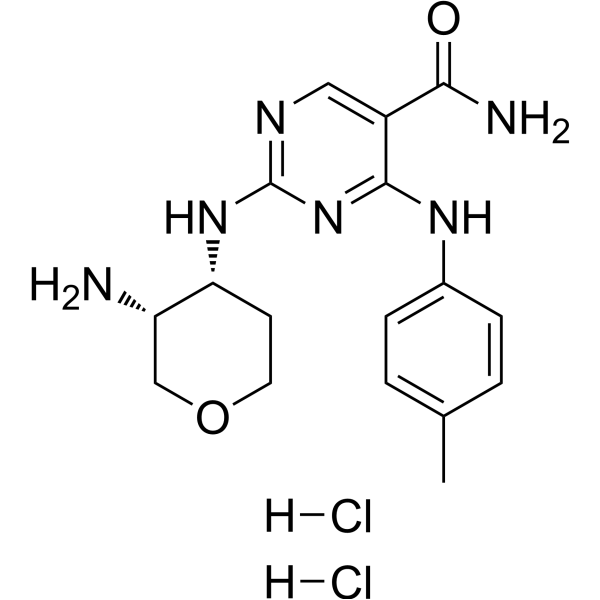
Physicochemical Properties
| Molecular Formula | C17H23CLN6O2 |
| Molecular Weight | 378.86 |
| Exact Mass | 414.133 |
| CAS # | 2341796-81-2 |
| Related CAS # | GSK143;1240390-27-5 |
| PubChem CID | 138991755 |
| Appearance | Off-white to light yellow solid powder |
| Hydrogen Bond Donor Count | 6 |
| Hydrogen Bond Acceptor Count | 7 |
| Rotatable Bond Count | 5 |
| Heavy Atom Count | 27 |
| Complexity | 443 |
| Defined Atom Stereocenter Count | 2 |
| SMILES | N(C1C=CC(C)=CC=1)C1=NC(N[C@@H]2CCOC[C@@H]2N)=NC=C1C(=O)N.Cl |
| InChi Key | UEHPBSLIDBDMCZ-WICJZZOFSA-N |
| InChi Code | InChI=1S/C17H22N6O2.2ClH/c1-10-2-4-11(5-3-10)21-16-12(15(19)24)8-20-17(23-16)22-14-6-7-25-9-13(14)18;;/h2-5,8,13-14H,6-7,9,18H2,1H3,(H2,19,24)(H2,20,21,22,23);2*1H/t13-,14+;;/m0../s1 |
| Chemical Name | 2-[[(3R,4R)-3-aminooxan-4-yl]amino]-4-(4-methylanilino)pyrimidine-5-carboxamide;dihydrochloride |
| HS Tariff Code | 2934.99.9001 |
| Storage |
Powder-20°C 3 years 4°C 2 years In solvent -80°C 6 months -20°C 1 month Note: Please store this product in a sealed and protected environment (e.g. under nitrogen), avoid exposure to moisture and light. |
| Shipping Condition | Room temperature (This product is stable at ambient temperature for a few days during ordinary shipping and time spent in Customs) |
Biological Activity
| Targets | pIC50: 7.5 (SYK) and 7.1 (pErk)[1] |
| ln Vitro | GSK143 dihydrochloride (compound 20) inhibits the following: JAK1/2/3 (pIC50=5.8/5.8/5.7), Aurora B (pIC50=4.8), hWB (pIC50=6.6), hERG (pIC50=4.7), LCK (pIC50=5.3), LYN (pIC50=5.4), and ZAP-70 (pIC50=4.7)[1]. The CLL cells exhibit an IC50 of 323 nM with GSK 143 dihydrochloride (10–10,000 nM; every 24 hours for three days). Early signaling processes, such as SYK phosphorylation and calcium flow, are abrogated by GSK 143 dihydrochloride (1 GSK143 dihydrochloride; 0.1-10 μM; for 30 min)[2]. |
| ln Vivo | In the intestinal muscularis, GSK143 (0.1–10 mg/kg; orally; 1.5 hours) decreases inflammation and inhibits the recruitment of immune cells[3]. The cutaneous reverse passive Arthus reaction is reduced by GSK143 (3, 10, 30, 100 mg/kg; oral; one hour before ovalbumin challenge) in a dose-dependent manner by around 50% and 70% at 10 mg/kg and 30 mg/kg, respectively[2]. GSK143 in rats has a T1/2 of 4.2 hours, a low clearance of 16 mL/min/kg, a moderate bioavailability of 30%, and a Vss of 4.1 L/kg (iv of 1 mg/kg; po of 3 mg/kg)[1]. |
| Cell Assay |
Cell Viability Assay[2] Cell Types: Chronic lymphocytic leukaemia (CLL) cells Tested Concentrations: 10, 100, 1000, 10000 nM Incubation Duration: Every 24 hrs (hours) for 3 days Experimental Results: Had an IC50 of 323 nM. |
| Animal Protocol |
Animal/Disease Models: Wild type C57NL/BL6 mice, 10-12 weeks old[3] Doses: 0.1, 1, 3, 10 mg/kg Route of Administration: po (oral gavage) 1.5 hrs (hours) before Intestinal manipulation (IM) Experimental Results: diminished inflammation and prevented recruitment of immune cells in the intestinal muscularis. Animal/Disease Models: Male CD rats (175-200 g)[1] Doses: 1 mg/kg of iv; 3 mg/kg of po (pharmacokinetic/PK Analysis) Route of Administration: IV or PO Experimental Results: Had a T1/2 of 4.2 hrs (hours), low clearance (16 mL/min/kg), moderate bioavailability of 30% and a Vss of 4.1 L/kg. |
| References |
[1]. Discovery of GSK143, a Highly Potent, Selective and Orally Efficacious Spleen Tyrosine Kinase Inhibitor. Bioorg Med Chem Lett. 2011 Oct 15;21(20):6188-94. [2]. Highly Selective SYK Inhibitor, GSK143, Abrogates Survival Signals in Chronic Lymphocytic Leukaemia. Br J Haematol. 2018 Sep;182(6):927-930. [3]. Inhibition of Spleen Tyrosine Kinase as Treatment of Postoperative Ileus. Gut. 2013 Nov;62(11):1581-90. |
Solubility Data
| Solubility (In Vitro) |
H2O : 100 mg/mL (240.78 mM) DMSO : ≥ 50 mg/mL (120.39 mM) |
| Solubility (In Vivo) |
Solubility in Formulation 1: ≥ 2.5 mg/mL (6.02 mM) (saturation unknown) in 10% DMSO + 40% PEG300 + 5% Tween80 + 45% Saline (add these co-solvents sequentially from left to right, and one by one), clear solution. For example, if 1 mL of working solution is to be prepared, you can add 100 μL of 25.0 mg/mL clear DMSO stock solution to 400 μL PEG300 and mix evenly; then add 50 μL Tween-80 to the above solution and mix evenly; then add 450 μL normal saline to adjust the volume to 1 mL. Preparation of saline: Dissolve 0.9 g of sodium chloride in 100 mL ddH₂ O to obtain a clear solution. Solubility in Formulation 2: ≥ 2.5 mg/mL (6.02 mM) (saturation unknown) in 10% DMSO + 90% (20% SBE-β-CD in Saline) (add these co-solvents sequentially from left to right, and one by one), clear solution. For example, if 1 mL of working solution is to be prepared, you can add 100 μL of 25.0 mg/mL clear DMSO stock solution to 900 μL of 20% SBE-β-CD physiological saline solution and mix evenly. Preparation of 20% SBE-β-CD in Saline (4°C,1 week): Dissolve 2 g SBE-β-CD in 10 mL saline to obtain a clear solution. Solubility in Formulation 3: ≥ 2.5 mg/mL (6.02 mM) (saturation unknown) in 10% DMSO + 90% Corn Oil (add these co-solvents sequentially from left to right, and one by one), clear solution. For example, if 1 mL of working solution is to be prepared, you can add 100 μL of 25.0 mg/mL clear DMSO stock solution to 900 μL of corn oil and mix evenly. (Please use freshly prepared in vivo formulations for optimal results.) |
| Preparing Stock Solutions | 1 mg | 5 mg | 10 mg | |
| 1 mM | 2.6395 mL | 13.1975 mL | 26.3950 mL | |
| 5 mM | 0.5279 mL | 2.6395 mL | 5.2790 mL | |
| 10 mM | 0.2639 mL | 1.3197 mL | 2.6395 mL |