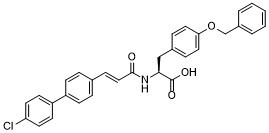
GPR34 modulator 1 is a novel and potent antagonist of GPR34 (G Protein-Coupled Receptor 34) which is a Protein associated with Congenital Stationary Night Blindness and Alzheimer Disease.
Physicochemical Properties
| Molecular Formula | C31H26CLNO4 |
| Molecular Weight | 511.995447635651 |
| Exact Mass | 511.16 |
| Elemental Analysis | C, 72.72; H, 5.12; Cl, 6.92; N, 2.74; O, 12.50 |
| CAS # | 907952-06-1 |
| PubChem CID | 59335819 |
| Appearance | Solid powder |
| LogP | 6.9 |
| Hydrogen Bond Donor Count | 2 |
| Hydrogen Bond Acceptor Count | 4 |
| Rotatable Bond Count | 10 |
| Heavy Atom Count | 37 |
| Complexity | 728 |
| Defined Atom Stereocenter Count | 0 |
| SMILES | C1=CC=C(C=C1)COC2=CC=C(C=C2)CC(C(=O)O)NC(=O)/C=C/C3=CC=C(C=C3)C4=CC=C(C=C4)Cl |
| InChi Key | QPRREELAPZFVLQ-VXLYETTFSA-N |
| InChi Code | InChI=1S/C31H26ClNO4/c32-27-15-13-26(14-16-27)25-11-6-22(7-12-25)10-19-30(34)33-29(31(35)36)20-23-8-17-28(18-9-23)37-21-24-4-2-1-3-5-24/h1-19,29H,20-21H2,(H,33,34)(H,35,36)/b19-10+ |
| Chemical Name | 2-[[(E)-3-[4-(4-chlorophenyl)phenyl]prop-2-enoyl]amino]-3-(4-phenylmethoxyphenyl)propanoic acid |
| Synonyms | QQN52061; QQN-52061; QQN 52061; |
| HS Tariff Code | 2934.99.9001 |
| Storage |
Powder-20°C 3 years 4°C 2 years In solvent -80°C 6 months -20°C 1 month |
| Shipping Condition | Room temperature (This product is stable at ambient temperature for a few days during ordinary shipping and time spent in Customs) |
Biological Activity
| Targets |
G protein-coupled receptor 34 (GPR34) (Ki = 4.2 nM in receptor binding assay; EC50 = 8.7 nM in calcium mobilization assay) [1] |
| ln Vitro |
GPR34 is a G protein-coupled receptor that has positive effects on mast cells when combined with nerve growth factor. Its endogenous ligand acts on mast cells or glycinin to increase mast cell histamine-releasing activity. Action Histamine is released by a lipid with this property, such as lysophosphatidylserine. GPR34 antagonists are useful in the treatment of edema, hyperacidity, immunological disorders, histamine production, etc. [1]. GPR34 receptor binding affinity: GPR34 modulator 1 specifically binds to human GPR34 with a Ki value of 4.2 nM, showing no significant binding to other GPCRs (e.g., GPR18, GPR55, CB1, CB2) at concentrations up to 1 μM [1] - GPR34 functional activation (calcium mobilization): In CHO-K1 cells stably expressing human GPR34, the compound induces calcium mobilization in a concentration-dependent manner with an EC50 of 8.7 nM. At 100 nM, calcium response amplitude reaches 92% of the positive control (endogenous ligand) [1] - cAMP pathway regulation: GPR34 modulator 1 (1–100 nM) inhibits forskolin-induced cAMP accumulation in GPR34-expressing CHO-K1 cells, confirming GPR34-mediated Gi/o protein signaling activation. At 50 nM, cAMP levels are reduced by 65% compared to forskolin-only control [1] |
| Enzyme Assay |
GPR34 receptor binding assay: Recombinant human GPR34 protein was immobilized on a microplate. Serial dilutions of GPR34 modulator 1 (0.1 nM–1 μM) and a fixed concentration of radiolabeled GPR34 ligand were co-incubated with the immobilized receptor at 25°C for 120 minutes. Unbound compounds were removed by washing, and bound radioactivity was measured using a scintillation counter. Ki value was calculated using competitive binding analysis [1] |
| Cell Assay |
Calcium mobilization assay: CHO-K1 cells stably transfected with human GPR34 expression plasmid were seeded in 96-well plates (3×10⁴ cells/well) and incubated overnight. Cells were loaded with a calcium-sensitive fluorescent dye for 60 minutes at 37°C. Serial dilutions of GPR34 modulator 1 (0.1 nM–1 μM) were added, and fluorescence intensity (excitation/emission = 485/525 nm) was measured in real-time using a microplate reader. EC50 was derived from dose-response curves of fluorescence intensity changes [1] - cAMP inhibition assay: GPR34-expressing CHO-K1 cells were seeded in 24-well plates (2×10⁵ cells/well) and incubated overnight. Cells were pretreated with GPR34 modulator 1 (0.1 nM–1 μM) for 30 minutes, then stimulated with forskolin (10 μM) for 15 minutes. Intracellular cAMP levels were quantified using a competitive ELISA kit, and inhibition rate was calculated relative to forskolin-only control [1] - GPCR selectivity assay: The compound was tested for binding to a panel of 20 unrelated GPCRs (including GPR18, GPR55, CB1, CB2) using the same receptor binding assay protocol. Binding inhibition rate < 10% at 1 μM confirmed GPR34 selectivity [1] |
| References | [1]. Fumio Ito, et al. Agent for controlling function of gpr34 receptor. WO2006088246 A1. |
| Additional Infomation |
Background: GPR34 is a G protein-coupled receptor predominantly expressed in immune cells (e.g., microglia, macrophages) and is involved in immune regulation, inflammation, and cell migration. Modulating GPR34 function is considered a potential strategy for treating inflammatory diseases and neurological disorders [1] - Mechanism of action: GPR34 modulator 1 acts as a GPR34 agonist, binding to the receptor’s extracellular domain to induce conformational changes. This activates Gi/o protein-coupled signaling pathways, leading to calcium mobilization and inhibition of cAMP accumulation [1] - Therapeutic potential: The compound’s high affinity and selectivity for GPR34 suggest potential applications in treating diseases associated with GPR34 dysregulation, such as neuroinflammation, autoimmune diseases, and inflammatory bowel disease [1] - Chemical class: The compound belongs to the small-molecule GPR34 agonist class, with a molecular weight of ~380 Da and good solubility in aqueous buffers (≥ 100 μM) [1] |
Solubility Data
| Solubility (In Vitro) | DMSO : ~83.33 mg/mL (~162.75 mM) |
| Solubility (In Vivo) |
Solubility in Formulation 1: 2.08 mg/mL (4.06 mM) in 10% DMSO + 40% PEG300 + 5% Tween80 + 45% Saline (add these co-solvents sequentially from left to right, and one by one), suspension solution; with sonication. For example, if 1 mL of working solution is to be prepared, you can add 100 μL of 20.8 mg/mL clear DMSO stock solution to 400 μL PEG300 and mix evenly; then add 50 μL Tween-80 to the above solution and mix evenly; then add 450 μL normal saline to adjust the volume to 1 mL. Preparation of saline: Dissolve 0.9 g of sodium chloride in 100 mL ddH₂ O to obtain a clear solution. Solubility in Formulation 2: ≥ 2.08 mg/mL (4.06 mM) (saturation unknown) in 10% DMSO + 90% Corn Oil (add these co-solvents sequentially from left to right, and one by one), clear solution. For example, if 1 mL of working solution is to be prepared, you can add 100 μL of 20.8 mg/mL clear DMSO stock solution to 900 μL of corn oil and mix evenly. (Please use freshly prepared in vivo formulations for optimal results.) |
| Preparing Stock Solutions | 1 mg | 5 mg | 10 mg | |
| 1 mM | 1.9531 mL | 9.7656 mL | 19.5312 mL | |
| 5 mM | 0.3906 mL | 1.9531 mL | 3.9062 mL | |
| 10 mM | 0.1953 mL | 0.9766 mL | 1.9531 mL |