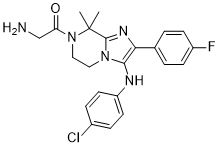
GNF179, an optimized 8,8-dimethyl imidazolopiperazine analog, is a novel, potent and orally bioavailable antiparasitic agent that exhibited the potency(4.8 nM against the multidrug resistant strain W2) in vitro metabolic stability and in vivo oral bioavailability. Most malaria drug development focuses on parasite stages detected in red blood cells, even though, to achieve eradication, next-generation drugs active against both erythrocytic and exo-erythrocytic forms would be preferable.
Physicochemical Properties
| Molecular Formula | C22H23CLFN5O |
| Molecular Weight | 427.9023 |
| Exact Mass | 427.158 |
| CAS # | 1261114-01-5 |
| Related CAS # | GNF179 (Metabolite);1310455-86-7 |
| PubChem CID | 58178960 |
| Appearance | Light yellow to yellow solid powder |
| LogP | 4.833 |
| Hydrogen Bond Donor Count | 2 |
| Hydrogen Bond Acceptor Count | 5 |
| Rotatable Bond Count | 4 |
| Heavy Atom Count | 30 |
| Complexity | 606 |
| Defined Atom Stereocenter Count | 0 |
| InChi Key | KFSKTWYDIHJITF-UHFFFAOYSA-N |
| InChi Code | InChI=1S/C22H23ClFN5O/c1-22(2)21-27-19(14-3-7-16(24)8-4-14)20(26-17-9-5-15(23)6-10-17)28(21)11-12-29(22)18(30)13-25/h3-10,26H,11-13,25H2,1-2H3 |
| Chemical Name | 2-amino-1-(3-((4-chlorophenyl)amino)-2-(4-fluorophenyl)-8,8-dimethyl-5,6-dihydroimidazo[1,2-a]pyrazin-7(8H)-yl)ethanone |
| Synonyms | GNF179; GNF-179; GNF 179 |
| HS Tariff Code | 2934.99.9001 |
| Storage |
Powder-20°C 3 years 4°C 2 years In solvent -80°C 6 months -20°C 1 month |
| Shipping Condition | Room temperature (This product is stable at ambient temperature for a few days during ordinary shipping and time spent in Customs) |
Biological Activity
| Targets |
Acts on Plasmodium liver stages and gametocytes [1] |
| ln Vitro |
Atovaquone's liver-stage target, plasmid cytochrome bc1, is unlikely to be induced by GNF179 and does not quickly block plasmid protein production. GNF179 (5-100 nM; 48 h) eliminates oocyst production at 5 nM and is very suppressive to sexual life cycle advancement in princely gametocytes [2]. It is possible that GNF179 acts on sporophytes rather than the liver stage [1]. Inhibited Plasmodium berghei liver stage development: GNF179 exhibited potent activity against P. berghei sporozoite-induced hepatocyte infection, with an IC50 of 12 nM (determined by fluorescent imaging of liver stage schizonts) [1] - Reduced Plasmodium falciparum liver stage burden: 100 nM GNF179 inhibited P. falciparum liver stage development by ~95% in human hepatoma (HepG2) cells [1] - No significant transmission-blocking activity on P. falciparum gametocytes: Concentrations up to 1 μM did not inhibit gametocyte maturation or exflagellation in field-isolated strains [2] - Low cytotoxicity to human hepatocytes: CC50 > 10 μM in HepG2 cells, resulting in a therapeutic index (CC50/IC50) > 830 [1] |
| ln Vivo |
Rodent malaria models demonstrate the antimalarial activity of GNF179 (15 mg/kg; po; single dose) [1]. Protected mice against Plasmodium berghei sporozoite infection: Oral administration of GNF179 (10 mg/kg) 4 hours before sporozoite injection reduced liver stage burden by ~90% compared to vehicle control [1] - Prevented blood-stage parasitemia in mice: A single oral dose of 30 mg/kg GNF179 administered 24 hours post-sporozoite infection completely blocked the development of blood-stage malaria (0% parasitemia vs. 100% in vehicle group) [1] - Dose-dependent efficacy: 3 mg/kg oral dose reduced liver stage burden by ~60%, while 30 mg/kg achieved ~98% inhibition [1] |
| Cell Assay |
Plasmodium liver stage infection assay: HepG2 cells were seeded in 96-well plates and incubated overnight. Cells were infected with P. berghei or P. falciparum sporozoites (1×10⁴ sporozoites/well) and treated with serial dilutions of GNF179 (0.1-1000 nM) immediately after infection. After 48 hours (P. berghei) or 72 hours (P. falciparum) of incubation, liver stage schizonts were visualized by fluorescent staining (parasite-specific antibody or GFP expression) and counted. IC50 values were calculated based on the percentage of infected cells relative to vehicle control [1] - Gametocyte transmission-blocking assay: Field-isolated P. falciparum gametocytes (stages III-V) were cultured in vitro and treated with GNF179 (0.01-10 μM) for 24 hours. Gametocyte viability was assessed by trypan blue staining, and exflagellation rate (male gametocyte activation) was quantified by microscopic counting. Transmission-blocking activity was determined by measuring the ability of treated gametocytes to infect Anopheles mosquitoes (in vitro membrane feeding assay) [2] - Hepatocyte cytotoxicity assay: HepG2 cells were seeded in 96-well plates and treated with GNF179 (0.1-100 μM) for 72 hours. Cell viability was measured by MTT assay, and CC50 was calculated to determine therapeutic index [1] |
| Animal Protocol |
Animal/Disease Models: Naïve balb/c (Bagg ALBino) mouse infected with P. berghei[1] Doses: 15 mg/kg Route of Administration: po (po (oral gavage)) single dose Experimental Results:Protected against an infectious P. berghei sporozoite. Animal/Disease Models: First exposure to balb/c (Bagg ALBino) mouse[ 1] Doses: 3 or 20 mg/kg Route of Administration: IV or PO (pharmacokinetic/PK/PK analysis) Experimental Results: pharmacokinetic/PK/PKs of GNF179 in naïve balb/c (Bagg ALBino) mouse. Dose AUC(0-∞) (hrsµM) AUC/dose t1/2 (hrs) MRT (hrs) CL (ml/min/kg) Vss (L/kg) C0 or Cmax (µM) F (%) 3 mg/kg iv 8.88 3.0 8.9 9.0 22 11.8 6.1 nd 20 mg/kg po 20.70 1.0 8.4 nd nd 1.2 58 AUC, area under the curve; T1/2, half-life; CL, clearance; VSS, steady-state volume of distribution; C0, initial Concentration; Cmax maximum concentration; F, fraction of absorbed dose; hrs (hrs (hours)), hrs (hrs (hours)); nd, not determined. Mouse Plasmodium berghei liver stage infection model: 6-8 week-old C57BL/6 mice were randomly divided into vehicle and treatment groups. GNF179 was dissolved in 10% DMSO + 90% corn oil and administered orally at doses of 3, 10, or 30 mg/kg. For preventive efficacy, mice were dosed 4 hours before intravenous injection of 1×10⁴ P. berghei sporozoites. For therapeutic efficacy, dosing was performed 24 hours post-sporozoite injection. On day 4 post-infection, mice were euthanized, and liver tissues were collected to quantify liver stage burden by fluorescent imaging or real-time PCR (parasite 18S rRNA) [1] - Mouse blood-stage parasitemia monitoring: Mice from the liver stage infection model were monitored for blood-stage parasitemia starting on day 5 post-sporozoite injection. Blood smears were prepared daily, stained with Giemsa, and parasitemia was quantified by microscopic counting of infected red blood cells [1] |
| Toxicity/Toxicokinetics |
In vitro cytotoxicity: No significant toxicity to HepG2 cells at concentrations ≤10 μM (cell viability > 90%); CC50 = 10.2 μM [1] - Acute in vivo toxicity: No mortality or overt adverse effects (body weight loss, behavioral changes) in mice at oral doses up to 100 mg/kg [1] - No hepatotoxicity in mice: Daily oral administration of 30 mg/kg for 5 days caused no significant changes in serum ALT/AST levels or liver histopathology [1] |
| References |
[1]. Imaging of Plasmodium liver stages to drive next-generation antimalarial drug discovery. Science. 2011 Dec 9;334(6061):1372-7. [2]. A Novel Ex Vivo Drug Assay for Assessing the Transmission-Blocking Activity of Compounds on Field-Isolated Plasmodium falciparum Gametocytes. Antimicrob Agents Chemother. 2022 Nov 2:e0100122. |
| Additional Infomation |
GNF179 is a novel small-molecule antimalarial agent identified through high-throughput screening for Plasmodium liver stage inhibitors [1] - Core mechanism of action: Targets the liver stage of Plasmodium parasites, blocking the development of sporozoites into schizonts, thereby preventing the progression to blood-stage infection (which causes malaria symptoms) [1] - Potential therapeutic application: Malaria prevention and treatment, with a focus on targeting the liver stage to block infection before symptom onset [1] - Distinguished by high potency against Plasmodium liver stages and low cytotoxicity to human hepatocytes, supporting a favorable therapeutic index [1] |
Solubility Data
| Solubility (In Vitro) | DMSO : ~100 mg/mL (~233.70 mM) |
| Solubility (In Vivo) |
Solubility in Formulation 1: ≥ 2.08 mg/mL (4.86 mM) (saturation unknown) in 10% DMSO + 40% PEG300 + 5% Tween80 + 45% Saline (add these co-solvents sequentially from left to right, and one by one), clear solution. For example, if 1 mL of working solution is to be prepared, you can add 100 μL of 20.8 mg/mL clear DMSO stock solution to 400 μL PEG300 and mix evenly; then add 50 μL Tween-80 to the above solution and mix evenly; then add 450 μL normal saline to adjust the volume to 1 mL. Preparation of saline: Dissolve 0.9 g of sodium chloride in 100 mL ddH₂ O to obtain a clear solution. Solubility in Formulation 2: ≥ 2.08 mg/mL (4.86 mM) (saturation unknown) in 10% DMSO + 90% (20% SBE-β-CD in Saline) (add these co-solvents sequentially from left to right, and one by one), clear solution. For example, if 1 mL of working solution is to be prepared, you can add 100 μL of 20.8 mg/mL clear DMSO stock solution to 900 μL of 20% SBE-β-CD physiological saline solution and mix evenly. Preparation of 20% SBE-β-CD in Saline (4°C,1 week): Dissolve 2 g SBE-β-CD in 10 mL saline to obtain a clear solution. Solubility in Formulation 3: ≥ 2.08 mg/mL (4.86 mM) (saturation unknown) in 10% DMSO + 90% Corn Oil (add these co-solvents sequentially from left to right, and one by one), clear solution. For example, if 1 mL of working solution is to be prepared, you can add 100 μL of 20.8 mg/mL clear DMSO stock solution to 900 μL of corn oil and mix evenly. (Please use freshly prepared in vivo formulations for optimal results.) |
| Preparing Stock Solutions | 1 mg | 5 mg | 10 mg | |
| 1 mM | 2.3370 mL | 11.6850 mL | 23.3699 mL | |
| 5 mM | 0.4674 mL | 2.3370 mL | 4.6740 mL | |
| 10 mM | 0.2337 mL | 1.1685 mL | 2.3370 mL |