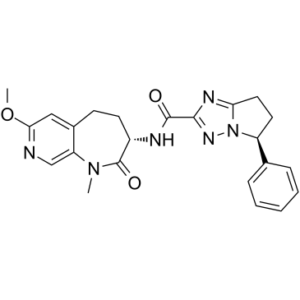
GNE684(GNE-684) is a novel and potent inhibitor of receptor interacting protein 1 (RIP1), it inhibits human RIP1 potently over than mouse and rat with IC50s of 21 nM, 189 nM and 691 nM, respectively. The kinase RIP1 acts in multiple signaling pathways to regulate inflammatory responses and it can trigger both apoptosis and necroptosis. Its kinase activity has been implicated in a range of inflammatory, neurodegenerative, and oncogenic diseases.
Physicochemical Properties
| Molecular Formula | C23H24N6O3 |
| Molecular Weight | 432.475064277649 |
| Exact Mass | 432.190988 |
| Elemental Analysis | C, 63.88; H, 5.59; N, 19.43; O, 11.10 |
| CAS # | 2438637-64-8 |
| PubChem CID | 138377384 |
| Appearance | Typically exists as solid at room temperature |
| LogP | 2.4 |
| SMILES | N1=C(C(N[C@H]2C(=O)N(C)C3C=NC(OC)=CC=3CC2)=O)N=C2CC[C@H](C3=CC=CC=C3)N12 |
| InChi Key | JXFYROJRZJPKTQ-IRXDYDNUSA-N |
| InChi Code | InChI=1S/C23H24N6O3/c1-28-18-13-24-20(32-2)12-15(18)8-9-16(23(28)31)25-22(30)21-26-19-11-10-17(29(19)27-21)14-6-4-3-5-7-14/h3-7,12-13,16-17H,8-11H2,1-2H3,(H,25,30)/t16-,17-/m0/s1 |
| Chemical Name | (5S)-N-[(3S)-7-methoxy-1-methyl-2-oxo-4,5-dihydro-3H-pyrido[3,4-b]azepin-3-yl]-5-phenyl-6,7-dihydro-5H-pyrrolo[1,2-b][1,2,4]triazole-2-carboxamide |
| Synonyms | GNE-684; GNE 684; GNE684; 2438637-64-8; CHEMBL5208359; (5S)-N-[(3S)-7-Methoxy-1-methyl-2-oxo-4,5-dihydro-3H-pyrido[3,4-b]azepin-3-yl]-5-phenyl-6,7-dihydro-5H-pyrrolo[1,2-b][1,2,4]triazole-2-carboxamide; (5S)-N-[(3S)-7-methoxy-1-methyl-2-oxo-2,3,4,5-tetrahydro-1H-pyrido[3,4-b]azepin-3-yl]-5-phenyl-6,7-dihydro-5H-pyrrolo[1,2-b][1,2,4]triazole-2-carboxamide; rel-(S)-N-((S)-7-Methoxy-1-methyl-2-oxo-2,3,4,5-tetrahydro-1H-pyrido[3,4-b]azepin-3-yl)-5-phenyl-6,7-dihydro-5H-pyrrolo[1,2-b][1,2,4]triazole-2-carboxamide; SCHEMBL25798914; GTPL13107; GNE684 |
| HS Tariff Code | 2934.99.9001 |
| Storage |
Powder-20°C 3 years 4°C 2 years In solvent -80°C 6 months -20°C 1 month |
| Shipping Condition | Room temperature (This product is stable at ambient temperature for a few days during ordinary shipping and time spent in Customs) |
Biological Activity
| Targets | Receptor interacting protein 1 (RIP1) |
| ln Vitro | In multiple human and animal cell lines, GNE684 (20 μM; 20 hours) efficiently suppresses RIP1 kinase-driven cell death[1]. GNE684 (20 μM; 0–60 minutes) inhibits RIP1 autophosphorylation generated by TBZ (2 μM BV6, 20 ng/ml TNF, 20 μM zVAD), as well as RIP3 autophosphorylation and RIP3-mediated phosphorylation of MLKL[1]. |
| ln Vivo | Additionally, in the KPP or KPR (LSL-Kras G12D/+; p16/p19 fl/wt; Trp53 R270H/wt; Pdx1-cre) PDAC models, GNE684 had no effect on overall survival or tumor growth[1]. Intestinal epithelial cells (IECs) that lack NEMO are the source of colitis and ileitis, which are inhibited by GNE684 (50 mg/kg; po twice daily)[1]. |
| Cell Assay |
Cell Viability Assay[1] Cell Types: L929 cells, Jurkat cells, MEFs Tested Concentrations: 20 μM Incubation Duration: 20 hrs (hours) Experimental Results: Inhibited RIP1 kinase driven cell death effectively in several human and mouse cell lines. Western Blot Analysis[1] Cell Types: HT-29 cells, J774A.1 cells Tested Concentrations: 0 μM, 20 μM Incubation Duration: 0 minute, 15 minutes, 60 minutes Experimental Results: Disrupted TBZ (2 μM BV6, 20 ng/ml TNF, 20μM zVAD)-induced RIP1 autophosphorylation, interactions between RIP1 and RIP3, RIP3 autophosphorylation, and phosphorylation of MLKL by RIP3. |
| Animal Protocol |
Animal/Disease Models: Nemofl/fl Villin.creERT2 mice (NEMO IEC-KO)[1] Doses: 50 mg/kg Route of Administration: Oral administration; twice (two times) daily; from days 2–6 treated with tamoxifen Experimental Results: Almost completely protected the NEMO-deficient intestines from colitis and ileitis. |
| References |
[1]. RIP1 inhibition blocks inflammatory diseases but not tumor growth or metastases. Cell Death Differ. 2019 May 17. |
| Additional Infomation | The kinase RIP1 acts in multiple signaling pathways to regulate inflammatory responses and it can trigger both apoptosis and necroptosis. Its kinase activity has been implicated in a range of inflammatory, neurodegenerative, and oncogenic diseases. Here, we explore the effect of inhibiting RIP1 genetically, using knock-in mice that express catalytically inactive RIP1 D138N, or pharmacologically, using the murine-potent inhibitor GNE684. Inhibition of RIP1 reduced collagen antibody-induced arthritis, and prevented skin inflammation caused by mutation of Sharpin, or colitis caused by deletion of Nemo from intestinal epithelial cells. Conversely, inhibition of RIP1 had no effect on tumor growth or survival in pancreatic tumor models driven by mutant Kras, nor did it reduce lung metastases in a B16 melanoma model. Collectively, our data emphasize a role for the kinase activity of RIP1 in certain inflammatory disease models, but question its relevance to tumor progression and metastases. |
Solubility Data
| Solubility (In Vitro) | May dissolve in DMSO (in most cases), if not, try other solvents such as H2O, Ethanol, or DMF with a minute amount of products to avoid loss of samples |
| Solubility (In Vivo) |
Note: Listed below are some common formulations that may be used to formulate products with low water solubility (e.g. < 1 mg/mL), you may test these formulations using a minute amount of products to avoid loss of samples. Injection Formulations (e.g. IP/IV/IM/SC) Injection Formulation 1: DMSO : Tween 80: Saline = 10 : 5 : 85 (i.e. 100 μL DMSO stock solution → 50 μL Tween 80 → 850 μL Saline) *Preparation of saline: Dissolve 0.9 g of sodium chloride in 100 mL ddH ₂ O to obtain a clear solution. Injection Formulation 2: DMSO : PEG300 :Tween 80 : Saline = 10 : 40 : 5 : 45 (i.e. 100 μL DMSO → 400 μLPEG300 → 50 μL Tween 80 → 450 μL Saline) Injection Formulation 3: DMSO : Corn oil = 10 : 90 (i.e. 100 μL DMSO → 900 μL Corn oil) Example: Take the Injection Formulation 3 (DMSO : Corn oil = 10 : 90) as an example, if 1 mL of 2.5 mg/mL working solution is to be prepared, you can take 100 μL 25 mg/mL DMSO stock solution and add to 900 μL corn oil, mix well to obtain a clear or suspension solution (2.5 mg/mL, ready for use in animals). Injection Formulation 4: DMSO : 20% SBE-β-CD in saline = 10 : 90 [i.e. 100 μL DMSO → 900 μL (20% SBE-β-CD in saline)] *Preparation of 20% SBE-β-CD in Saline (4°C,1 week): Dissolve 2 g SBE-β-CD in 10 mL saline to obtain a clear solution. Injection Formulation 5: 2-Hydroxypropyl-β-cyclodextrin : Saline = 50 : 50 (i.e. 500 μL 2-Hydroxypropyl-β-cyclodextrin → 500 μL Saline) Injection Formulation 6: DMSO : PEG300 : castor oil : Saline = 5 : 10 : 20 : 65 (i.e. 50 μL DMSO → 100 μLPEG300 → 200 μL castor oil → 650 μL Saline) Injection Formulation 7: Ethanol : Cremophor : Saline = 10: 10 : 80 (i.e. 100 μL Ethanol → 100 μL Cremophor → 800 μL Saline) Injection Formulation 8: Dissolve in Cremophor/Ethanol (50 : 50), then diluted by Saline Injection Formulation 9: EtOH : Corn oil = 10 : 90 (i.e. 100 μL EtOH → 900 μL Corn oil) Injection Formulation 10: EtOH : PEG300:Tween 80 : Saline = 10 : 40 : 5 : 45 (i.e. 100 μL EtOH → 400 μLPEG300 → 50 μL Tween 80 → 450 μL Saline) Oral Formulations Oral Formulation 1: Suspend in 0.5% CMC Na (carboxymethylcellulose sodium) Oral Formulation 2: Suspend in 0.5% Carboxymethyl cellulose Example: Take the Oral Formulation 1 (Suspend in 0.5% CMC Na) as an example, if 100 mL of 2.5 mg/mL working solution is to be prepared, you can first prepare 0.5% CMC Na solution by measuring 0.5 g CMC Na and dissolve it in 100 mL ddH2O to obtain a clear solution; then add 250 mg of the product to 100 mL 0.5% CMC Na solution, to make the suspension solution (2.5 mg/mL, ready for use in animals). Oral Formulation 3: Dissolved in PEG400 Oral Formulation 4: Suspend in 0.2% Carboxymethyl cellulose Oral Formulation 5: Dissolve in 0.25% Tween 80 and 0.5% Carboxymethyl cellulose Oral Formulation 6: Mixing with food powders Note: Please be aware that the above formulations are for reference only. InvivoChem strongly recommends customers to read literature methods/protocols carefully before determining which formulation you should use for in vivo studies, as different compounds have different solubility properties and have to be formulated differently. (Please use freshly prepared in vivo formulations for optimal results.) |
| Preparing Stock Solutions | 1 mg | 5 mg | 10 mg | |
| 1 mM | 2.3122 mL | 11.5612 mL | 23.1225 mL | |
| 5 mM | 0.4624 mL | 2.3122 mL | 4.6245 mL | |
| 10 mM | 0.2312 mL | 1.1561 mL | 2.3122 mL |