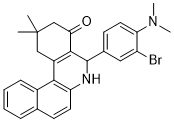
GLS-IN-968 is an allosteric inhibitor of glutaminase (GLS). It inhibits the transformation of fibroblasts that is dependent on Rho-GTPase and inhibits the growth and invasive activity of breast cancer cells in vitro.
Physicochemical Properties
| Molecular Formula | C27H27BRN2O |
| Molecular Weight | 475.43 |
| Exact Mass | 474.131 |
| Elemental Analysis | C, 68.21; H, 5.72; Br, 16.81; N, 5.89; O, 3.37 |
| CAS # | 311795-38-7 |
| Related CAS # | 311795-38-7 |
| PubChem CID | 3099980 |
| Appearance | White to off-white solid powder |
| LogP | 7.115 |
| Hydrogen Bond Donor Count | 1 |
| Hydrogen Bond Acceptor Count | 3 |
| Rotatable Bond Count | 2 |
| Heavy Atom Count | 31 |
| Complexity | 744 |
| Defined Atom Stereocenter Count | 0 |
| SMILES | O=C1C(C(C2=CC=C(N(C)C)C(Br)=C2)NC3=C4C5=CC=CC=C5C=C3)=C4CC(C)(C)C1 |
| InChi Key | NVFRRJQWRZFDLM-UHFFFAOYSA-N |
| InChi Code | InChI=1S/C27H27BrN2O/c1-27(2)14-19-24-18-8-6-5-7-16(18)9-11-21(24)29-26(25(19)23(31)15-27)17-10-12-22(30(3)4)20(28)13-17/h5-13,26,29H,14-15H2,1-4H3 |
| Chemical Name | 5-[3-bromo-4-(dimethylamino)phenyl]-2,2-dimethyl-1,3,5,6-tetrahydrobenzo[a]phenanthridin-4-one |
| Synonyms | GLS-IN-968; GLSIN968; GLS IN 968; Glutaminase inhibitor-968; Glutaminase inhibitor compound 968; Glutaminase inhibitor 968; GLS inhibitor 968 |
| HS Tariff Code | 2934.99.9001 |
| Storage |
Powder-20°C 3 years 4°C 2 years In solvent -80°C 6 months -20°C 1 month |
| Shipping Condition | Room temperature (This product is stable at ambient temperature for a few days during ordinary shipping and time spent in Customs) |
Biological Activity
| Targets | Glutaminase C |
| ln Vitro | The cellular transformation of NIH 3T3 cells is inhibited by glutaminase C-IN-1 (Compound 968; 10 μM; 14 days) [1]. Targets specific to Dbl have their signaling activity inhibited by glutaminase C-IN-1 (10 μM; 6 d) [1]. Human breast cancer cells' transforming activity is burst by glutaminase C-IN-1 [1]. In transformed cells, glutamine reset is burst by glutaminase C-IN-1 (10 μM) [2]. |
| Cell Assay |
Cell Viability Assay[1] Cell Types: MDA-MB231 cells, SKBR3 cells, and NIH 3T3 cells Tested Concentrations: 10 μM Incubation Duration: 5 h Experimental Results: Inhibited -1 preferentially binds to glutaminase C in the framework state[2]. Cell growth. |
| Animal Protocol |
Animal/Disease Models: P493 B lymphoma cells SCID (severe combined immunodeficient) mouse[1] Glutaminase C-IN-1 (compound 968) (200 μg/mouse; intraperitoneal (ip) injection; one time/day for 12 days) reduces tumor volume in mice[1] . Doses: 200 μg/mouse Route of Administration: intraperitoneal (ip) injection, one time/day for 12 days Experimental Results: The tumor size was diminished by approximately 50%. |
| References |
[1]. Targeting mitochondrial glutaminase activity inhibits oncogenic transformation. Cancer Cell. 2010 Sep 14;18(3):207-19. [2]. Mechanism by which a recently discovered allosteric inhibitor blocks glutamine metabolism in transformed cells. Proc Natl Acad Sci U S A. 2015 Jan 13;112(2):394-9. |
| Additional Infomation | 5-[3-bromo-4-(dimethylamino)phenyl]-2,2-dimethyl-2,3,5,6-tetrahydrobenzo[a]phenanthridin-4(1H)-one is a partially hydrogenated benzophenanthridine carrying an oxo group at C-4, geminal methyl groups at C-2 and a 3-bromo-4-(dimethylamino)phenyl group at C-5. It has a role as an EC 3.5.1.2 (glutaminase) inhibitor. |
Solubility Data
| Solubility (In Vitro) | DMSO : ~25 mg/mL (~52.59 mM) |
| Solubility (In Vivo) |
Solubility in Formulation 1: 2.5 mg/mL (5.26 mM) in 10% DMSO + 40% PEG300 + 5% Tween80 + 45% Saline (add these co-solvents sequentially from left to right, and one by one), suspension solution; with sonication. For example, if 1 mL of working solution is to be prepared, you can add 100 μL of 25.0 mg/mL clear DMSO stock solution to 400 μL PEG300 and mix evenly; then add 50 μL Tween-80 to the above solution and mix evenly; then add 450 μL normal saline to adjust the volume to 1 mL. Preparation of saline: Dissolve 0.9 g of sodium chloride in 100 mL ddH₂ O to obtain a clear solution. Solubility in Formulation 2: ≥ 2.5 mg/mL (5.26 mM) (saturation unknown) in 10% DMSO + 90% Corn Oil (add these co-solvents sequentially from left to right, and one by one), clear solution. For example, if 1 mL of working solution is to be prepared, you can add 100 μL of 25.0 mg/mL clear DMSO stock solution to 900 μL of corn oil and mix evenly. (Please use freshly prepared in vivo formulations for optimal results.) |
| Preparing Stock Solutions | 1 mg | 5 mg | 10 mg | |
| 1 mM | 2.1034 mL | 10.5168 mL | 21.0336 mL | |
| 5 mM | 0.4207 mL | 2.1034 mL | 4.2067 mL | |
| 10 mM | 0.2103 mL | 1.0517 mL | 2.1034 mL |