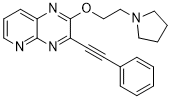
GK921 is a novel and potent inhibitor of transglutaminase 2 (TGase), with an IC50 of 7.71 μM for TGase 2 that is recombinant. GK921 was cytotoxic to RCC, with an average GI50 of 0.905 μM across eight RCC cell lines. In the preclinical xenograft tumor models ACHN and CAKI-1, a single treatment with GK921 stabilized p53 and nearly eliminated tumor growth. The TGase 2 inhibitor GK921 inhibits the growth of RCC in xenograft tumor models, indicating a potential novel therapeutic strategy for RCC.
Physicochemical Properties
| Molecular Formula | C21H20N4O |
| Molecular Weight | 344.41 |
| Exact Mass | 344.164 |
| Elemental Analysis | C, 73.23; H, 5.85; N, 16.27; O, 4.65 |
| CAS # | 1025015-40-0 |
| Related CAS # | 1025015-40-0 |
| PubChem CID | 56682080 |
| Appearance | Off-white to brown solid powder |
| LogP | 2.837 |
| Hydrogen Bond Donor Count | 0 |
| Hydrogen Bond Acceptor Count | 5 |
| Rotatable Bond Count | 6 |
| Heavy Atom Count | 26 |
| Complexity | 501 |
| Defined Atom Stereocenter Count | 0 |
| SMILES | C12=NC=CC=C1N=C(OCCN3CCCC3)C(C#CC4=CC=CC=C4)=N2 |
| InChi Key | MNYJJHBAEYKXEG-UHFFFAOYSA-N |
| InChi Code | InChI=1S/C21H20N4O/c1-2-7-17(8-3-1)10-11-19-21(26-16-15-25-13-4-5-14-25)24-18-9-6-12-22-20(18)23-19/h1-3,6-9,12H,4-5,13-16H2 |
| Chemical Name | 3-(2-phenylethynyl)-2-(2-pyrrolidin-1-ylethoxy)pyrido[2,3-b]pyrazine |
| Synonyms | GK921; GK-921; GK 921 |
| HS Tariff Code | 2934.99.9001 |
| Storage |
Powder-20°C 3 years 4°C 2 years In solvent -80°C 6 months -20°C 1 month |
| Shipping Condition | Room temperature (This product is stable at ambient temperature for a few days during ordinary shipping and time spent in Customs) |
Biological Activity
| Targets |
TGase (IC50 = 7.71 μM) GK921 inhibits the dose-dependent polymerization of p53 and I-κBα induced by TGase 2. GK921 was cytotoxic, with GI50 values ranging from 10-10 to 10-4 M. GI50 on average is 9.05×10⁻⁷ M. A concentration-dependent rise in cleaved poly(ADP-ribose) polymerase (c-PARP) and p53 levels is seen when GK921 rescues p53 levels, which in turn triggers apoptosis[1]. |
| ln Vitro |
GK921 inhibits the dose-dependent polymerization of p53 and I-κBα induced by TGase 2. GK921 was cytotoxic, with GI50 values ranging from 10-10 to 10-4 M. GI50 on average is 9.05×10⁻⁷ M. A concentration-dependent rise in cleaved poly(ADP-ribose) polymerase (c-PARP) and p53 levels is seen when GK921 rescues p53 levels, which in turn triggers apoptosis[1]. GK921 showed cytotoxicity against a panel of eight renal cell carcinoma cell lines in a sulforhodamine B assay, with an average GI50 of 0.905 µM. The individual GI50 values ranged from 0.77 µM (CAKI-1) to 56.14 µM (A498). [1] Treatment of ACHN and CAKI-1 cells with 1 µM GK921 for 12 hours induced apoptosis, as evidenced by increased Annexin V staining (3.4-fold and 7.9-fold increase, respectively) and TUNEL positivity (30-fold and 10-fold increase, respectively) compared to controls. [1] Western blot analysis in ACHN and CAKI-1 cells (wild-type p53) showed that treatment with GK921 (0.1, 1, 5 µM for 8 hours) led to a concentration-dependent increase in p53 protein levels and the cleavage of poly(ADP-ribose) polymerase, indicating apoptosis induction. [1] Immunocytochemistry confirmed increased nuclear p53 protein levels in ACHN and CAKI-1 cells after treatment with 1 µM GK921 for 4 hours. [1] A dual luciferase reporter assay using a BAX promoter construct (containing a p53-binding site) in CAKI-1 cells demonstrated that GK921 treatment (0.5, 1, 2.5, 5 µM for 4 hours) increased p53 transcriptional activity in a concentration-dependent manner. This effect was mimicked by TGase 2 siRNA but not observed in HEK293 cells which express low levels of TGase 2. [1] GK921 inhibited TGase 2-mediated polymerization of its protein substrates I-κBα and p53 in a cell-free system in a dose-dependent manner. [1] A kinase profiler service indicated that GK921 does not have inhibitory effects on EGFR signaling kinases. [1] |
| ln Vivo |
GK921 stabilizes p53 in the preclinical xenograft tumor models ACHN and CAKI-1, almost completely reducing tumor growth after a single treatment[1]. In ACHN cell xenograft models established in female BALB/c nude mice, oral administration of GK921 (8 mg/kg, once daily, 5 days/week for 64 days) starting when tumors reached ~100 mm³ significantly suppressed tumor growth compared to vehicle-treated controls. [1] In CAKI-1 cell xenograft models under the same treatment regimen, oral GK921 (8 mg/kg) also significantly suppressed tumor growth. [1] Immunohistochemical analysis of tumor tissues from the ACHN xenograft model showed a threefold increase in p53-positive cells in the GK921-treated group compared to the control group. [1] |
| Enzyme Assay |
Following a 10-minute preincubation period in 0.1 mL of reaction buffer containing varying concentrations of GK13 or GK921, with or without 10 mM CaCl2, TGase 2from guinea pig liver is added. The substrate solution contains 2 The inhibitory effect of GK921 on TGase 2 enzymatic activity was determined by measuring the incorporation of radiolabeled [1,4-¹⁴C] putrescine into succinylated casein. One milliunit of guinea pig liver TGase 2 was pre-incubated with various concentrations of the compound in reaction buffer with or without 10 mM CaCl₂ for 10 minutes. Subsequently, a substrate solution containing succinylated casein and the radiolabeled putrescine was added, and the mixture was incubated at 37°C for 1 hour. The reaction was stopped by adding cold trichloroacetic acid. The precipitated proteins were collected on glass fiber filters, washed, dried, and the incorporated radioactivity was measured using a scintillation counter. Activity compared to a positive control (enzyme with buffer alone) was used to calculate the IC50 value via logistic linear regression. [1] |
| Cell Assay |
The BAX promoter luciferase reporter construct is transfected into the cells. The dual luciferase assay kit is used to measure the activities of firefly and Renilla luciferase after exposure to GK921 (0, 0.5, 1, 2.5, and 5 μM), with pRL-CMV serving as an internal control. For cytotoxicity assessment (SRB assay), cells were seeded in 96-well plates and allowed to adhere for 24 hours. GK921 or vehicle was then added, and cells were incubated for 48 hours at 37°C. Cells were fixed with trichloroacetic acid, washed, and dried. Fixed cells were stained with sulforhodamine B dye, washed with acetic acid, and dried again. The bound dye was solubilized in Tris base, and absorbance was measured at 515 nm to determine cell density. GI50 values (concentration causing 50% growth inhibition) were calculated. [1] For apoptosis analysis by Annexin V/PI staining, cells treated with GK921 were harvested, washed, and resuspended in binding buffer. Cell suspensions were stained with Annexin V-FITC and propidium iodide, incubated in the dark, and analyzed by flow cytometry within 1 hour. [1] For the TUNEL assay to detect apoptosis in cells, fixed cells were processed using a commercial in situ cell death detection kit according to the manufacturer's instructions to label DNA strand breaks. [1] For the dual luciferase reporter assay to measure p53 activity, CAKI-1 cells were transfected with a BAX promoter-driven firefly luciferase reporter construct and a Renilla luciferase control plasmid. After treatment with GK921, cell lysates were prepared, and both firefly and Renilla luciferase activities were measured sequentially using a dual-luciferase assay kit. Firefly luciferase activity was normalized to Renilla activity. [1] |
| Animal Protocol |
Mice: GK921 is dissolved in DMSO for mice. For 64 days, the vehicle alone and GK921 (8 mg/kg) are given orally once daily, five days a week. Every two to three days, the size of the main tumors is measured with calipers. One calculates the tumor volume[1]. For the xenograft efficacy study, female BALB/c nude mice (6-8 weeks old) were subcutaneously inoculated with ACHN or CAKI-1 renal carcinoma cells (5.0 x 10⁶ cells) near the scapula. After about one month, when tumors reached approximately 100 mm³ in volume, mice were randomly divided into treatment and control groups (n=6 per group). GK921 was formulated in 0.5% carboxymethyl cellulose in phosphate-buffered saline (vehicle). The treatment group received GK921 at a dose of 8 mg/kg body weight via oral gavage once daily, 5 days per week, for a total of 64 days. The control group received the vehicle only on the same schedule. Tumor dimensions were measured every 2-3 days with calipers, and volume was calculated. For endpoint analysis, mice were injected intraperitoneally with BrdU, euthanized after 2 hours, and tumors were excised for histology and immunohistochemistry. [1] A preliminary maximum tolerated dose test was conducted. Oral administration of GK921 at 10 mg/kg did not cause lethality or body weight loss, while intraperitoneal injection at 10 mg/kg caused about 10% body weight loss. The final efficacy study dose was set at 8 mg/kg orally for safety reasons. [1] |
| Toxicity/Toxicokinetics |
In a preliminary maximum tolerated dose test in mice, oral administration of GK921 at 10 mg/kg was not lethal and did not cause body weight loss. Intraperitoneal injection at 10 mg/kg caused approximately 10% body weight loss. [1] In the 64-day chronic oral efficacy study at 8 mg/kg (5 days/week), no overt signs of toxicity, lethality, or body weight loss were reported in the treatment groups compared to controls. [1] The literature does not provide data on median lethal dose (LD50), detailed organ toxicity, drug-drug interactions, or plasma protein binding for GK921. [1] |
| References |
[1]. Transglutaminase 2 inhibitor abrogates renal cell carcinoma in xenograft models. J Cancer Res Clin Oncol. 2014 May;140(5):757-67. |
| Additional Infomation |
GK921 (3-(phenylethynyl)-2-(2-(pyridin-2-yl)ethoxy)pyrido[3,2-b]pyrazine) is a synthetic small molecule inhibitor of transglutaminase 2, optimized from a quinoxaline derivative lead compound GK13. [1] The proposed mechanism of action involves inhibition of TGase 2 enzyme activity, which prevents TGase 2-mediated cross-linking and depletion of the tumor suppressor protein p53. This leads to stabilization of p53, activation of p53 transcriptional activity (e.g., upregulation of pro-apoptotic BAX), and subsequent induction of apoptosis in renal cell carcinoma cells. [1] The study suggests that GK921 monotherapy may have therapeutic potential for renal cell carcinoma, particularly in tumors dependent on TGase 2 activity for survival. It also proposes that combining TGase 2 inhibition with tyrosine kinase inhibitor therapy could be beneficial. [1] TGase 2 expression was found to be significantly upregulated in clinical renal cell carcinoma tissue samples compared to normal kidney tissues. [1] |
Solubility Data
| Solubility (In Vitro) | DMSO: ≥ 30 mg/mL (~87.1 mM) |
| Solubility (In Vivo) |
Solubility in Formulation 1: ≥ 2.5 mg/mL (7.26 mM) (saturation unknown) in 10% DMSO + 40% PEG300 + 5% Tween80 + 45% Saline (add these co-solvents sequentially from left to right, and one by one), clear solution. For example, if 1 mL of working solution is to be prepared, you can add 100 μL of 25.0 mg/mL clear DMSO stock solution to 400 μL PEG300 and mix evenly; then add 50 μL Tween-80 to the above solution and mix evenly; then add 450 μL normal saline to adjust the volume to 1 mL. Preparation of saline: Dissolve 0.9 g of sodium chloride in 100 mL ddH₂ O to obtain a clear solution. Solubility in Formulation 2: ≥ 2.5 mg/mL (7.26 mM) (saturation unknown) in 10% DMSO + 90% (20% SBE-β-CD in Saline) (add these co-solvents sequentially from left to right, and one by one), clear solution. For example, if 1 mL of working solution is to be prepared, you can add 100 μL of 25.0 mg/mL clear DMSO stock solution to 900 μL of 20% SBE-β-CD physiological saline solution and mix evenly. Preparation of 20% SBE-β-CD in Saline (4°C,1 week): Dissolve 2 g SBE-β-CD in 10 mL saline to obtain a clear solution. (Please use freshly prepared in vivo formulations for optimal results.) |
| Preparing Stock Solutions | 1 mg | 5 mg | 10 mg | |
| 1 mM | 2.9035 mL | 14.5176 mL | 29.0352 mL | |
| 5 mM | 0.5807 mL | 2.9035 mL | 5.8070 mL | |
| 10 mM | 0.2904 mL | 1.4518 mL | 2.9035 mL |