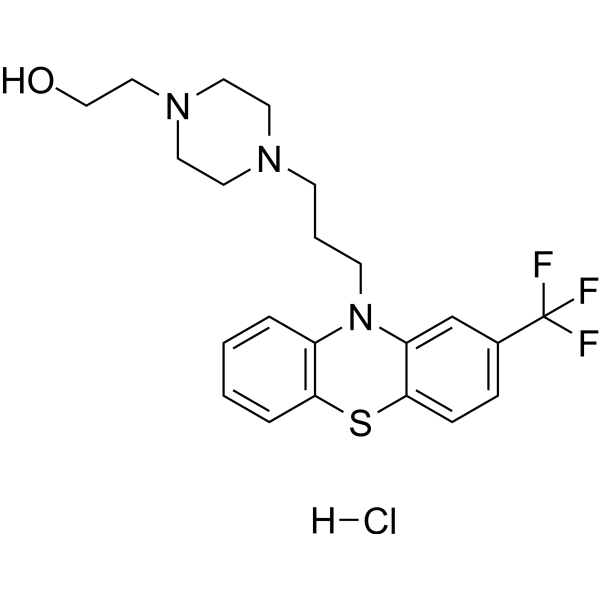
Physicochemical Properties
| Molecular Formula | C22H27CLF3N3OS |
| Molecular Weight | 473.982493638992 |
| Exact Mass | 473.151 |
| CAS # | 1254-47-3 |
| PubChem CID | 6602611 |
| Appearance | Typically exists as solid at room temperature |
| Hydrogen Bond Donor Count | 2 |
| Hydrogen Bond Acceptor Count | 8 |
| Rotatable Bond Count | 6 |
| Heavy Atom Count | 31 |
| Complexity | 544 |
| Defined Atom Stereocenter Count | 0 |
| SMILES | C(N1C2=CC=CC=C2SC2C=CC(C(F)(F)F)=CC1=2)CCN1CCN(CCO)CC1.Cl |
| InChi Key | CUXQPMGPJPHNFO-UHFFFAOYSA-N |
| InChi Code | InChI=1S/C22H26F3N3OS.ClH/c23-22(24,25)17-6-7-21-19(16-17)28(18-4-1-2-5-20(18)30-21)9-3-8-26-10-12-27(13-11-26)14-15-29;/h1-2,4-7,16,29H,3,8-15H2;1H |
| Chemical Name | 2-[4-[3-[2-(trifluoromethyl)phenothiazin-10-yl]propyl]piperazin-1-yl]ethanol;hydrochloride |
| HS Tariff Code | 2934.99.9001 |
| Storage |
Powder-20°C 3 years 4°C 2 years In solvent -80°C 6 months -20°C 1 month |
| Shipping Condition | Room temperature (This product is stable at ambient temperature for a few days during ordinary shipping and time spent in Customs) |
Biological Activity
| Targets | Dopamine receptor, Sodium channels, SARS-CoV-2[1][2] |
| ln Vivo | Fluphenazine (1 mg/kg; IG, from gestational day 6 to 15) hydrochloride causes teratogenicity in pregnant mice[5]. Fluphenazine (0.125-1 mg/kg; IP, single dose) hydrochloride antagonizes the stereotyped biting induced by methylphenidate and significantly inhibits climbing behavior[6]. |
| Animal Protocol |
Animal/Disease Models: Mature female Swiss-Webster mice[5] Doses: 1 mg/kg Route of Administration: IG, treated from day 6 to day 15 of gestation Experimental Results: Significantly reduced fetal weight and length, increased the incidence of incomplete ossification of sternebrae and skull bones. Animal/Disease Models: Mice (injected with 60 mg/kg Methylphenidate)[6] Doses: 0.125, 0.25, 0.5, and 1 mg/kg Route of Administration: IP, single dosage Experimental Results: Antagonized Methylphenidate-induced stereotyped gnawing; inhibited significantly climbing behaviour in mice at 0.0625-0.5 mg/kg, and at the dose of 1 mg/kg abolished this effect completely. |
| Toxicity/Toxicokinetics |
Effects During Pregnancy and Lactation ◉ Summary of Use during Lactation There is no published experience with fluphenazine during breastfeeding. Very limited long-term follow-up data indicate no adverse developmental effects when other phenothiazines are used alone. Because of the lack of published experience with fluphenazine during breastfeeding, other antipsychotic agents may be preferred, especially while nursing a newborn or preterm infant. Monitor the infant for drowsiness and developmental milestones, especially if other antipsychotics are used concurrently. ◉ Effects in Breastfed Infants Relevant published information was not found as of the revision date. ◉ Effects on Lactation and Breastmilk Like other phenothiazines, fluphenazine elevates serum prolactin and has caused galactorrhea. The elevation is related to serum levels and lasts 2 to 4 weeks with the depot injectable formulation. The maternal prolactin level in a mother with established lactation may not affect her ability to breastfeed. |
| References |
[1].The neuroleptic drug, fluphenazine, blocks neuronal voltage-gated sodium channels. Brain Res. 2006;1106(1):72-81. [2].Based on Principles and Insights of COVID-19 Epidemiology, Genome Sequencing, and Pathogenesis: Retrospective Analysis of Sinigrin and ProlixinRX (Fluphenazine) Provides Off-Label Drug Candidates. SLAS Discov. 2020 Dec;25(10):1123-1140. [3].Siragusa S, Bistas KG, Saadabadi A. Fluphenazine. 2022 May 8. In: StatPearls [Internet]. Treasure Island (FL): StatPearls Publishing; 2022 Jan. [4].Peripheral diabetic neuropathy treated with amitriptyline and fluphenazine. JAMA. 1977 Nov 21;238(21):2291-2. [5].Teratogenic effect of diphenylhydantoin and/or fluphenazine in mice. J Appl Toxicol. 1996 May-Jun;16(3):221-5. [6].Narcotic analgesics and stereotyped behaviour in mice. Naunyn Schmiedebergs Arch Pharmacol. 1980 Jul;312(3):225-7. |
| Additional Infomation |
A phenothiazine used in the treatment of PSYCHOSES. Its properties and uses are generally similar to those of CHLORPROMAZINE. See also: Fluphenazine Hydrochloride (annotation moved to). |
Solubility Data
| Solubility (In Vitro) | Typically soluble in DMSO (e.g. 10 mM) |
| Solubility (In Vivo) |
Note: Listed below are some common formulations that may be used to formulate products with low water solubility (e.g. < 1 mg/mL), you may test these formulations using a minute amount of products to avoid loss of samples. Injection Formulations (e.g. IP/IV/IM/SC) Injection Formulation 1: DMSO : Tween 80: Saline = 10 : 5 : 85 (i.e. 100 μL DMSO stock solution → 50 μL Tween 80 → 850 μL Saline) *Preparation of saline: Dissolve 0.9 g of sodium chloride in 100 mL ddH ₂ O to obtain a clear solution. Injection Formulation 2: DMSO : PEG300 :Tween 80 : Saline = 10 : 40 : 5 : 45 (i.e. 100 μL DMSO → 400 μLPEG300 → 50 μL Tween 80 → 450 μL Saline) Injection Formulation 3: DMSO : Corn oil = 10 : 90 (i.e. 100 μL DMSO → 900 μL Corn oil) Example: Take the Injection Formulation 3 (DMSO : Corn oil = 10 : 90) as an example, if 1 mL of 2.5 mg/mL working solution is to be prepared, you can take 100 μL 25 mg/mL DMSO stock solution and add to 900 μL corn oil, mix well to obtain a clear or suspension solution (2.5 mg/mL, ready for use in animals). Injection Formulation 4: DMSO : 20% SBE-β-CD in saline = 10 : 90 [i.e. 100 μL DMSO → 900 μL (20% SBE-β-CD in saline)] *Preparation of 20% SBE-β-CD in Saline (4°C,1 week): Dissolve 2 g SBE-β-CD in 10 mL saline to obtain a clear solution. Injection Formulation 5: 2-Hydroxypropyl-β-cyclodextrin : Saline = 50 : 50 (i.e. 500 μL 2-Hydroxypropyl-β-cyclodextrin → 500 μL Saline) Injection Formulation 6: DMSO : PEG300 : castor oil : Saline = 5 : 10 : 20 : 65 (i.e. 50 μL DMSO → 100 μLPEG300 → 200 μL castor oil → 650 μL Saline) Injection Formulation 7: Ethanol : Cremophor : Saline = 10: 10 : 80 (i.e. 100 μL Ethanol → 100 μL Cremophor → 800 μL Saline) Injection Formulation 8: Dissolve in Cremophor/Ethanol (50 : 50), then diluted by Saline Injection Formulation 9: EtOH : Corn oil = 10 : 90 (i.e. 100 μL EtOH → 900 μL Corn oil) Injection Formulation 10: EtOH : PEG300:Tween 80 : Saline = 10 : 40 : 5 : 45 (i.e. 100 μL EtOH → 400 μLPEG300 → 50 μL Tween 80 → 450 μL Saline) Oral Formulations Oral Formulation 1: Suspend in 0.5% CMC Na (carboxymethylcellulose sodium) Oral Formulation 2: Suspend in 0.5% Carboxymethyl cellulose Example: Take the Oral Formulation 1 (Suspend in 0.5% CMC Na) as an example, if 100 mL of 2.5 mg/mL working solution is to be prepared, you can first prepare 0.5% CMC Na solution by measuring 0.5 g CMC Na and dissolve it in 100 mL ddH2O to obtain a clear solution; then add 250 mg of the product to 100 mL 0.5% CMC Na solution, to make the suspension solution (2.5 mg/mL, ready for use in animals). Oral Formulation 3: Dissolved in PEG400 Oral Formulation 4: Suspend in 0.2% Carboxymethyl cellulose Oral Formulation 5: Dissolve in 0.25% Tween 80 and 0.5% Carboxymethyl cellulose Oral Formulation 6: Mixing with food powders Note: Please be aware that the above formulations are for reference only. InvivoChem strongly recommends customers to read literature methods/protocols carefully before determining which formulation you should use for in vivo studies, as different compounds have different solubility properties and have to be formulated differently. (Please use freshly prepared in vivo formulations for optimal results.) |
| Preparing Stock Solutions | 1 mg | 5 mg | 10 mg | |
| 1 mM | 2.1098 mL | 10.5490 mL | 21.0979 mL | |
| 5 mM | 0.4220 mL | 2.1098 mL | 4.2196 mL | |
| 10 mM | 0.2110 mL | 1.0549 mL | 2.1098 mL |