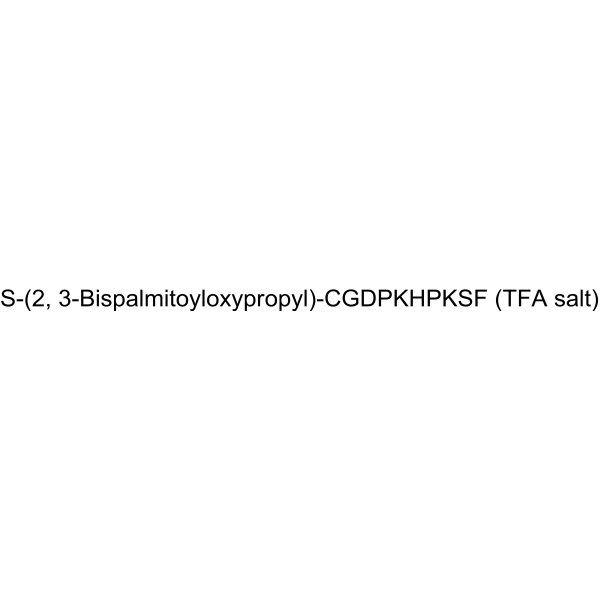
Physicochemical Properties
| Molecular Formula | C82H141F3N14O20S |
| Molecular Weight | 1780.18 |
| Related CAS # | FSL-1;322455-70-9 |
| Appearance | White to off-white solid powder |
| HS Tariff Code | 2934.99.9001 |
| Storage |
Powder-20°C 3 years 4°C 2 years In solvent -80°C 6 months -20°C 1 month |
| Shipping Condition | Room temperature (This product is stable at ambient temperature for a few days during ordinary shipping and time spent in Customs) |
Biological Activity
| Targets | TLR2 HSV-2 TLR6 MMP-9 |
| ln Vitro | In human vaginal epithelial cells (EC), FSL-1 TFA dramatically lowers HSV-2 replication [1]. FSL-1 TFA elaborates a cytokine response profile that offers substantial resistance against experimental genital HSV-2 infection [1]. Human monocyte THP-1 cells are exposed to 50 ng/mL of FSL-1 TFA for 24 hours, which causes MMP-9 production at the mRNA and protein levels [2]. The signaling pathway of MAP kinase/NF-κB is triggered by FSL-1 TFA [2]. |
| ln Vivo | Mice exposed to genital HSV-2 challenge are considerably shielded by FSL-1 TFA [1]. |
| Cell Assay |
Cell Viability Assay[1] Cell Types: V11I, V12I or V19I immortalized human vaginal EC Tested Concentrations: 6 μg or 0.1 μg Incubation Duration: Added at 24, 6 or just prior to HSV-2 inoculation(104pfu/well) Experimental Results: The 6 μg does produce significant reductions when delivered at 24 or 6 h prior to HSV-2 inoculation. The 0.1 μg dose produced decreased HSV-2 replication at 24 or 6 h prior to viral challenge. |
| Animal Protocol |
Animal/Disease Models: Female Swiss-Webster mice (weighing 20-25 g)[1] Doses: 2 or 6 μg Route of Administration: Delivered vaginally using a positive displacement pipet, prior to or following viral challenge as specified for each experiment. Experimental Results: The 2 μg does delivered 6 h prior to HSV-2 challenge increased the ID50 (260 pfu) and LD50 (660 pfu) by 10-fold compared to DPBS vehicle control. The single 6 μg dose produced Dramatically improved outcomes compared to DPBS vehicle application. |
| References |
[1]. FSL-1, a bacterial-derived toll-like receptor 2/6 agonist, enhances resistance to experimental HSV-2 infection. Virol J. 2009 Nov 10;6:195. [2]. The Toll-Like Receptor 2/6 Agonist, FSL-1 Lipopeptide, Therapeutically Mitigates Acute Radiation Syndrome. Sci Rep. 2017 Dec 11;7(1):17355. |
Solubility Data
| Solubility (In Vitro) | H2O :~50 mg/mL (~28.09 mM) |
| Solubility (In Vivo) |
Note: Listed below are some common formulations that may be used to formulate products with low water solubility (e.g. < 1 mg/mL), you may test these formulations using a minute amount of products to avoid loss of samples. Injection Formulations (e.g. IP/IV/IM/SC) Injection Formulation 1: DMSO : Tween 80: Saline = 10 : 5 : 85 (i.e. 100 μL DMSO stock solution → 50 μL Tween 80 → 850 μL Saline) *Preparation of saline: Dissolve 0.9 g of sodium chloride in 100 mL ddH ₂ O to obtain a clear solution. Injection Formulation 2: DMSO : PEG300 :Tween 80 : Saline = 10 : 40 : 5 : 45 (i.e. 100 μL DMSO → 400 μLPEG300 → 50 μL Tween 80 → 450 μL Saline) Injection Formulation 3: DMSO : Corn oil = 10 : 90 (i.e. 100 μL DMSO → 900 μL Corn oil) Example: Take the Injection Formulation 3 (DMSO : Corn oil = 10 : 90) as an example, if 1 mL of 2.5 mg/mL working solution is to be prepared, you can take 100 μL 25 mg/mL DMSO stock solution and add to 900 μL corn oil, mix well to obtain a clear or suspension solution (2.5 mg/mL, ready for use in animals). Injection Formulation 4: DMSO : 20% SBE-β-CD in saline = 10 : 90 [i.e. 100 μL DMSO → 900 μL (20% SBE-β-CD in saline)] *Preparation of 20% SBE-β-CD in Saline (4°C,1 week): Dissolve 2 g SBE-β-CD in 10 mL saline to obtain a clear solution. Injection Formulation 5: 2-Hydroxypropyl-β-cyclodextrin : Saline = 50 : 50 (i.e. 500 μL 2-Hydroxypropyl-β-cyclodextrin → 500 μL Saline) Injection Formulation 6: DMSO : PEG300 : castor oil : Saline = 5 : 10 : 20 : 65 (i.e. 50 μL DMSO → 100 μLPEG300 → 200 μL castor oil → 650 μL Saline) Injection Formulation 7: Ethanol : Cremophor : Saline = 10: 10 : 80 (i.e. 100 μL Ethanol → 100 μL Cremophor → 800 μL Saline) Injection Formulation 8: Dissolve in Cremophor/Ethanol (50 : 50), then diluted by Saline Injection Formulation 9: EtOH : Corn oil = 10 : 90 (i.e. 100 μL EtOH → 900 μL Corn oil) Injection Formulation 10: EtOH : PEG300:Tween 80 : Saline = 10 : 40 : 5 : 45 (i.e. 100 μL EtOH → 400 μLPEG300 → 50 μL Tween 80 → 450 μL Saline) Oral Formulations Oral Formulation 1: Suspend in 0.5% CMC Na (carboxymethylcellulose sodium) Oral Formulation 2: Suspend in 0.5% Carboxymethyl cellulose Example: Take the Oral Formulation 1 (Suspend in 0.5% CMC Na) as an example, if 100 mL of 2.5 mg/mL working solution is to be prepared, you can first prepare 0.5% CMC Na solution by measuring 0.5 g CMC Na and dissolve it in 100 mL ddH2O to obtain a clear solution; then add 250 mg of the product to 100 mL 0.5% CMC Na solution, to make the suspension solution (2.5 mg/mL, ready for use in animals). Oral Formulation 3: Dissolved in PEG400 Oral Formulation 4: Suspend in 0.2% Carboxymethyl cellulose Oral Formulation 5: Dissolve in 0.25% Tween 80 and 0.5% Carboxymethyl cellulose Oral Formulation 6: Mixing with food powders Note: Please be aware that the above formulations are for reference only. InvivoChem strongly recommends customers to read literature methods/protocols carefully before determining which formulation you should use for in vivo studies, as different compounds have different solubility properties and have to be formulated differently. (Please use freshly prepared in vivo formulations for optimal results.) |
| Preparing Stock Solutions | 1 mg | 5 mg | 10 mg | |
| 1 mM | 0.5617 mL | 2.8087 mL | 5.6174 mL | |
| 5 mM | 0.1123 mL | 0.5617 mL | 1.1235 mL | |
| 10 mM | 0.0562 mL | 0.2809 mL | 0.5617 mL |