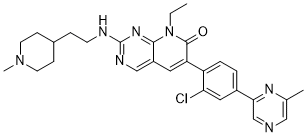
FRAX1036 (FRAX-1036; FRAX 1036) is a selective p21-activated kinase 1 (PAK1) inhibitor with potential anticancer activity. With Ki values of 23.3 nM and 72.4 nM, respectively, it inhibits PAK1 and PAK2.
Physicochemical Properties
| Molecular Formula | C28H32CLN7O |
| Molecular Weight | 518.062 |
| Exact Mass | 517.235 |
| Elemental Analysis | C, 64.92; H, 6.23; Cl, 6.84; N, 18.93; O, 3.09 |
| CAS # | 1432908-05-8 |
| Related CAS # | 1432908-05-8 |
| PubChem CID | 71557891 |
| Appearance | White to light yellow solid powder |
| Density | 1.3±0.1 g/cm3 |
| Boiling Point | 669.8±65.0 °C at 760 mmHg |
| Flash Point | 358.9±34.3 °C |
| Vapour Pressure | 0.0±2.0 mmHg at 25°C |
| Index of Refraction | 1.624 |
| LogP | 3.73 |
| Hydrogen Bond Donor Count | 1 |
| Hydrogen Bond Acceptor Count | 7 |
| Rotatable Bond Count | 7 |
| Heavy Atom Count | 37 |
| Complexity | 803 |
| Defined Atom Stereocenter Count | 0 |
| SMILES | O=C1C(C2=CC=C(C3=NC(C)=CN=C3)C=C2Cl)=CC4=CN=C(NCCC5CCN(C)CC5)N=C4N1CC |
| InChi Key | RYCBSFIKWACFBY-UHFFFAOYSA-N |
| InChi Code | InChI=1S/C28H32ClN7O/c1-4-36-26-21(16-32-28(34-26)31-10-7-19-8-11-35(3)12-9-19)13-23(27(36)37)22-6-5-20(14-24(22)29)25-17-30-15-18(2)33-25/h5-6,13-17,19H,4,7-12H2,1-3H3,(H,31,32,34) |
| Chemical Name | 6-[2-chloro-4-(6-methylpyrazin-2-yl)phenyl]-8-ethyl-2-[2-(1-methylpiperidin-4-yl)ethylamino]pyrido[2,3-d]pyrimidin-7-one |
| Synonyms | FRAX 1036; FRAX-1036; FRAX1036 |
| HS Tariff Code | 2934.99.9001 |
| Storage |
Powder-20°C 3 years 4°C 2 years In solvent -80°C 6 months -20°C 1 month |
| Shipping Condition | Room temperature (This product is stable at ambient temperature for a few days during ordinary shipping and time spent in Customs) |
Biological Activity
| Targets | PAK1 (Ki = 23.3 nM); PAK2 (Ki = 72.4 nM); PAK4 (Ki = 2.4 μM) | |
| ln Vitro |
|
|
| ln Vivo | Frax1036 treatment slows the growth of KT21 tumors and is unlikely to cause significant blood brain barrier permeability in mice. | |
| Enzyme Assay | The phosphorylation of a FRET peptide substrate (Ser/Thr19) labeled with coumarin and fluorescein is measured using the Z'-LYTETM assay to determine the activity/inhibition of human recombinant PAK1 (kinase domain), PAK2 (full length), or PAK4 (kinase domain). The samples used in the 10 μL assay mixtures include 20 pM PAK1; 50 pM PAK2; 90 pM PAK4), 0.01% Brij-35, 10 mM MgCl2, 1 mM EGTA, and 50 mM HEPES (pH 7.5). In black polypropylene 384-well plates, incubations are conducted at 22°C. The assay is started by adding 2.5 μL of assay buffer containing 4× ATP (160 μM PAK1; 480 μM PAK2; 16 μM PAK4). The enzyme, FRET peptide substrate, and serially diluted test compounds (FRAX1036, etc.) are preincubated together in assay buffer (7.5 μL) for 10 minutes prior to the assay. After the assay mixtures are incubated for 60 minutes, 5 μL of Z'-LYTETM development reagent is added to quench them, and an hour later, the emissions of fluorescein (520 nm) and coumarin (445 nm) are measured following excitation at 400 nm. A measurement is made of the emission ratio (445 nm/520 nm) to determine the extent of substrate phosphorylation[1]. | |
| Cell Assay |
|
|
| Animal Protocol |
Pak2-deficient mice 30 mg/kg by oral gavage |
|
| References |
[2]. Significance of KRAS/PAK1/Crk pathway in non-small cell lung cancer oncogenesis. BMC Cancer. 2015 May 9;15:381. |
Solubility Data
| Solubility (In Vitro) | DMSO: ~5.3 mg/mL (~10.2 mM) |
| Solubility (In Vivo) |
Solubility in Formulation 1: 10 mg/mL (19.30 mM) in 50% PEG300 +50% Saline (add these co-solvents sequentially from left to right, and one by one), suspension solution; with sonication. Preparation of saline: Dissolve 0.9 g of sodium chloride in 100 mL ddH₂ O to obtain a clear solution. (Please use freshly prepared in vivo formulations for optimal results.) |
| Preparing Stock Solutions | 1 mg | 5 mg | 10 mg | |
| 1 mM | 1.9303 mL | 9.6514 mL | 19.3028 mL | |
| 5 mM | 0.3861 mL | 1.9303 mL | 3.8606 mL | |
| 10 mM | 0.1930 mL | 0.9651 mL | 1.9303 mL |