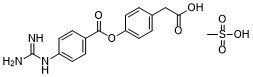
FOY 251 mesylate is a Camostat metabolite with anti-proteolytic activity, and acts as a proteinase inhibitor. It was found to be successful in the cellullar assay in combating SARS-CoV-2 infection. The management and avoidance of allergies are further uses for it.
Physicochemical Properties
| Molecular Formula | C17H19N3O7S |
| Molecular Weight | 409.41366 |
| Exact Mass | 409.094 |
| Elemental Analysis | C, 49.87; H, 4.68; N, 10.26; O, 27.35; S, 7.83 |
| CAS # | 71079-09-9 |
| Related CAS # | FOY 251 free base;71079-08-8 |
| PubChem CID | 130394 |
| Appearance | Off-white to light yellow solid powder |
| Density | 1.36g/cm3 |
| Boiling Point | 592.6ºC at 760 mmHg |
| Melting Point | 194-198ºC |
| Flash Point | 312.2ºC |
| Index of Refraction | 1.632 |
| LogP | 3.296 |
| Hydrogen Bond Donor Count | 4 |
| Hydrogen Bond Acceptor Count | 8 |
| Rotatable Bond Count | 6 |
| Heavy Atom Count | 28 |
| Complexity | 539 |
| Defined Atom Stereocenter Count | 0 |
| SMILES | CS(=O)(=O)O.C1=CC(=CC=C1CC(=O)O)OC(=O)C2=CC=C(C=C2)N=C(N)N |
| InChi Key | JXMOPIDYHUYOED-UHFFFAOYSA-N |
| InChi Code | InChI=1S/C16H15N3O4.CH4O3S/c17-16(18)19-12-5-3-11(4-6-12)15(22)23-13-7-1-10(2-8-13)9-14(20)21;1-5(2,3)4/h1-8H,9H2,(H,20,21)(H4,17,18,19);1H3,(H,2,3,4) |
| Chemical Name | 2-[4-[4-(diaminomethylideneamino)benzoyl]oxyphenyl]acetic acid;methanesulfonic acid |
| Synonyms | FOY-251 mesylate; FOY 251; FOY-251; FOY251 |
| HS Tariff Code | 2934.99.9001 |
| Storage |
Powder-20°C 3 years 4°C 2 years In solvent -80°C 6 months -20°C 1 month Note: Please store this product in a sealed and protected environment, avoid exposure to moisture. |
| Shipping Condition | Room temperature (This product is stable at ambient temperature for a few days during ordinary shipping and time spent in Customs) |
Biological Activity
| Targets |
FOY-251 mesylate primarily targets thrombin (Ki = 0.12 μM) and exhibits moderate inhibitory activity against factor Xa (Ki = 3.8 μM), both key enzymes in the coagulation cascade[2] It also modulates angiotensin II type 1 receptor (AT1R) -mediated signaling involved in blood pressure regulation[1] |
| ln Vitro |
FOY-251 inhibits prostasin's protease activity and dose-dependently reduces equivalent current (Ieq) in M-1 cells in vitro.[1] Thrombin Inhibition: FOY-251 mesylate potently inhibited human α-thrombin activity in a dose-dependent manner. At 0.5 μM, it inhibited thrombin-catalyzed fibrinogen cleavage by 92%, and at 0.1 μM, inhibition was 78%[2] - Factor Xa Inhibition: Showed moderate selectivity for factor Xa, inhibiting its amidolytic activity by 50% at 3.8 μM (Ki value). No significant inhibition of other coagulation enzymes (e.g., factor VIIa, trypsin) at concentrations up to 10 μM[2] - Vascular Smooth Muscle Cell (VSMC) Proliferation Inhibition: Suppressed platelet-derived growth factor (PDGF)-induced proliferation of rat aortic VSMCs. At 1-10 μM, it reduced cell proliferation by 30-65% after 72 hours, as measured by [3H]-thymidine incorporation[1] - AT1R Signaling Modulation: Inhibited angiotensin II-induced Ca2+ mobilization in A7r5 VSMCs (AT1R-expressing cells). At 5 μM, it reduced Ca2+ response by 45%, without affecting angiotensin II type 2 receptor (AT2R) signaling[1] - Anti-Platelet Aggregation: Inhibited thrombin-induced platelet aggregation in human platelet-rich plasma (PRP) with an IC50 of 0.8 μM. No significant effect on ADP-induced aggregation at concentrations up to 10 μM[2] |
| ln Vivo |
FOY-251 increases the plasma and circulating levels of FGF21 of transcription are maintained with the induction of liver integrated stress response (ISR) transcription target genes up to one week of treatment in both ob/ob and lean mice; when administered to DIO mice, the levels of FGF21 in the plasma also increase.[3] Antihypertensive Efficacy in SHR: In spontaneously hypertensive rats (SHR), oral administration of FOY-251 mesylate (10-30 mg/kg/day) for 4 weeks dose-dependently reduced systolic blood pressure (SBP) by 15-28 mmHg and diastolic blood pressure (DBP) by 10-20 mmHg. No significant change in heart rate was observed[1] - Antithrombotic Activity in Rat Arteriovenous Shunt Model: Intravenous administration of 5-20 mg/kg FOY-251 mesylate reduced thrombus weight by 35-70% compared to vehicle controls. The highest dose (20 mg/kg) achieved similar antithrombotic efficacy to warfarin (1 mg/kg)[2] - Vascular Remodeling Improvement: In SHR treated with 30 mg/kg/day (oral, 4 weeks), the compound reduced medial thickness of aortic walls by 22% and improved vascular compliance, as assessed by histomorphometric analysis[1] - No Effect on Bleeding Time: In mice, oral doses up to 50 mg/kg FOY-251 mesylate did not significantly prolong tail bleeding time, indicating a favorable safety profile compared to conventional anticoagulants[2] |
| Enzyme Assay |
M-1 cells were cultivated on a semi-permeable membrane, subjected to a 24-hour serum deprivation, and treated from the apical side with either 0.01–10 μM FOY-251 or 0.01–1 μM camostat mesilate. Transepithelial voltage (Vte) and resistance (Rte) were measured using a volt-ohm meter following a 24-hour incubation period. Ieq was calculated as the ratio of Vte to Rte and was normalized by dividing it by the active membrane's surface area (113 mm2). Thrombin Amidolytic Activity Assay: Human α-thrombin was incubated with a chromogenic substrate (S-2238) and serial dilutions of FOY-251 mesylate (0.01-10 μM) at 37°C for 30 minutes. The release of p-nitroaniline was measured spectrophotometrically at 405 nm. Inhibition curves were generated to calculate Ki and IC50 values[2] - Factor Xa Inhibition Assay: Recombinant human factor Xa was mixed with chromogenic substrate (S-2222) and FOY-251 mesylate (0.1-20 μM) in reaction buffer. Absorbance at 405 nm was recorded over 60 minutes to quantify substrate hydrolysis. Ki values were determined via Lineweaver-Burk plot analysis[2] - AT1R Binding Competition Assay: Membrane fractions from A7r5 cells (enriched in AT1R) were incubated with [3H]-angiotensin II and FOY-251 mesylate (0.1-50 μM) at 4°C for 2 hours. Bound radioactivity was separated by filtration and measured via liquid scintillation counting to assess competitive binding[1] |
| Cell Assay |
VSMC Proliferation Assay: Rat aortic VSMCs were seeded at 5×10³ cells/well in 96-well plates and serum-starved for 24 hours. FOY-251 mesylate (0.1-20 μM) was added 1 hour before stimulation with PDGF (20 ng/mL). After 72 hours, [3H]-thymidine was added for the final 18 hours, and incorporated radioactivity was measured to quantify proliferation[1] - Ca2+ Mobilization Assay: A7r5 cells were loaded with a fluorescent Ca2+ indicator and pre-treated with FOY-251 mesylate (0.5-10 μM) for 30 minutes. Angiotensin II (100 nM) was added, and fluorescence intensity was measured in real-time to assess Ca2+ flux[1] - Platelet Aggregation Assay: Human PRP was prepared from healthy donors and pre-incubated with FOY-251 mesylate (0.01-20 μM) for 5 minutes at 37°C. Thrombin (0.5 U/mL) or ADP (10 μM) was added, and aggregation was monitored via turbidimetry over 10 minutes[2] |
| Animal Protocol |
Male ob/ob mice, lean and diet-induced obese (DIO) C57BL/6 mice 0.8 mg/g food p.o. Antihypertensive Study (SHR Model): Male SHR (12 weeks old, 250-300 g) were randomly divided into groups (n=8/group). FOY-251 mesylate was dissolved in 0.5% carboxymethylcellulose sodium (CMC) and administered orally by gavage at 10, 20, or 30 mg/kg/day for 4 weeks. Control group received 0.5% CMC. SBP and DBP were measured weekly via tail-cuff plethysmography. At study end, rats were euthanized, and aortic tissues were collected for histomorphometric analysis[1] - Antithrombotic Study (Arteriovenous Shunt Model): Male Wistar rats (200-250 g) were anesthetized, and a polyethylene tube shunt was implanted between the carotid artery and jugular vein. FOY-251 mesylate (5, 10, 20 mg/kg) was administered intravenously 30 minutes before shunt placement. After 1 hour, the shunt was removed, and thrombus weight was measured. Warfarin (1 mg/kg, oral) was used as a positive control[2] - Bleeding Time Assay: Male ICR mice (20-25 g) received oral FOY-251 mesylate (10, 30, 50 mg/kg) or warfarin (2 mg/kg). After 2 hours, the tail tip (5 mm) was amputated, and bleeding time was recorded until hemostasis[2] |
| Toxicity/Toxicokinetics |
In Vitro Cytotoxicity: No significant cytotoxicity toward VSMCs, A7r5 cells, or human platelets at concentrations up to 50 μM[1][2] - Acute Toxicity: Single oral doses of up to 500 mg/kg in mice and rats did not cause mortality or severe toxicity. Mild transient diarrhea was observed at doses ≥300 mg/kg, resolving within 48 hours[2] - Subchronic Toxicity: Rats treated with 10-50 mg/kg/day oral FOY-251 mesylate for 8 weeks showed no significant changes in body weight, hematological parameters (RBC, WBC, platelets), or liver/kidney function (ALT, AST, BUN, creatinine). No histopathological lesions were detected in major organs[1] - Plasma Protein Binding: In vitro human plasma protein binding was 78-82%, as determined by ultrafiltration[2] |
| References |
[1]. J Hypertens . 2009 Jan;27(1):181-9. [2]. bioRxiv . 2020 Aug 5:2020.08.05.237651. [3]. Published online 2019 Mar 28. |
| Additional Infomation |
Background: FOY-251 mesylate is a synthetic small-molecule inhibitor of serine proteases, developed for the treatment of hypertension and thrombotic disorders[1][2] - Mechanism of Action: Exerts dual pharmacological effects: 1) Inhibits thrombin and factor Xa to block coagulation and platelet aggregation; 2) Modulates AT1R signaling to reduce vascular constriction and VSMC proliferation, thereby lowering blood pressure[1][2] - Therapeutic Advantages: Combines antihypertensive and antithrombotic activities in a single agent, with minimal bleeding risk compared to traditional anticoagulants (e.g., warfarin)[2] - Clinical Potential: Proposed for the management of hypertensive patients at high risk of thrombotic complications (e.g., stroke, myocardial infarction) due to its dual mechanism[1][3] - Formulation: Developed as an oral formulation with good aqueous solubility, facilitating absorption[2] |
Solubility Data
| Solubility (In Vitro) | DMSO : ~20 mg/mL (~48.85 mM) |
| Solubility (In Vivo) |
Solubility in Formulation 1: 2 mg/mL (4.89 mM) in 10% DMSO + 40% PEG300 + 5% Tween80 + 45% Saline (add these co-solvents sequentially from left to right, and one by one), suspension solution; with sonication. For example, if 1 mL of working solution is to be prepared, you can add 100 μL of 20.0 mg/mL clear DMSO stock solution to 400 μL PEG300 and mix evenly; then add 50 μL Tween-80 to the above solution and mix evenly; then add 450 μL normal saline to adjust the volume to 1 mL. Preparation of saline: Dissolve 0.9 g of sodium chloride in 100 mL ddH₂ O to obtain a clear solution. Solubility in Formulation 2: 2 mg/mL (4.89 mM) in 10% DMSO + 90% (20% SBE-β-CD in Saline) (add these co-solvents sequentially from left to right, and one by one), suspension solution; with ultrasonication. For example, if 1 mL of working solution is to be prepared, you can add 100 μL of 20.0 mg/mL clear DMSO stock solution to 900 μL of 20% SBE-β-CD physiological saline solution and mix evenly. Preparation of 20% SBE-β-CD in Saline (4°C,1 week): Dissolve 2 g SBE-β-CD in 10 mL saline to obtain a clear solution. Solubility in Formulation 3: ≥ 2 mg/mL (4.89 mM) (saturation unknown) in 10% DMSO + 90% Corn Oil (add these co-solvents sequentially from left to right, and one by one), clear solution. For example, if 1 mL of working solution is to be prepared, you can add 100 μL of 20.0 mg/mL clear DMSO stock solution to 900 μL of corn oil and mix evenly. (Please use freshly prepared in vivo formulations for optimal results.) |
| Preparing Stock Solutions | 1 mg | 5 mg | 10 mg | |
| 1 mM | 2.4425 mL | 12.2127 mL | 24.4254 mL | |
| 5 mM | 0.4885 mL | 2.4425 mL | 4.8851 mL | |
| 10 mM | 0.2443 mL | 1.2213 mL | 2.4425 mL |