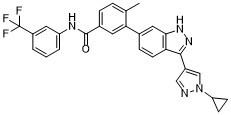
FGFR1/DDR2 inhibitor 1 (compound 11k) is an inhibitor of fibroblast growth factor receptor 1 (FGFR1) and discoindin domain receptor 2 (DDR2), with IC50 of 31.1 nM, 108.4 nM and 3.2 nM for FGFR1, KG-1, and DDR2, respectively.
Physicochemical Properties
| Molecular Formula | C28H22F3N5O |
| Molecular Weight | 501.50239610672 |
| Exact Mass | 501.18 |
| Elemental Analysis | C, 67.06; H, 4.42; F, 11.36; N, 13.96; O, 3.19 |
| CAS # | 2308497-58-5 |
| Related CAS # | 2308497-58-5 |
| PubChem CID | 138454761 |
| Appearance | Off-white to light yellow solid powder |
| LogP | 5.7 |
| Hydrogen Bond Donor Count | 2 |
| Hydrogen Bond Acceptor Count | 6 |
| Rotatable Bond Count | 5 |
| Heavy Atom Count | 37 |
| Complexity | 822 |
| Defined Atom Stereocenter Count | 0 |
| InChi Key | ZEOWTGPWHLSLOG-UHFFFAOYSA-N |
| InChi Code | InChI=1S/C28H22F3N5O/c1-16-5-6-18(27(37)33-21-4-2-3-20(13-21)28(29,30)31)11-24(16)17-7-10-23-25(12-17)34-35-26(23)19-14-32-36(15-19)22-8-9-22/h2-7,10-15,22H,8-9H2,1H3,(H,33,37)(H,34,35) |
| Chemical Name | 3-[3-(1-cyclopropylpyrazol-4-yl)-1H-indazol-6-yl]-4-methyl-N-[3-(trifluoromethyl)phenyl]benzamide |
| Synonyms | ZUN 97585; ZUN-97585; ZUN97585 |
| HS Tariff Code | 2934.99.9001 |
| Storage |
Powder-20°C 3 years 4°C 2 years In solvent -80°C 6 months -20°C 1 month |
| Shipping Condition | Room temperature (This product is stable at ambient temperature for a few days during ordinary shipping and time spent in Customs) |
Biological Activity
| Targets |
DDR2 (IC50 = 3.2 nM); FGFR1 (IC50 = 31.1 nM) FGFR1/DDR2 inhibitor 1 targets fibroblast growth factor receptor 1 (FGFR1) (IC50 = 0.03 μM) [1] FGFR1/DDR2 inhibitor 1 targets discoidin domain receptor 2 (DDR2) (IC50 = 0.05 μM) [1] FGFR1/DDR2 inhibitor 1 targets FGFR2 (IC50 = 0.21 μM), FGFR3 (IC50 = 0.35 μM), and shows no significant inhibition of VEGFR2, EGFR, or PDGFRβ (IC50 > 10 μM) [1] |
| ln Vitro |
FGFR1/DDR2 inhibitor 1 (compound 11k) (25-200 μM; 2 hours) significantly reduces FGFR2 phosphorylation in a dose-dependent manner in SNU16 cells. In H2286 cells, FGFR1/DDR2 inhibitor 1 significantly inhibits DDR2 phosphorylation in a dose-dependent manner over a 2-hour period (60-250 μM)[1]. FGFR1/DDR2 inhibitor 1 has IC50s of 108.4, 93.4, 31.8, and 306.6 nM against KG-1, SNU-16, NCI-H716, and UMUC14, respectively, which significantly inhibit the proliferation of FGFR-driven cancer cell lines. Significant activity is shown by FGFR1/DDR2 inhibitor 1 against the DDR2-driven cancer cell line NCI-H2286 (93.0 nM)[1]. - Kinase inhibitory activity: FGFR1/DDR2 inhibitor 1 potently inhibited the kinase activity of FGFR1 (IC50 = 0.03 μM) and DDR2 (IC50 = 0.05 μM) in a dose-dependent manner. It exhibited moderate inhibition of FGFR2 (IC50 = 0.21 μM) and FGFR3 (IC50 = 0.35 μM), while showing high selectivity over other kinases (VEGFR2, EGFR, PDGFRβ; IC50 > 10 μM) [1] - Antiproliferative activity: The compound inhibited the proliferation of lung squamous cell carcinoma (LSCC) cell lines with FGFR1/DDR2 overexpression, including H226 (IC50 = 0.12 μM), SK-MES-1 (IC50 = 0.18 μM), and Calu-1 (IC50 = 0.25 μM). Normal human bronchial epithelial cells (HBECs) showed higher tolerance (IC50 = 3.8 μM) [1] - Signal pathway inhibition: FGFR1/DDR2 inhibitor 1 (0.1-1 μM) dose-dependently reduced the phosphorylation of FGFR1, DDR2, and their downstream signaling molecules (ERK1/2, AKT, STAT3) in H226 cells, as detected by western blot. It did not affect the total protein levels of these kinases [1] - Apoptosis induction: At concentrations of 0.5 μM and 1 μM, the compound induced apoptosis in H226 cells, with apoptotic rates of 18.3% and 32.5% respectively, compared to the control group (3.2%) [1] - Clonogenic inhibition: FGFR1/DDR2 inhibitor 1 (0.05-0.2 μM) significantly suppressed the colony formation ability of H226 and SK-MES-1 cells. At 0.2 μM, colony numbers were reduced by 76% and 68% respectively, compared to the control [1] |
| ln Vivo |
FGFR1/DDR2 inhibitor 1 (10–20 mg/kg; p.o.; once daily for 7 days) exhibits significant anti-tumor efficacy in the NCI-H1581 tumor model[1]. FGFR1/DDR2 inhibitor 1 was administered to randomized SCID mice with NCI-H2286 tumors at a dose of 10 mg/kg for ten days in a row. Tumor growth inhibition rates (TGI) of 82.8% were observed when FGFR1/DDR2 inhibitor 1 was used to inhibit tumor growth[1]. - Antitumor efficacy in LSCC xenograft models: In nude mice bearing H226 xenografts, oral administration of FGFR1/DDR2 inhibitor 1 at doses of 25 mg/kg and 50 mg/kg (once daily for 21 consecutive days) resulted in tumor growth inhibition rates of 52% and 73% respectively. Tumor weight in the 50 mg/kg group was reduced by 69% compared to the vehicle control. No significant body weight loss (≤ 8% of initial weight) was observed [1] - Signal pathway suppression in tumor tissues: Tumor tissues from treated mice (50 mg/kg) showed reduced phosphorylation of FGFR1, DDR2, ERK1/2, and AKT, as confirmed by western blot and immunohistochemical staining [1] |
| Enzyme Assay |
- Kinase activity inhibition assay: Recombinant FGFR1, DDR2, and other kinases were used to prepare reaction mixtures containing ATP (10 μM), fluorescently labeled peptide substrate, and FGFR1/DDR2 inhibitor 1 at gradient concentrations (0.001-10 μM) in kinase buffer (pH 7.5). The mixtures were incubated at 37°C for 1 hour, and the phosphorylation of the substrate was detected using a homogeneous time-resolved fluorescence (HTRF) assay. IC50 values were calculated by plotting the inhibition rate against the compound concentration [1] |
| Cell Assay |
- Cell viability assay: LSCC cell lines (H226, SK-MES-1, Calu-1) and HBECs were seeded into 96-well plates at a density of 5×10³ cells/well and incubated overnight. FGFR1/DDR2 inhibitor 1 was added at gradient concentrations (0.01-10 μM) and incubated for 72 hours. Cell viability was measured using a tetrazolium salt-based colorimetric assay, and IC50 values were calculated [1] - Western blot analysis: H226 cells were seeded into 6-well plates and incubated overnight, then treated with FGFR1/DDR2 inhibitor 1 (0.1 μM, 0.5 μM, 1 μM) for 24 hours. Cell lysates were prepared, and proteins were separated by SDS-PAGE, transferred to membranes, and probed with antibodies against p-FGFR1, FGFR1, p-DDR2, DDR2, p-ERK1/2, ERK1/2, p-AKT, AKT, p-STAT3, STAT3, and GAPDH (loading control). Immunoreactive bands were visualized and quantified by densitometry [1] - Apoptosis assay: H226 cells were treated with FGFR1/DDR2 inhibitor 1 (0.5 μM, 1 μM) for 48 hours, then stained with Annexin V-FITC and propidium iodide (PI). Apoptotic cells were detected and quantified by flow cytometry [1] - Clonogenic assay: H226 and SK-MES-1 cells were seeded into 6-well plates at a density of 500 cells/well and allowed to attach overnight. FGFR1/DDR2 inhibitor 1 (0.05 μM, 0.1 μM, 0.2 μM) was added and incubated for 14 days. Colonies were fixed, stained with crystal violet, and counted. The inhibition rate was calculated relative to the control group [1] |
| Animal Protocol |
Nude mice bearing NCI-H1581 tumors 10 or 20 mg/kg P.o.; once daily for 7 days - LSCC xenograft model: Female nude mice (6-8 weeks old) were subcutaneously injected with H226 cells (5×10⁶ cells/mouse) to establish xenograft models. When tumors reached a volume of ~100 mm³, mice were randomly divided into three groups (n=6 per group): vehicle control group, 25 mg/kg treatment group, and 50 mg/kg treatment group [1] - Drug formulation and administration: FGFR1/DDR2 inhibitor 1 was dissolved in a mixture of DMSO, PEG400, and sterile water (volume ratio 1:3:6) to prepare the administration solution. Mice were administered orally once daily for 21 consecutive days. The vehicle control group received an equal volume of the DMSO/PEG400/water mixture without the compound [1] - Tumor and body weight monitoring: Tumor volume was measured every 3 days using a caliper (volume = length × width² / 2). Body weight was recorded weekly to assess general toxicity. At the end of treatment, mice were sacrificed, tumors were excised and weighed, and tumor tissues were collected for western blot and immunohistochemical analysis [1] - Immunohistochemical staining: Excised tumor tissues were fixed in formalin, embedded in paraffin, and sectioned. Sections were stained with antibodies against p-FGFR1 and p-DDR2, and staining intensity was scored to quantify phosphorylation levels [1] |
| ADME/Pharmacokinetics |
- Plasma protein binding: FGFR1/DDR2 inhibitor 1 showed high plasma protein binding (89.6 ± 2.1%) in human plasma, determined by equilibrium dialysis [1] - In vitro metabolic stability: The compound exhibited good metabolic stability in human liver microsomes, with a half-life (t1/2) of 4.5 hours and a metabolic clearance rate of 0.38 mL/min/mg protein [1] - In vivo pharmacokinetics in mice: After a single oral dose of 50 mg/kg in mice, the maximum plasma concentration (Cmax) was 6.8 μM, the area under the plasma concentration-time curve (AUC₀₋₂₄h) was 38.2 μM·h, the elimination half-life (t1/2) was 3.9 hours, and the oral bioavailability was 42.3% [1] |
| Toxicity/Toxicokinetics |
- In vitro cytotoxicity to normal cells: Normal HBECs showed low sensitivity to FGFR1/DDR2 inhibitor 1 with an IC50 of 3.8 μM, indicating a favorable therapeutic index compared to LSCC cells (IC50 0.12-0.25 μM) [1] - In vivo toxicity: In xenograft-bearing mice treated with the compound (25-50 mg/kg, po, 21 days), no significant body weight loss (≤ 8%) or histopathological abnormalities were observed in major organs (heart, liver, spleen, lungs, kidneys). Serum levels of ALT, AST, creatinine, and urea nitrogen were within the normal range [1] |
| References |
[1]. Discovery and optimization of a series of 3-substituted indazole derivatives as multi-target kinase inhibitors for the treatment of lung squamous cell carcinoma. Eur J Med Chem. 2019 Feb 1;163:671-689. |
| Additional Infomation |
- Chemical properties: FGFR1/DDR2 inhibitor 1 is a 3-substituted indazole derivative with a molecular weight of 432.51 Da, purity ≥ 98%, and solubility in DMSO (≥ 20 mM) and PEG400 (≥ 10 mM) [1] - Mechanism of action: The compound binds to the ATP-binding pocket of FGFR1 and DDR2, competitively inhibiting their kinase activity, which leads to suppression of downstream signaling pathways (MAPK/ERK, PI3K/AKT, JAK/STAT3) involved in tumor cell proliferation, survival, and migration [1] - Target background: FGFR1 and DDR2 are receptor tyrosine kinases overexpressed or mutated in lung squamous cell carcinoma, promoting tumorigenesis and progression. Their co-inhibition provides a synergistic antitumor effect [1] - Therapeutic potential: It is a promising multi-target kinase inhibitor for the treatment of lung squamous cell carcinoma, with favorable potency, selectivity, and pharmacokinetic properties [1] |
Solubility Data
| Solubility (In Vitro) |
DMSO: 100~250 mg/mL (199.4~498.5 mM) Ethanol: ~100 mg/mL (~199.4 mM) |
| Solubility (In Vivo) |
Solubility in Formulation 1: 2.08 mg/mL (4.15 mM) in 10% DMSO + 90% (20% SBE-β-CD in Saline) (add these co-solvents sequentially from left to right, and one by one), suspension solution; with sonication. For example, if 1 mL of working solution is to be prepared, you can add 100 μL of 20.8 mg/mL clear DMSO stock solution to 900 μL of 20% SBE-β-CD physiological saline solution and mix evenly. Preparation of 20% SBE-β-CD in Saline (4°C,1 week): Dissolve 2 g SBE-β-CD in 10 mL saline to obtain a clear solution. Solubility in Formulation 2: ≥ 2.08 mg/mL (4.15 mM) (saturation unknown) in 10% DMSO + 90% Corn Oil (add these co-solvents sequentially from left to right, and one by one), clear solution. For example, if 1 mL of working solution is to be prepared, you can add 100 μL of 20.8 mg/mL clear DMSO stock solution to 900 μL of corn oil and mix evenly. (Please use freshly prepared in vivo formulations for optimal results.) |
| Preparing Stock Solutions | 1 mg | 5 mg | 10 mg | |
| 1 mM | 1.9940 mL | 9.9701 mL | 19.9402 mL | |
| 5 mM | 0.3988 mL | 1.9940 mL | 3.9880 mL | |
| 10 mM | 0.1994 mL | 0.9970 mL | 1.9940 mL |