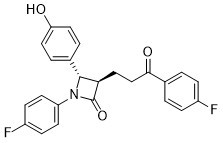
Ezetimibe (SCH58235; SCH-58235; Zetia, Ezetrol) is a selective inhibitor of cholesterol absorption in the gut used to lower cholesterol levels. Ezetimibe ketone is a phase-I metabolite of ezetimibe.
Physicochemical Properties
| Molecular Formula | C24H19NO3 |
| Molecular Weight | 407.40936 |
| Exact Mass | 407.133 |
| Elemental Analysis | C, 70.75; H, 4.70; F, 9.33; N, 3.44; O, 11.78 |
| CAS # | 191330-56-0 |
| Related CAS # | 191330-56-0 |
| PubChem CID | 9801494 |
| Appearance | White to off-white solid powder |
| Density | 1.325 |
| Boiling Point | 656.1±55.0 °C at 760 mmHg |
| Flash Point | 350.6±31.5 °C |
| Vapour Pressure | 0.0±2.0 mmHg at 25°C |
| Index of Refraction | 1.615 |
| LogP | 3.79 |
| Hydrogen Bond Donor Count | 1 |
| Hydrogen Bond Acceptor Count | 5 |
| Rotatable Bond Count | 6 |
| Heavy Atom Count | 30 |
| Complexity | 606 |
| Defined Atom Stereocenter Count | 2 |
| SMILES | C1=C(C=CC(=C1)F)C(=O)CC[C@@H]2[C@@H](C3=CC=C(C=C3)O)N(C4=CC=C(C=C4)F)C2=O |
| InChi Key | UEPZDXMEEKCJSP-FYYLOGMGSA-N |
| InChi Code | InChI=1S/C24H19F2NO3/c25-17-5-1-15(2-6-17)22(29)14-13-21-23(16-3-11-20(28)12-4-16)27(24(21)30)19-9-7-18(26)8-10-19/h1-12,21,23,28H,13-14H2/t21-,23-/m1/s1 |
| Chemical Name | (3R,4S)-1-(4-fluorophenyl)-3-[3-(4-fluorophenyl)-3-oxopropyl]-4-(4-hydroxyphenyl)azetidin-2-one |
| Synonyms | Ezetimibe ketone; EZM K; EZM-K |
| HS Tariff Code | 2934.99.9001 |
| Storage |
Powder-20°C 3 years 4°C 2 years In solvent -80°C 6 months -20°C 1 month |
| Shipping Condition | Room temperature (This product is stable at ambient temperature for a few days during ordinary shipping and time spent in Customs) |
Biological Activity
| Targets | NPC1L1; Nrf2 |
| References |
[1]. Efficient and scalable process for the synthesis of antihypercholesterolemic drug ezetimibe. Synthetic Communications. 2016, 46:20, 1687-1693. [2]. Ezetimibe, an NPC1L1 inhibitor, is a potent Nrf2 activator that protects mice from diet-induced nonalcoholic steatohepatitis. Free Radic Biol Med. 2016 Sep 12;99:520-532. [3]. Ezetimibe improves hepatic steatosis in relation to autophagy in obese and diabetic rats. World J Gastroenterol. 2015 Jul 7;21(25):7754-63. |
Solubility Data
| Solubility (In Vitro) | DMSO: ~100 mg/mL (~245.5 mM) |
| Solubility (In Vivo) |
Solubility in Formulation 1: ≥ 1.25 mg/mL (3.07 mM) (saturation unknown) in 10% DMSO + 40% PEG300 + 5% Tween80 + 45% Saline (add these co-solvents sequentially from left to right, and one by one), clear solution. For example, if 1 mL of working solution is to be prepared, you can add 100 μL of 12.5 mg/mL clear DMSO stock solution to 400 μL PEG300 and mix evenly; then add 50 μL Tween-80 to the above solution and mix evenly; then add 450 μL normal saline to adjust the volume to 1 mL. Preparation of saline: Dissolve 0.9 g of sodium chloride in 100 mL ddH₂ O to obtain a clear solution. Solubility in Formulation 2: 1.25 mg/mL (3.07 mM) in 10% DMSO + 90% (20% SBE-β-CD in Saline) (add these co-solvents sequentially from left to right, and one by one), suspension solution; with ultrasonication. For example, if 1 mL of working solution is to be prepared, you can add 100 μL of 12.5 mg/mL clear DMSO stock solution to 900 μL of 20% SBE-β-CD physiological saline solution and mix evenly. Preparation of 20% SBE-β-CD in Saline (4°C,1 week): Dissolve 2 g SBE-β-CD in 10 mL saline to obtain a clear solution. Solubility in Formulation 3: ≥ 1.25 mg/mL (3.07 mM) (saturation unknown) in 10% DMSO + 90% Corn Oil (add these co-solvents sequentially from left to right, and one by one), clear solution. For example, if 1 mL of working solution is to be prepared, you can add 100 μL of 12.5 mg/mL clear DMSO stock solution to 900 μL of corn oil and mix evenly. (Please use freshly prepared in vivo formulations for optimal results.) |
| Preparing Stock Solutions | 1 mg | 5 mg | 10 mg | |
| 1 mM | 2.4545 mL | 12.2726 mL | 24.5453 mL | |
| 5 mM | 0.4909 mL | 2.4545 mL | 4.9091 mL | |
| 10 mM | 0.2455 mL | 1.2273 mL | 2.4545 mL |