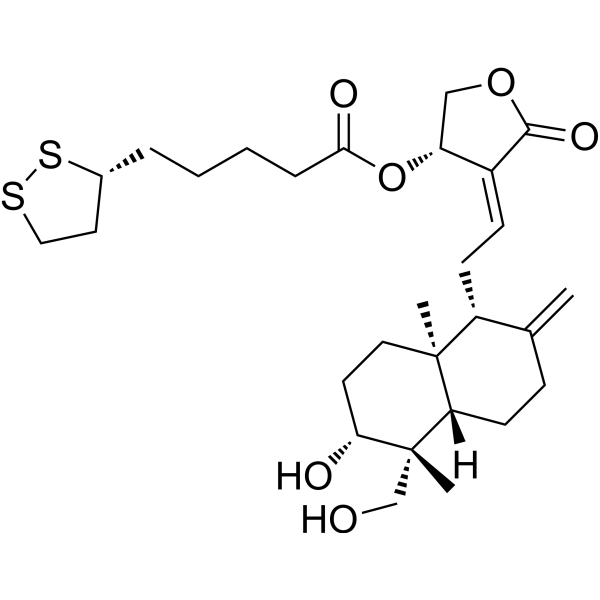
Physicochemical Properties
| Molecular Formula | C28H42O6S2 |
| Molecular Weight | 538.76 |
| CAS # | 1167601-06-0 |
| Appearance | Typically exists as solids at room temperature |
| SMILES | S1CC[C@@H](CCCCC(O[C@H]2/C(=C\C[C@H]3[C@@]4(C)[C@@]([H])([C@@](CO)(C)[C@H](O)CC4)CCC3=C)/C(=O)OC2)=O)S1 |
| HS Tariff Code | 2934.99.9001 |
| Storage |
Powder-20°C 3 years 4°C 2 years In solvent -80°C 6 months -20°C 1 month |
| Shipping Condition | Room temperature (This product is stable at ambient temperature for a few days during ordinary shipping and time spent in Customs) |
Biological Activity
| Targets | NF-κB; anti-diabetic |
| ln Vivo | In alloxan-induced diabetic mouse model, AL-1 lowered blood glucose, increased insulin and prevented loss of beta cells and their dysfunction, stimulated glucose transport protein subtype 4 (GLUT4) membrane translocation in soleus muscles. Pretreatment of RIN-m cells with AL-1 prevented H2O2-induced cellular damage, quenched glucose and glibenclamide-stimulated reactive oxidative species production, and inhibited cytokine-stimulated NF-kappaB activation. Conclusion: We have demonstrated that AL-1 had both hypoglycemic and beta cell protective effects which translated into antioxidant and NF-kappaB inhibitory activity. AL-1 is a potential new anti-diabetic agent [1]. |
| Animal Protocol | In alloxan-treated mice (a model of type 1 diabetes), drugs were administered orally once daily for 6 days post-alloxan treatment. Fasting blood glucose and serum insulin were determined. Pathologic and immunohistochemical analysis of pancreatic islets were performed. Translocation of glucose transporter subtype 4 in soleus muscle was detected by western blot. In RIN-m cells in vitro, the effect of AL-1 on H2O2-induced damage and reactive oxidative species production stimulated by high glucose and glibenclamide were measured. Inhibition of nuclear factor kappa B (NF-kappaB) activation induced by IL-1beta and IFN-gamma was investigated. [1] |
| References |
[1]. Hypoglycemic and beta cell protective effects of andrographolide analogue for diabetes treatment. J Transl Med. 2009 Jul 16;7:62. |
| Additional Infomation | While all anti-diabetic agents can decrease blood glucose level directly or indirectly, few are able to protect and preserve both pancreatic beta cell mass and their insulin-secreting functions. Thus, there is an urgent need to find an agent or combination of agents that can lower blood glucose and preserve pancreatic beta cells at the same time. Herein, we report a dual-functional andrographolide-lipoic acid conjugate (AL-1). The anti-diabetic and beta cell protective activities of this novel andrographolide-lipoic acid conjugate were investigated.[1] |
Solubility Data
| Solubility (In Vitro) | May dissolve in DMSO (in most cases), if not, try other solvents such as H2O, Ethanol, or DMF with a minute amount of products to avoid loss of samples |
| Solubility (In Vivo) |
Note: Listed below are some common formulations that may be used to formulate products with low water solubility (e.g. < 1 mg/mL), you may test these formulations using a minute amount of products to avoid loss of samples. Injection Formulations (e.g. IP/IV/IM/SC) Injection Formulation 1: DMSO : Tween 80: Saline = 10 : 5 : 85 (i.e. 100 μL DMSO stock solution → 50 μL Tween 80 → 850 μL Saline) *Preparation of saline: Dissolve 0.9 g of sodium chloride in 100 mL ddH ₂ O to obtain a clear solution. Injection Formulation 2: DMSO : PEG300 :Tween 80 : Saline = 10 : 40 : 5 : 45 (i.e. 100 μL DMSO → 400 μLPEG300 → 50 μL Tween 80 → 450 μL Saline) Injection Formulation 3: DMSO : Corn oil = 10 : 90 (i.e. 100 μL DMSO → 900 μL Corn oil) Example: Take the Injection Formulation 3 (DMSO : Corn oil = 10 : 90) as an example, if 1 mL of 2.5 mg/mL working solution is to be prepared, you can take 100 μL 25 mg/mL DMSO stock solution and add to 900 μL corn oil, mix well to obtain a clear or suspension solution (2.5 mg/mL, ready for use in animals). Injection Formulation 4: DMSO : 20% SBE-β-CD in saline = 10 : 90 [i.e. 100 μL DMSO → 900 μL (20% SBE-β-CD in saline)] *Preparation of 20% SBE-β-CD in Saline (4°C,1 week): Dissolve 2 g SBE-β-CD in 10 mL saline to obtain a clear solution. Injection Formulation 5: 2-Hydroxypropyl-β-cyclodextrin : Saline = 50 : 50 (i.e. 500 μL 2-Hydroxypropyl-β-cyclodextrin → 500 μL Saline) Injection Formulation 6: DMSO : PEG300 : castor oil : Saline = 5 : 10 : 20 : 65 (i.e. 50 μL DMSO → 100 μLPEG300 → 200 μL castor oil → 650 μL Saline) Injection Formulation 7: Ethanol : Cremophor : Saline = 10: 10 : 80 (i.e. 100 μL Ethanol → 100 μL Cremophor → 800 μL Saline) Injection Formulation 8: Dissolve in Cremophor/Ethanol (50 : 50), then diluted by Saline Injection Formulation 9: EtOH : Corn oil = 10 : 90 (i.e. 100 μL EtOH → 900 μL Corn oil) Injection Formulation 10: EtOH : PEG300:Tween 80 : Saline = 10 : 40 : 5 : 45 (i.e. 100 μL EtOH → 400 μLPEG300 → 50 μL Tween 80 → 450 μL Saline) Oral Formulations Oral Formulation 1: Suspend in 0.5% CMC Na (carboxymethylcellulose sodium) Oral Formulation 2: Suspend in 0.5% Carboxymethyl cellulose Example: Take the Oral Formulation 1 (Suspend in 0.5% CMC Na) as an example, if 100 mL of 2.5 mg/mL working solution is to be prepared, you can first prepare 0.5% CMC Na solution by measuring 0.5 g CMC Na and dissolve it in 100 mL ddH2O to obtain a clear solution; then add 250 mg of the product to 100 mL 0.5% CMC Na solution, to make the suspension solution (2.5 mg/mL, ready for use in animals). Oral Formulation 3: Dissolved in PEG400 Oral Formulation 4: Suspend in 0.2% Carboxymethyl cellulose Oral Formulation 5: Dissolve in 0.25% Tween 80 and 0.5% Carboxymethyl cellulose Oral Formulation 6: Mixing with food powders Note: Please be aware that the above formulations are for reference only. InvivoChem strongly recommends customers to read literature methods/protocols carefully before determining which formulation you should use for in vivo studies, as different compounds have different solubility properties and have to be formulated differently. (Please use freshly prepared in vivo formulations for optimal results.) |
| Preparing Stock Solutions | 1 mg | 5 mg | 10 mg | |
| 1 mM | 1.8561 mL | 9.2806 mL | 18.5611 mL | |
| 5 mM | 0.3712 mL | 1.8561 mL | 3.7122 mL | |
| 10 mM | 0.1856 mL | 0.9281 mL | 1.8561 mL |