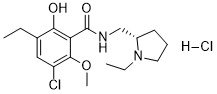
Eticlopride HCl (FLB131; FLB-131) is a potent antipsychotic agent acting as a selective dopamine D2‐like receptor antagonist. It exhibits high affinity for dopamine D2, α1‐adrenergic, α2‐adrenergic, 5HT1, 5HT2 receptors with Kis of 0.09, 112, 699, 6220, and 830 nM, respectively.
Physicochemical Properties
| Molecular Formula | C17H26CL2N2O3 |
| Molecular Weight | 377.306 |
| Exact Mass | 376.132 |
| Elemental Analysis | C, 54.12; H, 6.95; Cl, 18.79; N, 7.42; O, 12.72 |
| CAS # | 97612-24-3 |
| Related CAS # | 97612-24-3 (HCl); 84226-12-0 |
| PubChem CID | 57267 |
| Appearance | Solid powder |
| Melting Point | 144 - 146 °C |
| LogP | 3.1 |
| Hydrogen Bond Donor Count | 2 |
| Hydrogen Bond Acceptor Count | 4 |
| Rotatable Bond Count | 6 |
| Heavy Atom Count | 23 |
| Complexity | 396 |
| Defined Atom Stereocenter Count | 1 |
| SMILES | C(C1C(O)=C(CC)C=C(Cl)C=1OC)(=O)NC[C@@H]1CCCN1CC.Cl |
| InChi Key | HFJFXXDHVWLIKX-YDALLXLXSA-N |
| InChi Code | InChI=1S/C17H25ClN2O3.ClH/c1-4-11-9-13(18)16(23-3)14(15(11)21)17(22)19-10-12-7-6-8-20(12)5-2;/h9,12,21H,4-8,10H2,1-3H3,(H,19,22);1H/t12-;/m0./s1 |
| Chemical Name | 5-chloro-3-ethyl-N-[[(2S)-1-ethylpyrrolidin-2-yl]methyl]-2-hydroxy-6-methoxybenzamide;hydrochloride |
| Synonyms | FLB 131; FLB131; Eticlopride; FLB-131 |
| HS Tariff Code | 2934.99.9001 |
| Storage |
Powder-20°C 3 years 4°C 2 years In solvent -80°C 6 months -20°C 1 month |
| Shipping Condition | Room temperature (This product is stable at ambient temperature for a few days during ordinary shipping and time spent in Customs) |
Biological Activity
| Targets | D2 receptor ( Ki = 0.09 nM ) |
| References |
[1]. A review of the discovery, pharmacological characterization, and behavioral effects of the dopamine D2-like receptor antagonist eticlopride. CNS Neurosci Ther. Fall 2008;14(3):248-62. |
| Additional Infomation | 5-chloro-3-ethyl-N-[[(2S)-1-ethyl-2-pyrrolidinyl]methyl]-2-hydroxy-6-methoxybenzamide is a member of salicylamides. |
Solubility Data
| Solubility (In Vitro) |
DMSO: ~100 mg/mL (~265.0 mM) H2O: ~50 mg/mL (~132.5 mM) |
| Solubility (In Vivo) |
Solubility in Formulation 1: ≥ 2.5 mg/mL (6.63 mM) (saturation unknown) in 10% DMSO + 40% PEG300 + 5% Tween80 + 45% Saline (add these co-solvents sequentially from left to right, and one by one), clear solution. For example, if 1 mL of working solution is to be prepared, you can add 100 μL of 25.0 mg/mL clear DMSO stock solution to 400 μL PEG300 and mix evenly; then add 50 μL Tween-80 to the above solution and mix evenly; then add 450 μL normal saline to adjust the volume to 1 mL. Preparation of saline: Dissolve 0.9 g of sodium chloride in 100 mL ddH₂ O to obtain a clear solution. Solubility in Formulation 2: ≥ 2.5 mg/mL (6.63 mM) (saturation unknown) in 10% DMSO + 90% (20% SBE-β-CD in Saline) (add these co-solvents sequentially from left to right, and one by one), clear solution. For example, if 1 mL of working solution is to be prepared, you can add 100 μL of 25.0 mg/mL clear DMSO stock solution to 900 μL of 20% SBE-β-CD physiological saline solution and mix evenly. Preparation of 20% SBE-β-CD in Saline (4°C,1 week): Dissolve 2 g SBE-β-CD in 10 mL saline to obtain a clear solution. Solubility in Formulation 3: ≥ 2.5 mg/mL (6.63 mM) (saturation unknown) in 10% DMSO + 90% Corn Oil (add these co-solvents sequentially from left to right, and one by one), clear solution. For example, if 1 mL of working solution is to be prepared, you can add 100 μL of 25.0 mg/mL clear DMSO stock solution to 900 μL of corn oil and mix evenly. (Please use freshly prepared in vivo formulations for optimal results.) |
| Preparing Stock Solutions | 1 mg | 5 mg | 10 mg | |
| 1 mM | 2.6503 mL | 13.2517 mL | 26.5034 mL | |
| 5 mM | 0.5301 mL | 2.6503 mL | 5.3007 mL | |
| 10 mM | 0.2650 mL | 1.3252 mL | 2.6503 mL |