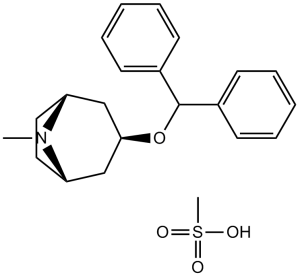
Benztropine mesylate (NSC-42199; ST-50997629; NSC 42199; ST 50997629; Cogentin; MLS000737056), the mesilate salt of Benztropine, is a highly potent dopamine transporter (DAT) inhibitor used for the treatment of symptoms of Parkinson's disease such as involuntary tremor and dystonia. It suppresses the dopamine transporter with an IC50 of 118 nM. Benztropine is a synthetic substance that acts centrally to sabotage M1 muscarinic acetylcholine receptors. It is derived from the combination of atropine and diphenhydramine.
Physicochemical Properties
| Molecular Formula | C22H29NO4S | |
| Molecular Weight | 403.53 | |
| Exact Mass | 403.181 | |
| Elemental Analysis | C, 65.81; H, 6.78; N, 3.49; O, 15.94; S, 7.99 | |
| CAS # | 132-17-2 | |
| Related CAS # | Benztropine; 86-13-5; Benztropine-13C,d3 mesylate; Benztropine-d3 mesylate; 202529-16-6 | |
| PubChem CID | 1201549 | |
| Appearance | White to light yellow crystalline powder | |
| Boiling Point | 547.8ºC at 760 mmHg | |
| Melting Point | 135 °C(lit.) | |
| Flash Point | 285.1ºC | |
| Vapour Pressure | 7.83E-13mmHg at 25°C | |
| LogP | 4.94 | |
| Hydrogen Bond Donor Count | 0 | |
| Hydrogen Bond Acceptor Count | 2 | |
| Rotatable Bond Count | 4 | |
| Heavy Atom Count | 23 | |
| Complexity | 340 | |
| Defined Atom Stereocenter Count | 2 | |
| SMILES | S(C([H])([H])[H])(=O)(=O)O[H].O(C([H])(C1C([H])=C([H])C([H])=C([H])C=1[H])C1C([H])=C([H])C([H])=C([H])C=1[H])C1([H])C([H])([H])[C@]2([H])C([H])([H])C([H])([H])[C@]([H])(C1([H])[H])N2C([H])([H])[H] |
|
| InChi Key | CPFJLLXFNPCTDW-IIPFOPBBSA-N | |
| InChi Code | InChI=1S/C21H25NO.CH4O3S/c1-22-18-12-13-19(22)15-20(14-18)23-21(16-8-4-2-5-9-16)17-10-6-3-7-11-17;1-5(2,3)4/h2-11,18-21H,12-15H2,1H3;1H3,(H,2,3,4)/t18-,19+,20?; | |
| Chemical Name | (1R,5S)-3-benzhydryloxy-8-methyl-8-azabicyclo[3.2.1]octane;methanesulfonic acid | |
| Synonyms |
|
|
| HS Tariff Code | 2934.99.9001 | |
| Storage |
Powder-20°C 3 years 4°C 2 years In solvent -80°C 6 months -20°C 1 month Note: Please store this product in a sealed and protected environment, avoid exposure to moisture. |
|
| Shipping Condition | Room temperature (This product is stable at ambient temperature for a few days during ordinary shipping and time spent in Customs) |
Biological Activity
| Targets | Human D2 Receptor | |
| ln Vitro |
|
|
| ln Vivo |
|
|
| Cell Assay |
Cell Line: MDA-MB-231 cells Concentration: 0.1 μM, 0.625 μM, 1.25 μM, 2.5 μM, 5 μM, 10 μM Incubation Time: 72 hours Result: Inhibited the cell growth of MDA-MB-231 cells with an IC50 of ~5 μM. |
|
| Animal Protocol |
Balb/c mice bearing 4T1 breast tumors 1.5 mg/kg Injection; 3 weeks |
|
| References |
[1]. J Med Chem . 2005 May 5;48(9):3337-43. [2]. J Biol Chem . 2001 Aug 3;276(31):29012-8. [3]. J Neurochem . 2004 May;89(4):853-64. [4]. Neurology . 1997 Apr;48(4):1077-81. [5]. Eur J Pharmacol . 1987 Jul 23;139(3):345-8. |
|
| Additional Infomation |
Benzatropine is tropane in which a hydrogen at position 3 is substituted by a diphenylmethoxy group (endo-isomer). An acetylcholine receptor antagonist, it is used (particularly as its methanesulphonate salt) in the treatment of Parkinson's disease, and to reduce parkinsonism and akathisia side effects of antipsychotic treatments. It has a role as an antiparkinson drug, a parasympatholytic, an antidyskinesia agent, a muscarinic antagonist and a oneirogen. Benztropine is an Anticholinergic and Antihistamine. The mechanism of action of benztropine is as a Cholinergic Antagonist and Histamine Receptor Antagonist. A centrally active muscarinic antagonist that has been used in the symptomatic treatment of PARKINSON DISEASE. Benztropine also inhibits the uptake of dopamine. See also: Benztropine (annotation moved to); Benztropine Mesylate (annotation moved to). |
Solubility Data
| Solubility (In Vitro) |
|
|||
| Solubility (In Vivo) |
Solubility in Formulation 1: ≥ 2.5 mg/mL (6.20 mM) (saturation unknown) in 10% DMSO + 40% PEG300 + 5% Tween80 + 45% Saline (add these co-solvents sequentially from left to right, and one by one), clear solution. For example, if 1 mL of working solution is to be prepared, you can add 100 μL of 25.0 mg/mL clear DMSO stock solution to 400 μL PEG300 and mix evenly; then add 50 μL Tween-80 to the above solution and mix evenly; then add 450 μL normal saline to adjust the volume to 1 mL. Preparation of saline: Dissolve 0.9 g of sodium chloride in 100 mL ddH₂ O to obtain a clear solution. Solubility in Formulation 2: ≥ 2.5 mg/mL (6.20 mM) (saturation unknown) in 10% DMSO + 90% Corn Oil (add these co-solvents sequentially from left to right, and one by one), clear solution. For example, if 1 mL of working solution is to be prepared, you can add 100 μL of 25.0 mg/mL clear DMSO stock solution to 900 μL of corn oil and mix evenly. Solubility in Formulation 3: 100 mg/mL (247.81 mM) in PBS (add these co-solvents sequentially from left to right, and one by one), clear solution; with ultrasonication. (Please use freshly prepared in vivo formulations for optimal results.) |
| Preparing Stock Solutions | 1 mg | 5 mg | 10 mg | |
| 1 mM | 2.4781 mL | 12.3907 mL | 24.7813 mL | |
| 5 mM | 0.4956 mL | 2.4781 mL | 4.9563 mL | |
| 10 mM | 0.2478 mL | 1.2391 mL | 2.4781 mL |