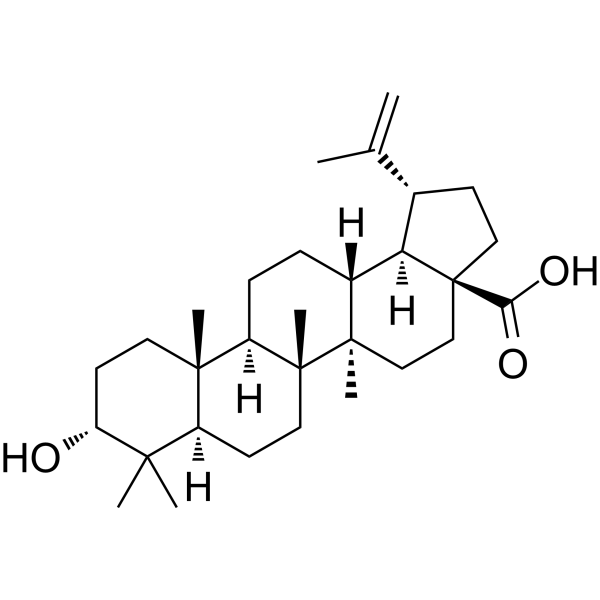
Physicochemical Properties
| Molecular Formula | C₃₀H₄₈O₃ |
| Molecular Weight | 456.70 |
| Exact Mass | 456.36 |
| CAS # | 38736-77-5 |
| PubChem CID | 2371 |
| Appearance | White to off-white solid powder |
| Density | 1.1±0.0 g/cm3 |
| Boiling Point | 550.0±0.0 °C at 760 mmHg |
| Melting Point | 277℃ |
| Flash Point | 300.5±0.0 °C |
| Vapour Pressure | 0.0±0.0 mmHg at 25°C |
| Index of Refraction | 1.533 |
| LogP | 8.94 |
| Hydrogen Bond Donor Count | 2 |
| Hydrogen Bond Acceptor Count | 3 |
| Rotatable Bond Count | 2 |
| Heavy Atom Count | 33 |
| Complexity | 861 |
| Defined Atom Stereocenter Count | 0 |
| InChi Key | QGJZLNKBHJESQX-UHFFFAOYSA-N |
| InChi Code | InChI=1S/C30H48O3/c1-18(2)19-10-15-30(25(32)33)17-16-28(6)20(24(19)30)8-9-22-27(5)13-12-23(31)26(3,4)21(27)11-14-29(22,28)7/h19-24,31H,1,8-17H2,2-7H3,(H,32,33) |
| Chemical Name | 9-hydroxy-5a,5b,8,8,11a-pentamethyl-1-prop-1-en-2-yl-1,2,3,4,5,6,7,7a,9,10,11,11b,12,13,13a,13b-hexadecahydrocyclopenta[a]chrysene-3a-carboxylic acid |
| HS Tariff Code | 2934.99.9001 |
| Storage |
Powder-20°C 3 years 4°C 2 years In solvent -80°C 6 months -20°C 1 month Note: This product requires protection from light (avoid light exposure) during transportation and storage. |
| Shipping Condition | Room temperature (This product is stable at ambient temperature for a few days during ordinary shipping and time spent in Customs) |
Biological Activity
| Targets |
The action targets of Epibetulinic acid are inducible nitric oxide synthase (iNOS) and cyclooxygenase-2 (COX-2), which mediate the production of nitric oxide (NO) and prostaglandin E2 (PGE2) respectively. The IC50 values are as follows: inhibition of LPS-induced NO production in RAW264.7 cells (12.5 ± 1.3 μM), inhibition of LPS-induced PGE2 production in RAW264.7 cells (15.2 ± 1.5 μM) [1] |
| ln Vitro |
1. Inhibition of LPS-induced NO production: RAW264.7 murine macrophages were treated with lipopolysaccharide (LPS, 1 μg/mL) to induce NO production, and co-treated with Epibetulinic acid at concentrations of 5 μM, 10 μM, 20 μM, 40 μM for 24 hours. The supernatant was collected and detected using Griess reagent. Results showed Epibetulinic acid inhibited NO production in a concentration-dependent manner: 20 μM Epibetulinic acid reduced NO levels by 68 ± 4%, and 40 μM reduced NO levels by 85 ± 5%, with an IC50 of 12.5 ± 1.3 μM [1] 2. Inhibition of LPS-induced PGE2 production: RAW264.7 cells were treated with LPS (1 μg/mL) and Epibetulinic acid (5 μM, 10 μM, 20 μM, 40 μM) for 24 hours. The supernatant was collected and detected using a PGE2-specific ELISA kit. Results indicated Epibetulinic acid dose-dependently inhibited PGE2 production: 20 μM Epibetulinic acid decreased PGE2 levels by 59 ± 3%, 40 μM decreased by 78 ± 4%, with an IC50 of 15.2 ± 1.5 μM [1] 3. Cell viability evaluation: MTT assay was used to detect the effect of Epibetulinic acid on RAW264.7 cell viability. After 24-hour treatment with Epibetulinic acid (up to 40 μM), the cell viability remained above 90% compared to the control group, indicating no significant cytotoxicity at the tested concentrations [1] |
| Enzyme Assay |
1. NO inhibition assay: RAW264.7 cells were seeded in 96-well plates at a density of 1×10^4 cells/well and incubated overnight at 37°C in a 5% CO2 incubator. The medium was replaced with fresh medium containing LPS (1 μg/mL) and different concentrations of Epibetulinic acid (5 μM, 10 μM, 20 μM, 40 μM). After 24-hour incubation, 50 μL of supernatant from each well was mixed with 50 μL of Griess reagent (equal volumes of 1% sulfanilamide in 5% phosphoric acid and 0.1% N-(1-naphthyl)ethylenediamine dihydrochloride) in a new 96-well plate. The mixture was incubated at room temperature for 10 minutes, and the absorbance was measured at 540 nm using a microplate reader. The concentration of NO was calculated using a sodium nitrite standard curve, and the inhibition rate and IC50 were determined [1] 2. PGE2 inhibition assay: RAW264.7 cells were seeded in 24-well plates at a density of 5×10^5 cells/well and cultured overnight. The medium was replaced with medium containing LPS (1 μg/mL) and Epibetulinic acid (5 μM, 10 μM, 20 μM, 40 μM) and incubated for 24 hours. The supernatant was collected by centrifugation (1000×g for 10 minutes) and stored at -80°C. Before detection, the supernatant was thawed, and the PGE2 concentration was measured using a commercial ELISA kit according to the kit instructions. The absorbance was read at 450 nm, and the inhibition rate and IC50 were calculated based on the standard curve [1] |
| Cell Assay |
1. RAW264.7 cell culture and seeding: RAW264.7 murine macrophages were cultured in Dulbecco's Modified Eagle Medium (DMEM) supplemented with 10% fetal bovine serum and 1% penicillin-streptomycin. Cells were passaged every 2-3 days to maintain logarithmic growth. For experiments, cells were seeded in 96-well plates (1×10^4 cells/well) for NO assay and MTT assay, or 24-well plates (5×10^5 cells/well) for PGE2 assay, and incubated overnight to allow cell attachment [1] 2. MTT cell viability assay: After 24-hour treatment with Epibetulinic acid (5 μM, 10 μM, 20 μM, 40 μM), 20 μL of MTT solution (5 mg/mL) was added to each well of the 96-well plate. The plate was incubated at 37°C for 4 hours, then the supernatant was carefully removed. 150 μL of dimethyl sulfoxide (DMSO) was added to each well to dissolve the formazan crystals. The absorbance was measured at 570 nm using a microplate reader, and the cell viability was calculated as (Absorbance of sample / Absorbance of control) × 100% [1] |
| References |
[1]. Activity of lupane triterpenoids from Maytenus species as inhibitors of nitric oxide and prostaglandin E2. Bioorg Med Chem. 2006 Mar 1;14(5):1573-9. |
| Additional Infomation |
Lup-20(29)-en-28-oic acid, 3beta-hydroxy- has been reported in Salvia miltiorrhiza, Pongamia pinnata var. pinnata, and other organisms with data available. A lupane-type triterpene derivative of betulin which was originally isolated from BETULA or birch tree. It has anti-inflammatory, anti-HIV and antineoplastic activities. See also: Betulinic Acid (annotation moved to). 1. Epibetulinic acid is a lupane-type triterpenoid compound isolated from plants of the Maytenus genus (specifically Maytenus ilicifolia and Maytenus robusta ), which are traditionally used in folk medicine for anti-inflammatory and analgesic purposes [1] 2. The anti-inflammatory mechanism of Epibetulinic acid is mainly related to its ability to inhibit the activity of iNOS and COX-2, thereby reducing the overproduction of NO and PGE2—two key mediators of inflammatory responses. This mechanism is consistent with the anti-inflammatory effects of other lupane triterpenoids but shows higher potency compared to structurally similar compounds (e.g., betulinic acid) in the same study [1] 3. The study confirms that Epibetulinic acid has potential anti-inflammatory activity with low cytotoxicity, providing experimental basis for further development of Epibetulinic acid as an anti-inflammatory lead compound or its application in traditional medicine validation [1] |
Solubility Data
| Solubility (In Vitro) | DMSO : ~100 mg/mL (~218.96 mM) |
| Solubility (In Vivo) |
Note: Listed below are some common formulations that may be used to formulate products with low water solubility (e.g. < 1 mg/mL), you may test these formulations using a minute amount of products to avoid loss of samples. Injection Formulations (e.g. IP/IV/IM/SC) Injection Formulation 1: DMSO : Tween 80: Saline = 10 : 5 : 85 (i.e. 100 μL DMSO stock solution → 50 μL Tween 80 → 850 μL Saline) *Preparation of saline: Dissolve 0.9 g of sodium chloride in 100 mL ddH ₂ O to obtain a clear solution. Injection Formulation 2: DMSO : PEG300 :Tween 80 : Saline = 10 : 40 : 5 : 45 (i.e. 100 μL DMSO → 400 μLPEG300 → 50 μL Tween 80 → 450 μL Saline) Injection Formulation 3: DMSO : Corn oil = 10 : 90 (i.e. 100 μL DMSO → 900 μL Corn oil) Example: Take the Injection Formulation 3 (DMSO : Corn oil = 10 : 90) as an example, if 1 mL of 2.5 mg/mL working solution is to be prepared, you can take 100 μL 25 mg/mL DMSO stock solution and add to 900 μL corn oil, mix well to obtain a clear or suspension solution (2.5 mg/mL, ready for use in animals). Injection Formulation 4: DMSO : 20% SBE-β-CD in saline = 10 : 90 [i.e. 100 μL DMSO → 900 μL (20% SBE-β-CD in saline)] *Preparation of 20% SBE-β-CD in Saline (4°C,1 week): Dissolve 2 g SBE-β-CD in 10 mL saline to obtain a clear solution. Injection Formulation 5: 2-Hydroxypropyl-β-cyclodextrin : Saline = 50 : 50 (i.e. 500 μL 2-Hydroxypropyl-β-cyclodextrin → 500 μL Saline) Injection Formulation 6: DMSO : PEG300 : castor oil : Saline = 5 : 10 : 20 : 65 (i.e. 50 μL DMSO → 100 μLPEG300 → 200 μL castor oil → 650 μL Saline) Injection Formulation 7: Ethanol : Cremophor : Saline = 10: 10 : 80 (i.e. 100 μL Ethanol → 100 μL Cremophor → 800 μL Saline) Injection Formulation 8: Dissolve in Cremophor/Ethanol (50 : 50), then diluted by Saline Injection Formulation 9: EtOH : Corn oil = 10 : 90 (i.e. 100 μL EtOH → 900 μL Corn oil) Injection Formulation 10: EtOH : PEG300:Tween 80 : Saline = 10 : 40 : 5 : 45 (i.e. 100 μL EtOH → 400 μLPEG300 → 50 μL Tween 80 → 450 μL Saline) Oral Formulations Oral Formulation 1: Suspend in 0.5% CMC Na (carboxymethylcellulose sodium) Oral Formulation 2: Suspend in 0.5% Carboxymethyl cellulose Example: Take the Oral Formulation 1 (Suspend in 0.5% CMC Na) as an example, if 100 mL of 2.5 mg/mL working solution is to be prepared, you can first prepare 0.5% CMC Na solution by measuring 0.5 g CMC Na and dissolve it in 100 mL ddH2O to obtain a clear solution; then add 250 mg of the product to 100 mL 0.5% CMC Na solution, to make the suspension solution (2.5 mg/mL, ready for use in animals). Oral Formulation 3: Dissolved in PEG400 Oral Formulation 4: Suspend in 0.2% Carboxymethyl cellulose Oral Formulation 5: Dissolve in 0.25% Tween 80 and 0.5% Carboxymethyl cellulose Oral Formulation 6: Mixing with food powders Note: Please be aware that the above formulations are for reference only. InvivoChem strongly recommends customers to read literature methods/protocols carefully before determining which formulation you should use for in vivo studies, as different compounds have different solubility properties and have to be formulated differently. (Please use freshly prepared in vivo formulations for optimal results.) |
| Preparing Stock Solutions | 1 mg | 5 mg | 10 mg | |
| 1 mM | 2.1896 mL | 10.9481 mL | 21.8962 mL | |
| 5 mM | 0.4379 mL | 2.1896 mL | 4.3792 mL | |
| 10 mM | 0.2190 mL | 1.0948 mL | 2.1896 mL |