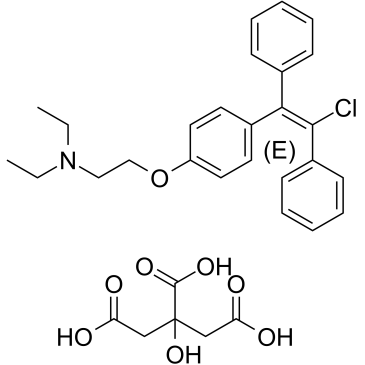
Enclomiphene citrate, formerly known as ICI-46476, RMI-16289 and trans-Clomiphene, is a non-steroidal estrogen receptor antagonist that can be taken orally that is being developed as a treatment for secondary hypogonadism in overweight men who want to get their testicles back to normal. Unlike replacement, orally bioavailable enclomiphene citrate increases testosterone and maintains sperm counts in obese hypogonadal men.
Physicochemical Properties
| Molecular Formula | C32H36CLNO8 |
| Molecular Weight | 598.089 |
| Exact Mass | 597.213 |
| Elemental Analysis | C, 64.26; H, 6.07; Cl, 5.93; N, 2.34; O, 21.40 |
| CAS # | 7599-79-3 |
| Related CAS # | Enclomiphene;15690-57-0;Clomiphene-d5 citrate;1217200-17-3;Enclomiphene hydrochloride;14158-65-7 |
| PubChem CID | 6420009 |
| Appearance | White to off-white solid powder |
| Boiling Point | 509ºC at 760mmHg |
| Flash Point | 261.6ºC |
| LogP | 5.314 |
| Hydrogen Bond Donor Count | 4 |
| Hydrogen Bond Acceptor Count | 9 |
| Rotatable Bond Count | 14 |
| Heavy Atom Count | 42 |
| Complexity | 708 |
| Defined Atom Stereocenter Count | 0 |
| SMILES | Cl/C(/C1C=CC=CC=1)=C(\C1C=CC=CC=1)/C1C=CC(=CC=1)OCCN(CC)CC.OC(C(=O)O)(CC(=O)O)CC(=O)O |
| InChi Key | PYTMYKVIJXPNBD-BTKVJIOYSA-N |
| InChi Code | InChI=1S/C26H28ClNO.C6H8O7/c1-3-28(4-2)19-20-29-24-17-15-22(16-18-24)25(21-11-7-5-8-12-21)26(27)23-13-9-6-10-14-23;7-3(8)1-6(13,5(11)12)2-4(9)10/h5-18H,3-4,19-20H2,1-2H3;13H,1-2H2,(H,7,8)(H,9,10)(H,11,12)/b26-25+ |
| Chemical Name | 2-[4-[(E)-2-chloro-1,2-diphenylethenyl]phenoxy]-N,N-diethylethanamine;2-hydroxypropane-1,2,3-tricarboxylic acid |
| Synonyms | ICI-46476; ICI 46476; ICI46476; Enclomiphene citrate; 7599-79-3; trans-Clomiphene citrate; Enclomid; Clomiphene b citrate; (E)-Clomiphene citrate; J303A6U9Y6; DTXSID80226887; RMI-16289; RMI 16289; RMI16289; (E)-Clomiphene citrate; Androxal; Enclomiphene citrate; Enclomid |
| HS Tariff Code | 2934.99.9001 |
| Storage |
Powder-20°C 3 years 4°C 2 years In solvent -80°C 6 months -20°C 1 month Note: Please store this product in a sealed and protected environment (e.g. under nitrogen), avoid exposure to moisture and light. |
| Shipping Condition | Room temperature (This product is stable at ambient temperature for a few days during ordinary shipping and time spent in Customs) |
Biological Activity
| Targets | ER/estrogen receptor |
| ln Vitro |
Enclomiphene citrate (0-100 μM, 6 h) suppresses gonadotrophin- and basal-stimulated small- and large-scale ovine luteal cell progesterone secretion in a dose-dependent manner[2]. Enclomiphene citrate (0-100 μg/mL, 24 h) dose-dependently suppresses the rates of blastocyst formation, degeneration, and fertilization in mouse oocytes[3]. Enclomiphene citrate (1 nM-10 μM, 6 h) dose-dependently reduces E2-induced inhibition of follicle stimulating hormone (FSH) secretion in primary sheep pituitary cells[4]. Enclomiphene (10⁻⁷ M) significantly increased basal progesterone secretion by small ovine luteal cells but not large luteal cells. In the presence of LH, it enhanced progesterone secretion in both cell types [2] Enclomiphene (10⁻⁵ M) did not affect development of mouse embryos from two-cell to blastocyst stage during in vitro fertilization [3] Enclomiphene (10⁻⁸–10⁻⁶ M) blocked estradiol-induced suppression of LH and FSH secretion in cultured ovine pituitary cells but showed no intrinsic agonistic activity [4] Enclomiphene (10⁻⁵ M) reduced estradiol-stimulated progesterone receptor expression in rat uterine tissue cultures [6] |
| ln Vivo |
In intact or castrated rats, clomiphene citrate (subcutaneous injection, 0.25 and 0.5 mg/animal, daily) inhibits spermatogenesis and lowers serum levels of testosterone and luteinizing hormone (LH)[5]. Enclomiphene citrate reduces serum cholesterol and body weight to sham levels when administered orally at a dose of 0.03–3 mg/kg per day for 90 days[6]. Enclomiphene (1 mg/kg) administered to pregnant mice did not alter blastocyst formation or implantation rates after in vivo fertilization [3] Enclomiphene (0.5 mg/kg/day for 10 days) increased testicular weight and serum testosterone in immature male rats [5] Enclomiphene (0.15 mg/kg/day for 4 days) elevated serum LH/FSH and antagonized estradiol-induced uterine weight gain in ovariectomized rats [6] |
| Cell Assay |
Progesterone secretion assay: Small and large ovine luteal cells were isolated via elutriation. Cells were treated with enclomiphene (10⁻⁷ M) with/without LH (10 ng/ml) for 3 hours. Progesterone in media was measured by radioimmunoassay [2] Pituitary gonadotropin secretion assay: Ovine pituitary cells were cultured for 72 hours. Cells were exposed to enclomiphene (10⁻⁸–10⁻⁶ M) ± estradiol (10⁻⁹ M). LH and FSH in supernatants were quantified by RIA [4] Progesterone receptor expression: Uterine tissues from ovariectomized rats were cultured with enclomiphene (10⁻⁵ M) ± estradiol. Receptor levels were analyzed using immunoblotting [6] |
| Animal Protocol |
Mouse embryo development: Female mice received enclomiphene (1 mg/kg, route unspecified) on gestation days 1–2. Embryos were collected on day 3 for blastocyst assessment [3] Immature rat testosterone study: Prepubertal male rats were injected subcutaneously with enclomiphene (0.5 mg/kg/day in saline) for 10 days. Testes and serum were collected for analysis [5] Ovariectomized rat model: Rats received subcutaneous enclomiphene (0.15 mg/kg/day in sesame oil) for 4 days ± estradiol benzoate (10 μg/kg). Uterine weight and serum hormones were measured [6] Animal/Disease Models: 21-day-old Charles River male rats [5] Doses: 0.25 and 0.5 mg/rat, one time/day for 24 days. Route of Administration: subcutaneous injection. Experimental Results: LH and testosterone levels in serum diminished. Animal/Disease Models: OVX (ovariectomy) rat model [6] Doses: 0.03, 1 and 3 mg/kg daily for 90 days. Method of Route of Administration: Oral administration Experimental Results: diminished body weight to sham levels and diminished serum cholesterol. demonstrated dose-dependent effects on the proximal tibia, with BMD and BMC approaching post-treatment sham levels. |
| ADME/Pharmacokinetics |
Absorption, Distribution and Excretion Based on early studies with 14 C-labeled clomifene, the drug was shown to be readily absorbed orally in humans. Based on early studies with 14C-labeled clomiphene citrate, the drug was shown to be readily absorbed orally in humans and excreted principally in the feces. Mean urinary excretion was approximately 8% with fecal excretion of about 42%. SC DOSE OF (14)C CLOMIPHENE CITRATE...WAS DISTRIBUTED IN TISSUES OF FEMALE GUINEA PIG NEONATES... ESTROGENIC-RESPONSIVE TISSUES SHOWED HIGH AFFINITY FOR (14)C. LEVELS OF (14)C...CONSTANT IN UTERUS...THOSE IN OVARIES & PLASMA DECLINED...IN ADRENALS INCR. /CLOMIPHENE CITRATE/ ABOUT ONE-HALF OF THE INGESTED DOSE IS EXCRETED IN FIVE DAYS; TRACES APPEAR IN THE FECES UP TO SIX WEEKS AFTER ADMIN. /CLOMIPHENE CITRATE/ Clomiphene is well absorbed following oral administration. The drug and its metabolites are eliminated primarily in the feces and to a lesser extent in the urine. The rather long plasma half-life (approximately 5 to 7 days) is due largely to plasma protein binding, enterophepatic circulation, and accumulation in fatty tissues. Active metabolites with long half-lives also may be produced. Metabolism / Metabolites Hepatic INCUBATION OF THE NONSTEROIDAL ANTIESTROGEN CLOMIPHENE WITH RAT LIVER MICROSOMES RESULTED IN THE FORMATION OF THE 4-HYDROXY-, N-DESETHYL-, & N-OXIDE METABOLITES, IN QUALITATIVE CONTRAST TO RESULTS PREVIOUSLY OBTAINED ANALOGOUSLY WITH RABBIT MICROSOMES IN WHICH ONLY THE FIRST 2 METABOLITES WERE DETECTED. ORAL ADMIN OF CLOMIPHENE RESULTED IN NO DETECTABLE URINARY ELIMINATION OF THE DRUG OR ITS METABOLITES. 4-HYDROXYCLOMIPHENE WAS THE SOLE DETECTABLE ELIMINATION PRODUCT IN FECAL EXTRACTIONS. Hepatic Biological Half-Life 5-7 days |
| Toxicity/Toxicokinetics |
Toxicity Summary Clomifene has both estrogenic and anti-estrogenic properties, but its precise mechanism of action has not been determined. Clomifene appears to stumulate the release of gonadotropins, follicle-stimulating hormone (FSH), and leuteinizing hormone (LH), which leads to the development and maturation of ovarian follicle, ovulation, and subsequent development and function of the coprus luteum, thus resulting in pregnancy. Gonadotropin release may result from direct stimulation of the hypothalamic-pituitary axis or from a decreased inhibitory influence of estrogens on the hypothalamic-pituitary axis by competing with the endogenous estrogens of the uterus, pituitary, or hypothalamus. Clomifene has no apparent progestational, androgenic, or antrandrogenic effects and does not appear to interfere with pituitary-adrenal or pituitary-thyroid function. Toxicity Data The acute oral LD50 of clomifene is 1700 mg/kg in mice and 5750 mg/kg in rats. The toxic dose in humans is not known. Toxic effects accompanying acute overdosage of clomifene have not been reported. Signs and symptoms of overdosage as a result of the use of more than the recommended dose during clomifene therapy include nausea, vomiting, vasomotor flushes, visual blurring, spots or flashes, scotomata, ovarian enlargement with pelvic or abdominal pain. 6420009 women TDLo oral 73500 ug/kg/3W BEHAVIORAL: WAKEFULNESS; BEHAVIORAL: TOXIC PSYCHOSIS American Journal of Psychiatry., 154(1169), 1997 6420009 man TDLo oral 10 mg/kg/2W-I BEHAVIORAL: HALLUCINATIONS, DISTORTED PERCEPTIONS; BEHAVIORAL: TOXIC PSYCHOSIS; BEHAVIORAL: IRRITABILITY American Journal of Psychiatry., 154(1169), 1997 |
| References |
[1]. Enclomiphene citrate for the treatment of secondary male hypogonadism. Expert Opin Pharmacother. 2016 Aug;17(11):1561-7. [2]. Effects of enclomiphene and zuclomiphene on basal and gonadotrophin-stimulated progesterone secretion by isolated subpopulations of small and large ovine luteal cells. Hum Reprod. 1996 Jun;11(6):1250-5. [3]. The effects of enclomiphene and zuclomiphene citrates on mouse embryos fertilized in vitro and in vivo. Am J Obstet Gynecol. 1986 Apr;154(4):727-36. [4]. Estrogenic and antiestrogenic effects of enclomiphene and zuclomiphene on gonadotropin secretion by ovine pituitary cells in culture. Endocrinology. 1983 Feb;112(2):442-8. [5]. The effect of clomiphene citrate and its Zu or En isomers on the reproductive system of the immature male rat. Andrologia. 1992 May-Jun;24(3):161-5. [6]. Differential responses of estrogen target tissues in rats including bone to clomiphene, enclomiphene, and zuclomiphene. Endocrinology. 1998 Sep;139(9):3712-20. |
| Additional Infomation |
Clomiphene Citrate can cause cancer and developmental toxicity according to state or federal government labeling requirements. Enclomiphene Citrate is the orally bioavailable citrate salt of enclomiphene, the trans-isomer of the nonsteroidal triphenylethylene compound clomiphene, with tissue-selective estrogenic and antiestrogenic activities. As a selective estrogen receptor modulator (SERM), enclomiphene binds to hypothalamic estrogen receptors, blocking the negative feedback of endogenous estrogens and stimulating the release of gonadotropin-releasing hormone (GnRH) from the hypothalamus; released GnRH subsequently stimulates the release of follicle-stimulating hormone (FSH) and luteinizing hormone (LH) from the anterior pituitary, resulting in ovulation. In addition, this agent may bind to estrogen receptors on breast cancer cells, resulting in the inhibition of estrogen-stimulated proliferation in susceptible cell populations. The trans or (E)-isomer of clomiphene. See also: Clomiphene Citrate (annotation moved to). Enclomiphene is the trans-isomer of clomiphene and acts as a selective estrogen receptor antagonist in the pituitary/hypothalamus, increasing gonadotropin and testosterone secretion in men with secondary hypogonadism [1] Unlike zuclomiphene, enclomiphene lacks estrogenic activity in bone tissue and does not affect bone mineral density in rats [6] |
Solubility Data
| Solubility (In Vitro) |
DMSO: ~100 mg/mL (~167.2 mM) Ethanol: ~2 mg/mL (~3.3 mM) |
| Solubility (In Vivo) |
Solubility in Formulation 1: ≥ 0.83 mg/mL (1.39 mM) (saturation unknown) in 10% DMSO + 40% PEG300 + 5% Tween80 + 45% Saline (add these co-solvents sequentially from left to right, and one by one), clear solution. For example, if 1 mL of working solution is to be prepared, you can add 100 μL of 8.3 mg/mL clear DMSO stock solution to 400 μL of PEG300 and mix evenly; then add 50 μL of Tween-80 to the above solution and mix evenly; then add 450 μL of normal saline to adjust the volume to 1 mL. Preparation of saline: Dissolve 0.9 g of sodium chloride in 100 mL ddH₂ O to obtain a clear solution. Solubility in Formulation 2: ≥ 0.83 mg/mL (1.39 mM) (saturation unknown) in 10% DMSO + 90% (20% SBE-β-CD in Saline) (add these co-solvents sequentially from left to right, and one by one), clear solution. For example, if 1 mL of working solution is to be prepared, you can add 100 μL of 8.3 mg/mL clear DMSO stock solution to 900 μL of 20% SBE-β-CD physiological saline solution and mix evenly. Preparation of 20% SBE-β-CD in Saline (4°C,1 week): Dissolve 2 g SBE-β-CD in 10 mL saline to obtain a clear solution. Solubility in Formulation 3: ≥ 0.83 mg/mL (1.39 mM) (saturation unknown) in 10% DMSO + 90% Corn Oil (add these co-solvents sequentially from left to right, and one by one), clear solution. For example, if 1 mL of working solution is to be prepared, you can add 100 μL of 8.3 mg/mL clear DMSO stock solution to 900 μL of corn oil and mix evenly. (Please use freshly prepared in vivo formulations for optimal results.) |
| Preparing Stock Solutions | 1 mg | 5 mg | 10 mg | |
| 1 mM | 1.6720 mL | 8.3599 mL | 16.7199 mL | |
| 5 mM | 0.3344 mL | 1.6720 mL | 3.3440 mL | |
| 10 mM | 0.1672 mL | 0.8360 mL | 1.6720 mL |